IN THE FIFTH PART OF OUR HISTORICAL SERIES, WE EXAMINE THE 1950S, WHICH WERE FAR FROM FABULOUS FOR DEALERS AND MANUFACTURERS

The 1957 Chevrolet would become an iconic model, but Ford outsold its crosstown rival that year
Canada had been battle-toughened in the Second World War, and when those soldiers came home to civilian life, the pent-up demand for new vehicles on both sides of the border should have been an automaker’s dream. In reality, it didn’t quite work out that way.
Today we call the 1950s decade the “Fabulous Fifties,” and admire those huge, chrome-laden cars, but in reality, it was often a very tough decade for dealers and manufacturers alike.
Once automakers got rolling after the 1942-1945 war production shutdown, American consumers snapped up a record 6.7 million vehicles in 1950. That was partly because their pre-war models were past their prime, but there was also an element of fear. North Korea invaded South Korea in June 1950, and American military forces were sent in to push back the Communist advance.
Many people bought cars because they expected another round of shortages and rationing when the automakers were called on once again to make war supplies. The civilian auto assembly lines continued to run this time, but the diversion caused vehicle production numbers to drop.
The “Big Three” of Chrysler, Ford and General Motors weren’t too worried, but things weren’t as bright for the few remaining American independent manufacturers, which combined made up about six per cent of the U.S. market.
Automakers counted on that strong postwar demand, but with raw materials in short supply that were correspondingly expensive, they couldn’t maintain their manufacturing with the economy of scale they needed to stay profitable.
Hoping for strength in numbers, Hudson and Nash combined in 1954 to form American Motors Corporation (AMC). That same year, also hoping bigger would be better, luxury maker Packard bought Studebaker. It wasn’t enough, and only the lower-priced Studebaker survived a 1957 restructuring.
While Americans bought the majority of vehicles, Canada’s love affair with the car was still growing. In 1946, there was one car for every 10 Canadians, but by 1956, it was one car for every five. Ontario and British Columbia had the highest concentration of cars by mid-decade.
Quebec was still the nation’s least-mobile province by 1956, with one car for every seven people, but its growth was the strongest: in 1946, it had only one car for every 19 people.
Imported vehicles were still relatively rare, but they were proving to be more popular in Canada than south of the border. Volkswagen Canada set up shop in 1952, three years before the U.S. branch opened, and the Beetle would hit third place in Canadian sales by 1960.
Mercedes-Benz was sold in the U.S. by a private importer starting in 1952, then by Packard-Studebaker dealers in 1958, and finally by Mercedes-Benz USA when it was formed in 1965.
Canada was way ahead: Mercedes-Benz Canada incorporated in 1955, opening its own stores in Toronto and Montreal that year, and in Vancouver the following year.
Japanese cars were only trickling in—Datsun sold its first car in the U.S. in 1958—but the number of automakers was growing back home. Subaru founded its car division in 1958, while Mitsubishi, which had built a car in 1917 but then turned to trucks, began auto production again in 1959.
Having formed in 1941, the Canadian Automobile Dealers Association (CADA) was becoming a major force, offering its first employee benefits to dealers in 1950. It lobbied automakers and governments on behalf of dealers, and mounted a campaign to completely pave the Trans-Canada Highway, which was still a hodgepodge of gravel roads that had only linked the country since the final sections were opened in 1942.
With car ownership increasing, it should have been good times for everyone, but that wasn’t the case. Rising wages and raw material costs contributed to runaway inflation in the U.S. economy, and that country would fall into recessions in 1953 and 1958.
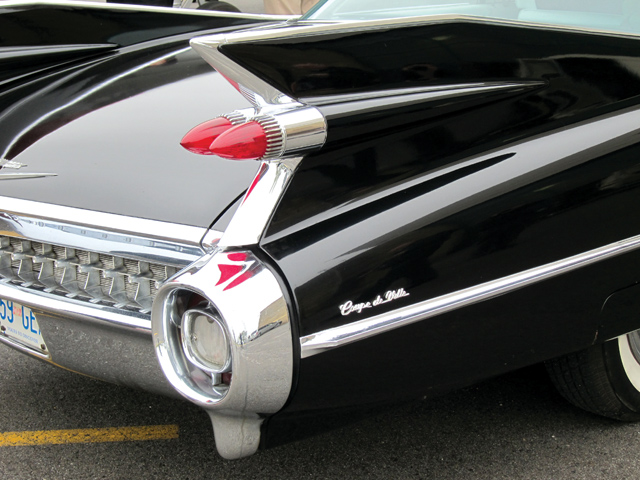
Cadillac’s huge fins of 1959 would later become a symbol of the decade
Cars underwent considerable changes in the early part of the decade. The few that still sported 1940s-style detachable “pontoon” front or rear fenders shed them in favour of smooth sides, and tall roofs gave way to lower, sleeker profiles.
Engines were getting bigger and far more powerful, while modern technologies like power steering, introduced by Chrysler in 1951, made them easier to drive.
Most vehicles were extensively redesigned from year to year, but while it’s part of their charm for collectors today, those quick changeovers created quality issues on the assembly line and for the people who bought them. Consumer magazines of the day frequently aired bitter complaints from drivers about doors that wouldn’t latch, transmissions that wouldn’t shift, and major repairs required in the first few months.
But if the cars were problematic, the way they were sold could be even worse.
Customers, especially in the U.S., complained about underhanded dealership sales tactics. These included grilling by salespeople, sometimes in rooms bugged with microphones for the managers to hear, inflated prep fees, high credit charges, with kickbacks to the finance company, promised high trade-in values that fell sharply when the contract was written up, and bait-and-switch tactics to get buyers into more expensive models.
What happened was automakers were pushing cars on their dealers and, in some areas, granting too many franchises. The National Automobile Dealers Association (NADA) complained to the U.S.
Federal Trade Commission, which passed an act in 1956 to reduce automakers’ pressure on their dealers.
Meanwhile, consumers had an advocate in Oklahoma senator Mike Monroney, who was fed up with the practices. His sponsorship of the Automobile Information Disclosure Act of 1958 required every new vehicle to have a sheet attached from the factory showing its MSRP, its list of standard equipment, and the individual prices of its options.
It’s still known as the “Monroney sticker” today.
Bigger was better in the 1950s, but as the “Swinging ’60s” loomed, automakers were looking at new challenges: changing tastes for smaller cars, the beginning of the muscle car era, and another consumer advocate who would make safety the centre of a campaign that would ultimately change cars once again.

Chevrolet introduced its first small-block V8 engine in 1955