THE CHALLENGES (AND ALSO BENEFITS) CAR SHARING COULD BRING TO AUTOMOTIVE RETAILING
 No one will argue that car sharing is essentially an urban trend. It’s also true that it’s witnessing significant growth both in Western Europe and North America. While we see the evidence around us in cities like Toronto, Montreal, Vancouver and Calgary, it’s not easy to get a handle on exactly how fast the business is growing and what impact it will have on retail sales of new and used vehicles.
Both the growth of the industry and its potential impact depend on two key factors: the rate of growth of the urban population and the willingness of consumers to give up (at least partially or temporarily) the dream of owning their own car.
The industry is growing
The University of California, Berkeley’s Transportation Sustainability Research Center published a paper in July 2013 showing the state of the car sharing industry in North America. Here’s a summary of their findings:
• In January, 2013, there were 46 active car-sharing programs in North America, with just over 1 million members sharing vehicles;
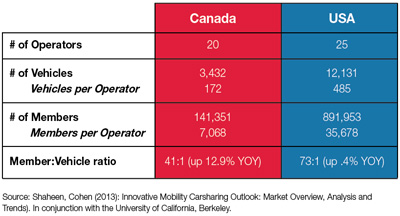
• Canadian operators numbered 20, with over 140,000 members sharing 3,432 vehicles;
• In the U.S., the equivalent numbers were: 891,953 members sharing 12,131 vehicles among 25 operators;
• In Mexico, 620 members shared 40 vehicles belonging to just one operator.
These numbers suggest that Canada is a more developed market, with both the number of members and the number of vehicles well above the 10:1 rule of thumb when compared against the U.S. The number of vehicles and members per operator in Canada show a very different industry in terms of its structure, reflecting the ever-present challenge of market size and scale in Canada:
Perhaps more importantly, the Berkeley study estimates that car-sharing membership grew by 53.4 per cent in Canada between January 2012 and January 2013 while car-sharing fleets grew by 35.9 per cent. Over the same period in the U.S., membership grew by 24.1 per cent and fleets grew by 23.6 per cent.
Potential impact on retail vehicle sales
A somewhat alarming statistic from U.S. consulting firm AlixPartners, suggests that car sharing could result in an estimated 32 personal vehicle purchases avoided per each car sharing vehicle. In the U.S., where the study was done, AlixPartners’ projections “suggest 1.2 million in avoided sales nationally through 2020.” Given the relative strength of the industry in Canada and if these projections hold true proportionately, the impact here could even be bigger.
AlixPartners surveyed 1,000 licensed drivers in 10 developed metropolitan markets where car sharing was available. They also surveyed 1,000 nationally as a control sample. Aside from their volume projections, they found that the three key reasons for car sharing were down to ease of access, convenience and economics (environmental concerns ranked last out of five possibilities). They also found that potential avoidance of personal vehicle purchase was highest among younger consumers. AlixPartners also identifies the emerging “sharing economy” (pay-by-use preferred over ownership) as another key factor.
A word of caution here: it’s not entirely clear if the AlixPartners study addressed the issue of car sharing prospects who would not have considered owning or leasing a personal vehicle anyway, so the projection of lost sales may be on the high side.
What lies ahead for Canadian dealers?
It is easy to see the pattern that might emerge in the Canadian market. In a society that is increasingly urban — where technology and convenience are king and economic realities tend to be felt quickly, the foundation for growth in car sharing is clearly there. At least three manufacturers have car sharing programs that operate alongside their retail business in Europe and also some U.S. markets. Mercedes-Benz has Car2Go, while Ford in Europe offers Ford2Go and BMW, DriveNow.
In most situations (especially with BMW and Mercedes-Benz) car sharing revolves around electric vehicles. This doesn’t mean it will only involve electric vehicles in the future but as these companies expand their offerings and services and as consumers begin to see them as viable alternatives to public transportation and even rental vehicles, the type of cars and variations in car sharing service are likely to proliferate in lock step with market growth.
It might not seem obvious, but there is opportunity here for dealers to pay attention to customers who gravitate towards car sharing, whether it’s their only means of mobility or one of their options. Car sharing can promote visibility of the product the dealership sells, leading to the possibility of greater vehicle sales. On the service side, car sharing can reduce overhead for service departments, eliminating the need for maintaining a fleet of loaner vehicles. The trend is accelerating and perhaps urban dealerships should begin to see themselves not just as retailers, but as providing a complete mobility to their customers, in whatever form makes most sense.