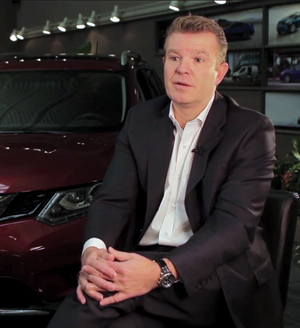
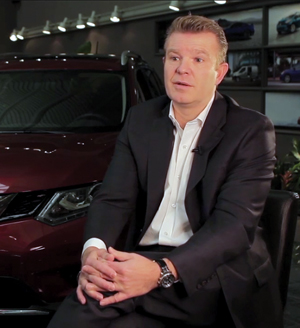
Canadian auto dealer traveled to Nissan Canada headquarters in Mississauga, Ont. where our columnist and automotive journalist Petrina Gentile conducted an exclusive interview with Christian Meunier, President, Nissan Canada Inc. Here’s part of the conversation. You can watch the full interview at www.canadianautomotivevideo.com.
PG: “You’re coming up to your first year anniversary with Nissan Canada. What have you learned so far and what do you see as the biggest challenge moving forward?”
CM: “The most impactful thing was related to the dealer communication piece — we established a true partnership with the dealers. I think we had some difficulties in the past and we still have some. It takes time to re-establish trust. It’s been a key focus of mine in the last few months.”
PG: Is it more important to have a virtual dealership or a traditional bricks-and-mortar shop?
CM: “We need both because actually the product we sell and the experience we sell is not virtual — it’s real. So it’s very critical to have the true dealership. The hardware and the people are very key to the true experience that people will get when they buy the car. But in terms of pre-information, you can expect 80 per cent of the purchase decision to be made prior to entering the dealership. There’s a 20 per cent component that happens at the dealership level in terms of satisfying the customer and getting the right information to them so they can make the consideration to purchase.”
PG: “How do you teach your dealers and sales staff to deal with more educated consumers?”
 CM: “We need to spend a lot of energy, time and money on training. What we decided to do this year, was to implement more frequent in-dealership training. By bringing the trainers to the dealership we have an opportunity to first capture more people because they’re on the site. We can train not only the salespeople, but also those in after sales and business managers etc. We have an opportunity to give them a comprehensive understanding of the product itself. The second thing is that it makes it easier for the dealers because they have all of their people onsite — they don’t have to take people away from the dealership to train somewhere else. It means we can go more often and we can have more follow up on training.”
PG: “How do you market to visible minorities in Canada?”
CM: “Today we don’t have a very good or effective way to market to different communities but it’s clearly one area of opportunity we’re going to focus on next year because I really believe we can make a difference. Coming to Canada I didn’t expect to find the diversity that existed in this country between Quebec, Newfoundland, Ontario, Alberta, and British Columbia. The diversity of the population is tremendous and the way we should go to market should not always be the same. There is a need for us to understand our customers better and to talk to them in a proper way, proper language, and sometimes even a different language. Ethnicity is something we need to pay some attention to from a marketing standpoint.”
PG: “Your big boss, Carlos Ghosn, wants Nissan to achieve eight per cent market share globally by 2016. Are you on track to do that?”
CM: “Yes, we’re totally on track to do that. The objective is at least to deliver eight per cent in 2016 in Canada as well.”
PG: “The Nissan LEAF has been a success story for you – you’ve sold more than 75,000 globally. How do you respond to naysayers who didn’t
believe in electric vehicles?”
CM: “We’re pretty lucky to have such a vehicle, which has been a very good success, not only in terms of sales, but also from customer satisfaction and quality. This car has been a home run from the beginning. In Canada, it’s been pretty limited because initially, we didn’t have the volume we needed. We’re going to sell 300-400 units on a full-year basis. I am very ambitious for this car next year. There’s a lot of activity going on in the marketplace, especially in Quebec, British Columbia, and Ontario. We’re going to do everything we can to maximize and put more cars on the road. The LEAF is definitely a brand builder for us and it really showcases the technology and the innovation Nissan can bring to market. It’s a car that is affordable for everyone. The MSRP for this car after rebates in Quebec is $23,000. It’s pretty similar in Ontario and British Columbia.”
PG: “You’ve completed revamped the line-up of your luxury arm, Infiniti. How are consumers reacting to the changes?”
CM: “Every transition. Every change is difficult, though a major one, our new nomenclature for the brand, is very simple. The Q line is for passenger cars; the QX line is for SUVs. The more you go up, the higher the number becomes. In the end, it brings a consistency to the lineup. It’s easier for the salespeople and also for customers. It also showcases the changes happening at Infiniti and the race toward the true tier one brand that Infiniti inspires to be.”