ARE YOU MAKING THE MOST OF AVAILABLE DATA TO BETTER UNDERSTAND YOUR CUSTOMERS?
 We live in an age where information truly is power. Much has been written recently about “Big Data” and how that is changing the way we do business.
Big Data essentially refers to the more effective mining and use of existing business information (most often transaction information) to help predict business outcomes and improve efficiency and profitability.
There are many challenges for companies embarking on this path and, in the words of a leading business school academic, the question is whether companies who engage in the pursuit of Big Data are really getting value for their money, or if they’re just “fishing for correlations.”
On the positive side, some of the more exciting developments in this area are aspects such as Potential Customer Analysis and “next product to buy.”
These are outcomes of the enhanced capabilities we have these days to understand what our customers are doing. This is turning much of the thinking around customer insight on its head. It suggests that looking intelligently at what customers actually do is as important, if not more so, in understanding future behaviour than asking them what they will do.
RECOGNIZING THE BENEFITS
In the dealership world, the amount of customer information available is significant — especially in the fixed operations area. Dealer Management Systems have come a long way and many offer sophisticated and effective tools that can help dealers better understand their customers, identify their service behaviour patterns and predict their future habits.
These capabilities are often underutilised, partly because of the lack of resources to really use the information, but also because the potential benefits are not clearly recognized.
In today’s world, however, the availability of timely and accurate customer behaviour data can mean a clear advantage in the battle for the customer’s next service visit.
Perhaps the answer lies in starting with some very basic steps. We recently surveyed just under 500 Canadians who had taken their vehicles for service to a dealership or an aftermarket service provider. Our interest lay in understanding what happened in the process from the appointment to the handover of the vehicle after service and to look at the impact of some of the basic steps on the level of satisfaction after the service experience.
We focused on some very simple and basic processes in service. Here’s what we found:
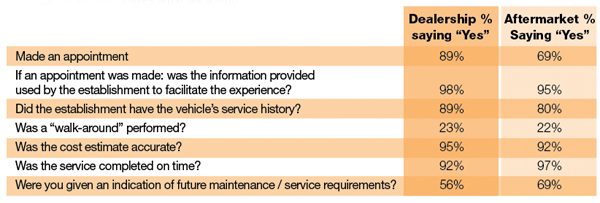
On the surface, most establishments seem to be doing a pretty good job of keeping on top of their customer information. One exception is the “walk around.”
While the argument could be made that the inspection is better done on the hoist, the evidence points to increased customer satisfaction when that walk around is done in front of the customer. And there are apps for that now that help capture more quantifiable and actionable information.
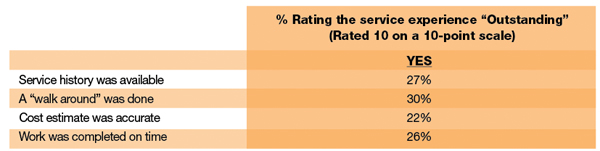
In case the point is missed, these items do have an impact on the level of satisfaction of the customer:
USING THE INFORMATION
All of the aspects of the service process covered above are measurable and the information is likely available within the DMS. Having information is not the secret — it’s what businesses do with that information that is the key to driving efficiency and profitability.
Many establishments are quite adept at putting these processes into practice and using the information they have to facilitate customer
handling. There are still opportunities to do more. The ability to use service information in a seamless way to help the sales process is one example.
In a recent study for instance, we found that service information was helpful in targeting a particular sales initiative more effectively through a better understanding of loyal service customers.
The ability and willingness to use the information tools available can be a distinct advantage for a dealership. Just as the major banks use customer transaction data to achieve “channel optimization” (understanding the customer base to maximise efficiency of servicing each customer according to behaviour patterns), dealerships can use the rich information captured in the DMS to optimise customer engagement and retention.
No surveys required!