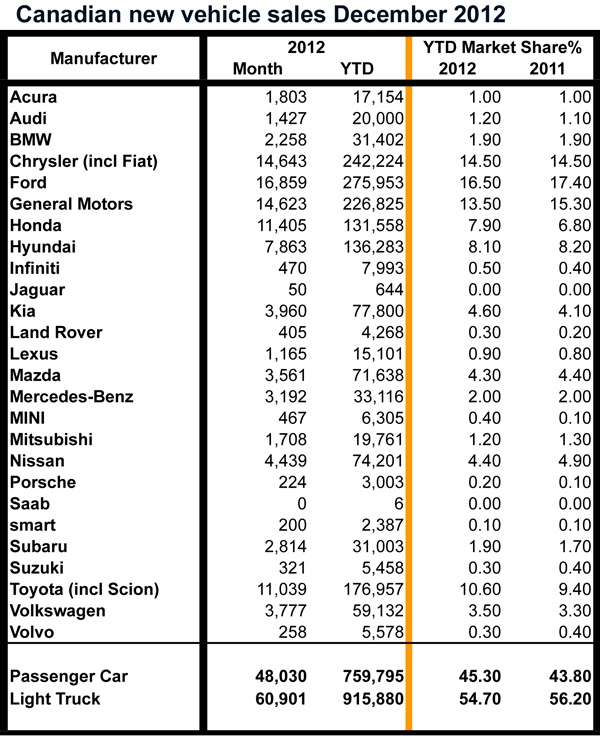
Although in most cases, demand for new cars dropped slightly in December, following November’s strong showing, they still helped result in the second best year on record in terms of total auto volume in Canada. Ford Motor Company, delivered 16,859 vehicles for December, which despite being a 13 per cent drop over the prior month, still helped Ford clinch the sales crown for 2012, thanks to a total of 275,953 units for the year. In second place, both for the month and the year was Chrysler Canada which, having witnessed strong gains through much of 2012 saw 14,643 units delivered in December (0.8 per cent gain on November) and total yearly sales of 242,224 units. General Motors, which finished in third, posted 14,623 deliveries for December, a 20 per cent drop over the prior month. GM continues to lose market share in Canada, down to 13.5 per cent in 2012, versus 15.3 per cent in 2011.
On the import side, Honda delivered a strong performance, thanks to sales of 11,405 units for the month, a sizeable 7.8 per cent gain on November. With 131,558 units sold, Honda finished the year fifth overall in terms of sales volume, behind the “Big Three” and Toyota, which delivered 176,957 units.
Other brands which saw solid gains, included Porsche, which thanks to 224 deliveries saw a whopping 267 per cent increase for December and also VW owned Audi, which continues to do well (1,427 deliveries for the month, representing a 61.8 per cent gain).
Overall, it appears that while still boasting larger percentages in terms of market penetration, current sales leader Ford and rival General Motors are continuing to lose ground to import brands, particularly the quartet of Honda, Hyundai, Kia and Toyota. Another trend seems to be the continued (and growing) popularity of luxury nameplates, given solid performances by Audi, Porsche and Mercedes-Benz.
Whether the strong performance witnessed by the market will continue into 2013 remains to be seen, especially given that Canadians are piling on record levels of debt, especially when it comes to automotive purchases. The growing trend of longer automotive finance contracts (up to 84 and even 96 months in some cases), as automakers try to compete with banks, is also resulting in more consumers becoming underwater on their loans (i.e. owing more on a vehicle than it’s actually worth at trade-in time). J.D. Power and Associates said that as of October last year, a record 30 per cent of all trade-ins in Canada were underwater.
Although statistics point to the fact that Canadians are managing their debt and delinquency rates for auto loans are currently low (less than one per cent), any rise in interest rates could trigger a significant slump in the market. Bank of Canada Governor Mark Carney issued yet another warning last month, urging consumers to rein in their debt, especially in view of growing economic uncertainty, fueled by the ongoing debt crisis in Europe.