Prime Minister Mark Carney’s agreement to allow a limited number of Chinese-made electric vehicles into Canada at a reduced tariff has triggered a growing debate about what their arrival could mean for manufacturers, dealers and consumers.
The arrangement established a first-year import quota of 49,000 Chinese-made EVs at Canada’s 6.1 per cent most-favoured-nation tariff rate, replacing the 100 per cent surtax previously applied to those vehicles. The quota is scheduled to increase by 6.5 per cent annually.
The agreement also gradually reserves a larger share of the quota for lower-value vehicles. Beginning in the second year, 10 per cent of the allocation is to be reserved for EVs with a free-on-board value of $35,000 or less. That share is scheduled to rise to 50 per cent by the fifth year.
The distinction is important: the $35,000 threshold applies to the vehicle’s value before shipping and other costs, not its eventual retail price in Canada.
On the surface, 49,000 vehicles may seem like a drop in the proverbial bucket in a Canadian market that sells close to two million new vehicles annually. According to Statistics Canada registration data, zero-emission vehicles accounted for approximately 10.3 per cent of new light-duty vehicle registrations in 2025, down from 15.4 per cent in 2024.
But the quota could still give Canadian consumers more choice at a time when affordability remains one of the industry’s greatest challenges. It could also establish a foothold for Chinese companies seeking greater access to the Canadian market.
The larger question is whether this will remain a limited import program or eventually lead to Chinese manufacturers assembling vehicles in Canada, investing in Canadian supply chains and creating new franchise opportunities for dealers.
A number of major Chinese automotive companies are already expanding rapidly outside their home market. They include BYD, Geely, Chery, SAIC Motor and Great Wall Motor, along with a growing number of technology-focused EV companies.
China also plays an important role in the production of vehicles sold under established Western brands. Geely’s automotive portfolio, for example, includes Volvo Cars, Polestar and Lotus, while Tesla manufactures vehicles at its Shanghai plant for export markets.
Shortly after the new trade arrangement was announced, Tesla began offering a Shanghai-built Model 3 in Canada with a starting price of $39,490 before taxes and fees. The new version substantially lowered the entry price of the Model 3 in Canada, although comparisons with previous models are complicated by differences in trim and drivetrain.
Chinese-built Lotus EVs are also expected to be among the first vehicles brought into Canada under the new tariff framework.
Bruce Rosen, Executive Director of Industry Relations for the Canadian Automobile Dealers Association, said the number of vehicles covered by the quota must be kept in perspective.
“Let’s keep in mind this is 49,000 units and increasing by 6.5 per cent over the next five years,” said Rosen. “Calculated, it reaches only about 63,000 vehicles by the fifth year. It’s not a lot of vehicles.
“If you divide it by whatever number of manufacturers go through the process of entering Canada between now and 2030, I think the impact overall is currently less than 2.5 per cent of our total vehicles sold in a year. It is not insignificant, but it’s not significant.”
Darren Slind, Co-founder and President of Clarify Group, described the agreement as a crack opening in the door.
“I think if you give them a beachhead, they’ve got potentially compelling products, and I think it’s going to begin to disrupt established buying patterns,” said Slind. “Over time, we don’t know how those quotas will evolve.
“Unless they feel their product is not competitive, they’re going to be hungry for more volume as more quotas are eventually lifted.”
Robert Karwel, Director of OEM Solutions for J.D. Power Canada, agreed that the number of Chinese-made vehicles entering Canada will initially be small. However, he said their arrival could still be noticed by dealers operating in segments where EV sales are concentrated.
Rosen said some franchise dealers concerned about the competitive impact may also be interested in representing Chinese brands.
“Our intention, of course, is that all of the Chinese OEMs make good use of an established protocol, which is a franchise dealer model that works exceptionally well,” said Rosen.
“Since many Chinese brands are unfamiliar to Canadian consumers, the trusted and established brand of the dealer will be key. That’s how I think they will get their foothold in the Canadian market.”
Robert McMillan, President of Volvo Cars Mississauga, said dealers do not yet know how significantly Chinese vehicles will affect the Canadian market because their manufacturing costs and economics are different from those of vehicles built in North America and Europe.
“We all have guidelines for cars that are built in North America and Europe as far as being more expensive to produce,” said McMillan. “But does that mean we’re going to abandon that industry because the Chinese are able to produce a low-cost car? We don’t know the price yet.”
Niel Hiscox, Co-founder and CEO of Clarify Group and publisher of Canadian auto dealer, said Chinese manufacturers may be able to introduce vehicles at prices legacy automakers would find difficult to match.
Differences in government support, labour costs, production scale and supply-chain integration could allow Chinese companies to price their vehicles aggressively, he said, creating additional pressure on established manufacturers.
Affordability is a huge concern right now in the industry,” said Hiscox. “While it remains to be seen what pricing will be, there’s absolutely a significant chunk of Canadians who believe introducing Chinese vehicles will help address that affordability.”
Rosen said the entry of Chinese-made EVs could have a positive impact if the federal government manages the process appropriately.
“The government is managing that quota, and to get a piece of that quota there are a lot of hoops to jump through,” said Rosen. “The Chinese manufacturers are doing the best they can to go through that process of acquiring the certificates to import cars to Canada, plus they have to go through homologation. It’s a long process.”
Asked whether he would consider retailing another Geely-owned brand if one were offered through Canadian Volvo dealers, McMillan said he would examine the opportunity.
“You take a look at every single opportunity,” said McMillan. “You can’t sit and not do anything. Retailing continues to evolve and you’ve got to evolve with it. You’ve just got to make sure you’re able to participate with them and you don’t get sidelined.”
Mélanie Joly, Canada’s Minister of Industry, travelled to China in June to discuss automotive investment and other economic priorities.
In an interview with CTV News following the trip, Joly said any Chinese vehicle-assembly operation in Canada would be expected to involve majority Canadian ownership, Canadian suppliers and compliance with Canadian labour requirements.
The federal government has described its strategy as an effort to encourage Chinese joint-venture investment in Canada while maintaining a fixed volume of Chinese EV imports.
Meanwhile, Reuters reported that BYD, one of the world’s largest EV manufacturers, was planning to establish six dealerships in Canada, according to an advisory firm scouting locations for the company. The report also said BYD had begun Canadian compliance procedures for two passenger vehicles.
Karwel said it is not impossible that Chinese manufacturers will eventually build vehicles in Canada, but he considers it highly unlikely in the near term because China already has substantial unused production capacity.
“One of the ingredients to their success is their access to a low-cost labour force and their supply chain,” said Karwel. “They’ve cornered the global market on many of the materials and resources needed to assemble an electric car.
“China produces roughly 25 million to 35 million vehicles annually but has manufacturing capacity of more than 50 million.”
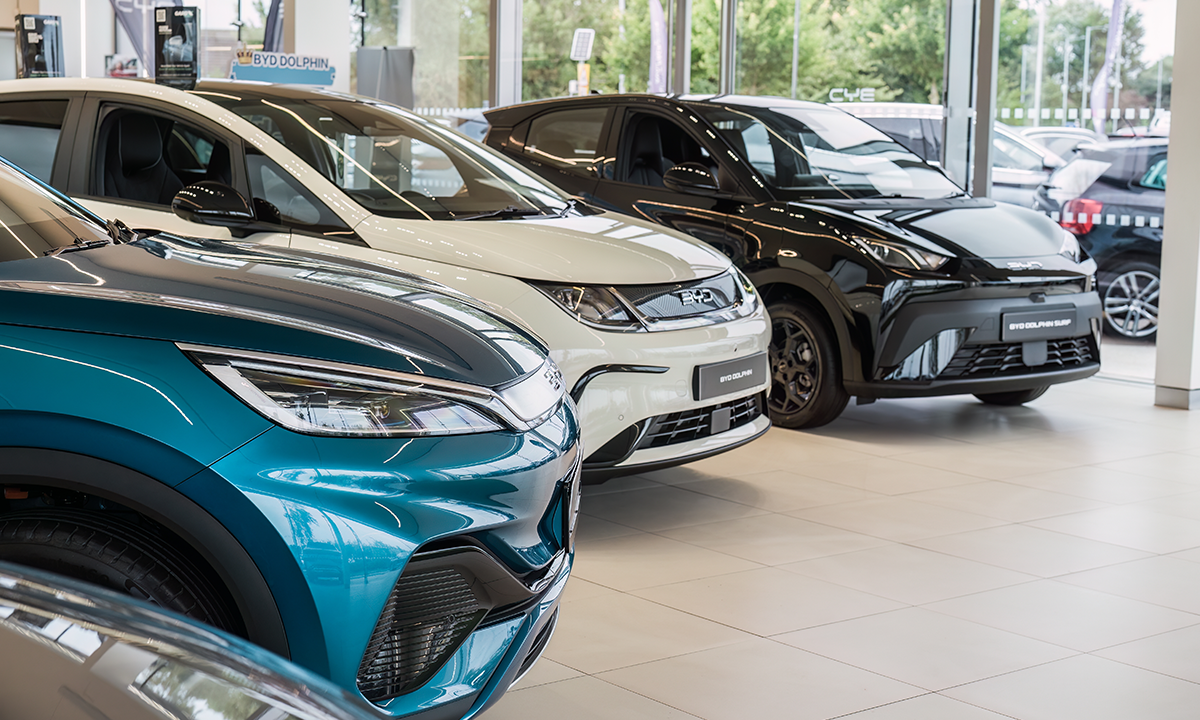
Meanwhile, Reuters reported that BYD, one of the world’s largest EV manufacturers, was planning to establish six dealerships in Canada, according to an advisory firm scouting locations for the company. The report also said BYD had begun Canadian compliance procedures for two passenger vehicles.
Karwel said Chinese manufacturers could nevertheless seek larger import quotas by offering some level of Canadian production or supply-chain investment.
The arrival of Chinese brands was also a catalyst for Clarify Group’s Vehicle Buyer Opinion Study (VBOS), sponsored by Universus Media Group.
The study surveyed 2,007 Canadians aged 18 and older who had purchased at least one vehicle during the previous five years. It explored vehicle-buying preferences, including consumers’ attitudes toward Chinese automotive brands.
Hiscox said an early result showed that 63 per cent of respondents were strongly or somewhat supportive of Chinese automotive brands entering Canada.
“That’s almost two-thirds of Canadians, the vast majority of whom have probably never driven one of these vehicles and may never have seen one in person,” said Hiscox. “I think the expected price point is absolutely part of it.”
Karwel cautioned that Chinese-brand vehicles may be priced closer to prevailing market levels than many consumers expect.
“I think there’s a preconceived notion out there that when you say ‘Chinese car,’ people think it’s going to be priced really cheap, very attainable, very accessible,” said Karwel.
“The fact there’s a limit on how many can be imported means manufacturers may not need to compete at the very bottom of the market on price.”
Karwel said media reports suggest Chinese manufacturers are likely to consider a franchised dealer model for their domestic brands, potentially working with established Canadian dealer groups.
The economics could be complicated, however, if retailers are required to make substantial investments while facing limited vehicle allocations.
“Some of those discussions get complicated if a potential Canadian dealer is going to be investing in building a store, converting an existing underutilized store or building from scratch,” said Karwel.
“These are multimillion-dollar investments. Now imagine telling that dealer you can only sell a certain number of cars because you can only bring in a certain amount. If they are priced at the bottom of the market and you sell out really fast, what do you do for the remainder of the year?”
Slind said the impact of Chinese manufacturers on global markets provides a preview of what could eventually occur in Canada.
“If you look at the behaviour of other global markets that have allowed Chinese cars to enter, either with or without restrictions, they are penetrating the market,” said Slind.
“In the U.K., for example, Chinese brands have gained market share rapidly, and that growth is continuing.”
Hiscox has travelled to China, most recently as part of a CADA-organized visit involving Canadian dealers. He said the dealers were impressed by the vehicles’ technology, sophistication and finish.
“It just absolutely blew many of them away. It far exceeded expectations,” said Hiscox.
“There’s just no question the product could have a dramatic impact on the Canadian market. Are the cars good enough? Absolutely. Certainly in terms of EV product, they are ahead.”
Kenichi Kawaji, President and CEO of Mitsubishi Motor Sales of Canada, also told CTV News that Chinese EVs combine impressive exterior and interior technology with competitive pricing, making them difficult to compete against.
“It will be difficult to fight,” said Kawaji.
The first 49,000 vehicles will represent only a small portion of Canada’s new-vehicle market. Their longer-term importance, however, may depend less on the initial number than on what follows: how consumers respond, which brands gain quota allocations, whether established dealers receive franchises and whether Chinese manufacturers eventually invest in Canadian production.
For dealers, the question is no longer whether Chinese-made vehicles will enter Canada. It is how quickly their presence will evolve — and what opportunities and competitive pressures will come with them.