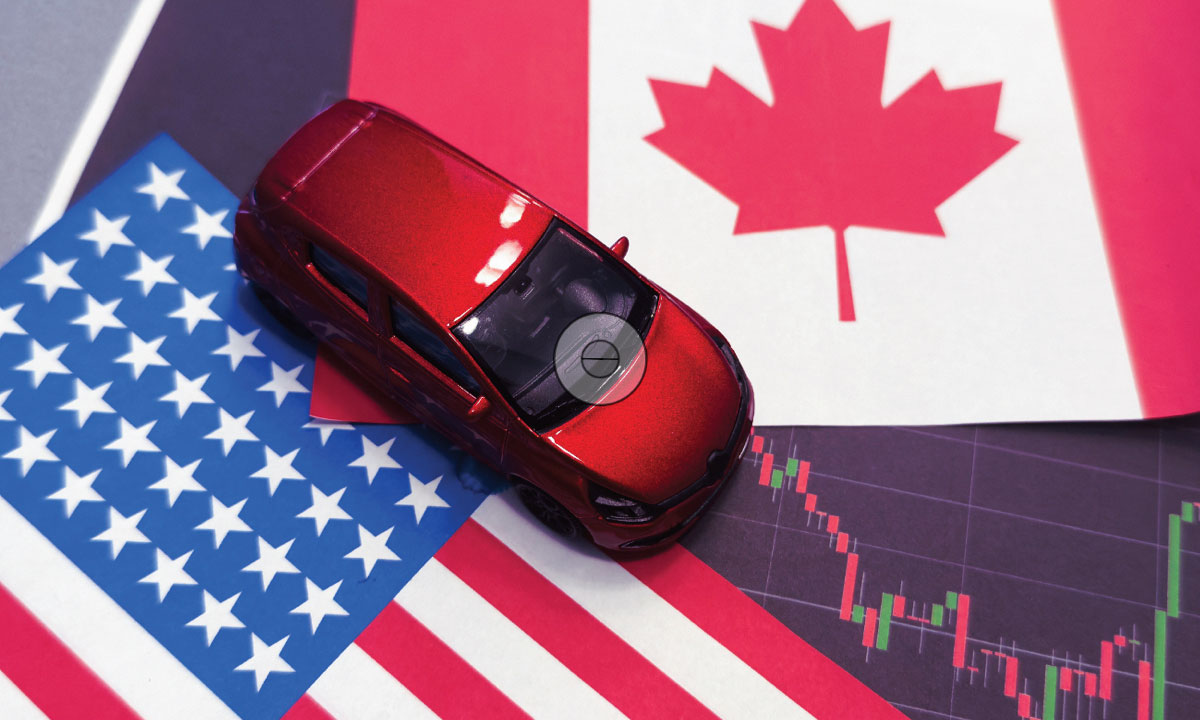
Trade tensions and shifting policy are forcing manufacturers and dealers to adapt as North America’s auto market enters a period of uncertainty
U.S. President Donald Trump has often described tariffs as “the most beautiful word in the dictionary.”
For many in Canada’s automotive industry, particularly manufacturers and dealers, the word carries far less appeal.
As Washington pushes for broader tariffs on vehicles built outside the United States, the threat of new trade barriers has created political and economic uncertainty across the North American auto sector. Canada has responded with countermeasures affecting certain U.S.-built vehicles entering the Canadian market, leaving manufacturers, suppliers and retailers navigating an increasingly complex trade environment.
Tariffs are bad for the car industry, bad for the economy and bad for customers on both sides of the border,” — Huw Williams, Canadian Automobile Dealers Association (CADA)
The debate comes as the Canada-United States-Mexico Agreement (CUSMA), which governs North American automotive trade, approaches its scheduled review in 2026, raising fresh questions about how the highly integrated continental auto industry could be affected.
For dealers and manufacturers alike, the shifting tariff landscape is already shaping decisions around vehicle sourcing, pricing and inventory.
Industry pushes back on tariffs
Huw Williams, who looks after public affairs for the Canadian Automobile Dealers Association (CADA), said tariffs ultimately harm the entire automotive ecosystem.
“Tariffs are bad for the car industry, bad for the economy and bad for customers on both sides of the border,” Williams told Canadian auto dealer.
He said the industry has been working on both sides of the border to emphasize how deeply integrated the Canadian and U.S. automotive markets have become.
“We need to have a united approach in Canada and the U.S. by the industry that talks about how tariffs don’t work for both countries,” said Williams.
CADA has been delivering that message directly to policymakers in Washington, highlighting Canada’s importance as a destination for U.S.-built vehicles.
“About 40 per cent of the vehicles sold in Canada are American-made, and we’re the largest market for U.S.-built vehicles outside the United States,” he said.
Williams said the upcoming CUSMA review will be closely watched by the automotive sector.
“This is not supposed to be a full renegotiation of CUSMA,” he said. “From our point of view, it’s more of a review of the agreement, revisiting some elements rather than rewriting the entire deal.”
He also pointed out that the current framework was negotiated during Trump’s first administration.
“This is Trump’s agreement,” said Williams. “He negotiated and signed it, so the foundations should be quite familiar.”
Manufacturers adjusting strategies
Manufacturers with production facilities in the United States, including Mercedes-Benz, Nissan and Hyundai, have had to rethink how they supply the Canadian market.
David Adams, president and CEO of Global Automakers of Canada (GAC), said some manufacturers have faced difficult decisions when it comes to moving vehicles across the border.
“For a number of our members, the challenge wasn’t so much vehicles going into the United States,” said Adams. “It was trying to bring vehicles that were built in the U.S. into Canada that weren’t compliant with the current trade framework.”
In those cases, manufacturers faced additional trade costs that made importing certain models difficult to justify financially.
“If they were going to bring them in, they’d have to sell them at a price that simply wouldn’t be competitive in the marketplace,” said Adams.
Manufacturers have worked to mitigate the impact where possible, he added.
“For dealers, manufacturers have been trying to do their best to minimize the effect on vehicles being sold in the marketplace,” he said.
But when one brand faces added trade costs and a competitor does not, the competitive balance can quickly shift.
“If you’re having to pay a tariff on a vehicle coming into the Canadian marketplace and your competitor doesn’t, you’re going to be at a cost disadvantage.”
Brian Kingston, president and CEO of the Canadian Vehicle Manufacturers’ Association (CVMA), has also warned that trade tensions are adding pressure to an industry already navigating major structural changes, including the transition toward electrification.
Dealers seeing supply impacts
For dealers on the ground, the most noticeable effect of tariffs so far has often been on supply.
Vaughn Wyant, president of the Western Canada-based Wyant Group, said tariffs have affected the business, but largely in subtle ways.
“Are the tariffs affecting our business? Yes, for sure they are,” said Wyant. “Is it putting us out of business? No. It’s really about the supply more than anything, although some models have had modest increases.”
Manufacturers have sometimes offset price pressures through incentives, he added.
“For the most part the tariffs are invisible,” he said.
Still, some consumers are adjusting their purchasing decisions amid the uncertainty.
“Some consumers are rushing decisions to get ahead of potential increases.”
Steve Marshall, owner of the Steve Marshall Group in British Columbia, said dealerships have little control over the situation.
“There’s no sense getting upset about it because you can’t do anything about it anyway,” said Marshall. “In the dealership we try to avoid talking about tariffs. The car costs what it costs and you work from there.”
Marshall said the industry will be watching the upcoming CUSMA review closely.
“It hasn’t affected our industry compared to a lot of other industries,” he said. “But it could be a completely different story depending on what happens next.”
Inventory and model availability
Shahin Alizadeh, president of Toronto’s Downtown Automotive Group, said tariffs have affected which vehicle manufacturers feel comfortable shipping to Canada.
“Anything built in the U.S. is now a challenge for brands that don’t have manufacturing in Canada,” said Alizadeh.
In many cases, manufacturers have simply reduced shipments of affected models.
“They’ve just reduced the number of vehicles coming in that would be impacted,” he said.
That has affected selection more than pricing.
“Ordinarily we would be selling a lot of Pathfinders and Muranos. Those are very scarce now,” he said.
“Nissan has said they will bring some in for the spring, but tariffs really handcuff manufacturers when it comes to bringing in the vehicles they think are appropriate for the market.”
Managing uncertainty
Laura Zanchin, dealer principal and executive vice president of the Vaughan-based Zanchin Automotive Group, said the impact varies widely depending on the brand.
“It’s that simple and it’s that complicated,” said Zanchin. “It’s not only the vehicles but the parts associated with those vehicles. Sometimes it’s difficult to even understand the full impact.”
She said manufacturers have been forced to move quickly to develop strategies that minimize disruption for dealers.
“They’ve had to act very smartly in a short period of time to try to come up with solutions rather than simply telling dealers certain models won’t be available.”
Zanchin said some manufacturers have absorbed part of the additional costs.
“I want to emphasize Mercedes-Benz Canada has been very respectful when it comes to the tariff situation,” she said. “They’ve absorbed a lot of the extra costs associated with it.”
At the dealership level, she said the best approach is often to stay focused on day-to-day operations.
“The more you think about all the noise out there, the less you concentrate on the business of today,” she said.
But she acknowledged the uncertainty has also affected consumer confidence.
“Think about how confused customers are right now because dealers are confused and manufacturers are confused,” said Zanchin. “They don’t know what’s going to happen even next month.”
A highly integrated industry
Normand Hébert Jr., president and CEO of Park Avenue Group in Quebec, said tariffs have clearly affected supply and pricing across some brands.
“We’ve seen it across some of the German brands we represent that have production in the United States,” said Hébert. “We have seen price increases that are higher than typical inflation levels.”
He said manufacturers have sometimes tried to offset tariff pressures by adjusting costs elsewhere in their operations.
At the same time, Hébert said Canada’s retaliatory trade measures create additional challenges for dealers.
“Although I understand the politics behind it, I believe counter-tariffs can be harmful to the Canadian dealer landscape,” he said.
For now, much of the industry is watching closely to see how trade policy evolves.
With the North American automotive sector deeply interconnected, even small changes to tariffs or trade rules can ripple quickly across manufacturing plants, supply chains and dealership showrooms.
For dealers, the challenge is managing that uncertainty while continuing to serve customers in an increasingly complex marketplace.