
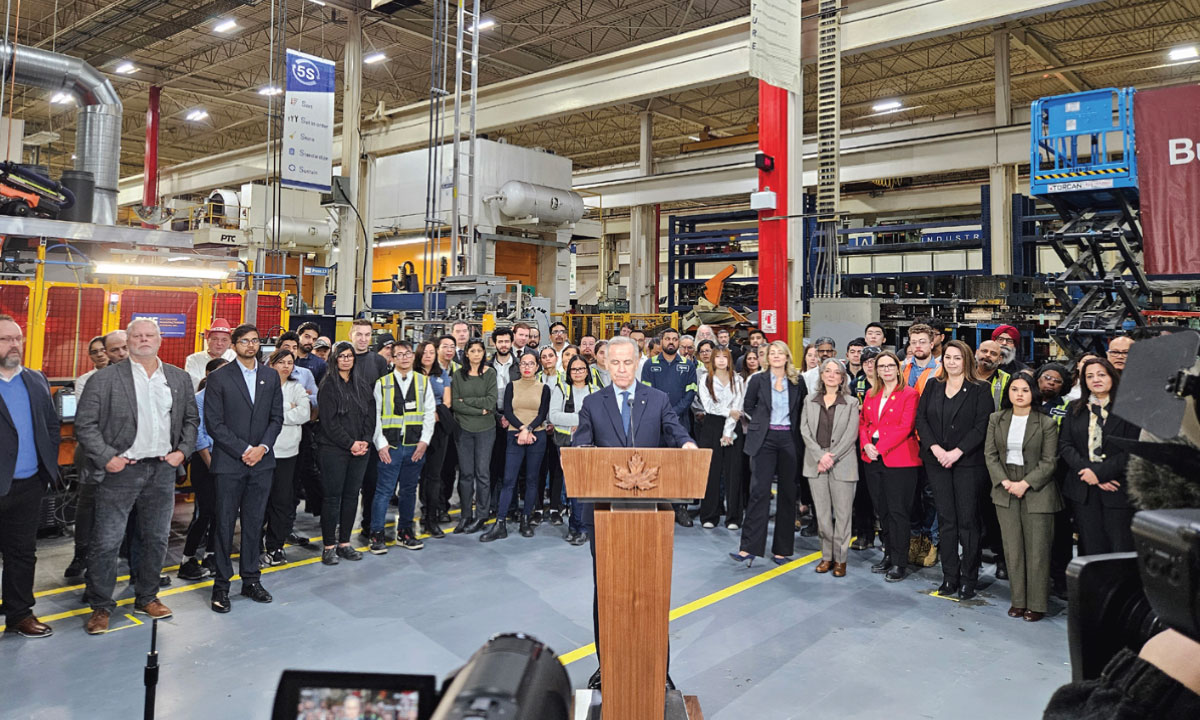
Photo: Perry Lefko
Prime Minister Carney’s auto strategy announcements offered some clarity but left plenty of uncertainty
The future of Canada’s automotive industry could well be wrapped up in two announcements made by the Prime Minister a little more than two weeks apart.
The first came on January 16, when the Prime Minister announced that 49,000 Chinese vehicles would be allowed into Canada at the Most Favoured Nation (MFN) tariff rate of 6.1 per cent, rather than the 106.1 per cent tariff that had been imposed on all Chinese vehicles since October 2024.
At the time, concerns had been raised about the high level of non-market state subsidization, as well as significant cybersecurity and privacy risks associated with Chinese connected vehicles.
The second announcement was the non-auto strategy unveiled at a press event held at Martinrea’s manufacturing facility north of Toronto on February 5.
For months, officials had suggested that no formal automotive strategy was under consideration, despite the fact that the Global Automakers of Canada — which I represent — and virtually every other automotive trade association had been calling for a comprehensive, long-term strategy.
The need became even more pressing in the face of President Trump’s tariffs and what many view as a direct assault on the Canadian automotive industry. What we ultimately received was an announcement that was, in many ways, comprehensive, but also confusing. Details on several of the five pillars were deferred pending further consultation with industry.
The United States remains the dominant regional market and the jurisdiction for which most Canadian- and Mexican-built vehicles are designed. If U.S. standards are less stringent, manufacturers — regardless of nationality — will build to that benchmark.
One might reasonably ask whether a more complete strategy could have been presented had those consultations occurred before the announcement. As it stands, much of the same uncertainty remains. And as we all know, uncertainty is the enemy of business.
For many, the most visible component of the multi-pillared strategy was the repeal of the Electric Vehicle Availability Standard, colloquially known as the ZEV mandate.
It was replaced with a return to industry-wide greenhouse gas (GHG) targets. If we translate the Prime Minister’s objective of achieving 75 per cent EV penetration by 2035, that implies a reduction of more than 50 per cent in GHG emissions on a grams-per-mile basis in just eight years. The new GHG standard is slated to take effect in the 2027 model year — which, from a production planning perspective, is effectively already here.
That is a very tall order for at least two reasons.
First, the targets will likely be Canada-unique, given that President Trump has dismantled virtually every regulation related to vehicle fuel consumption and emissions. Historically, Canada has aligned its emissions regulations and motor vehicle safety standards with those of the United States.
Second, typical year-over-year fuel efficiency improvements — often used as a proxy for GHG reductions — have been in the range of 1.5 to 2.5 per cent. That is far below the reductions now implied.
These regulations will also need to be developed quickly to avoid back-end loading the compliance burden, which would only compound the challenge.
Another key question is where Canada will source vehicles that meet these more stringent standards. The United States remains the dominant regional market and the jurisdiction for which most Canadian- and Mexican-built vehicles are designed. If U.S. standards are less stringent, manufacturers — regardless of nationality — will build to that benchmark. Does that mean vehicles built in Canada, 85 to 90 per cent of which are exported to the U.S., may not meet Canadian requirements?
Manufacturers could build Canada-specific variants, but doing so for a market that represents only 10 to 15 per cent of production would almost certainly increase costs.
As we move into the CUSMA/USMCA review, environmental divergence is becoming a real issue. At the same time, we are seeing industrial policy divergence. Canada is allowing 49,000 Chinese EVs to enter at the 6.1 per cent MFN rate, rather than the 106.1 per cent tariff it had adopted in lockstep with the United States.
Canada had its own reasons for that 2024 decision, including the desire to demonstrate to Washington that we are a reliable trading partner. That initiative, however, was followed by Section 232 tariffs, presidential mockery of our then-prime minister, and rhetoric questioning Canada’s standing as a country.
We are, without question, at an inflection point for Canada’s automotive industry.
My hope is that we emerge from the CUSMA/USMCA review with the agreement intact and with as little disruption as possible to a framework that has served North America well.
My expectation, however, is that the United States will arrive with a lengthy list of demands for Canada and Mexico, potentially ushering in an era of annual reviews and prolonged uncertainty. Perhaps, in time, a future administration will recognize that strong trading relationships with Canada and Mexico make the American automotive industry more competitive, not less.
Whether Canada’s recent policy pivots ultimately help or hinder us remains to be seen. What is clear is that taking action — and focusing on what we can control — is preferable to waiting for events to unfold around us.