
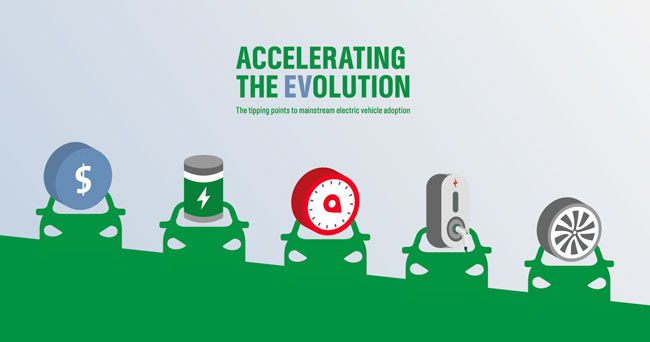
 Price point, charge time, and range are among the key “tipping points” to achieve mainstream electric vehicle adoption, according to Castrol’s Accelerating the EVolution study.
The study surveyed more than 1,000 consumers, fleet managers, and industry specialists across the U.S. as part of a larger, global study. It estimates that the U.S. EV market’s worth could reach $108 billion by 2025 if these tipping points are met.
“As we look forward to the road to recovery, I believe that electric vehicles have a key role to play,” said David Bouet, President BP Lubricants. (Castrol is a provider of oils, fluids and lubricants for industries like automotive). “Castrol’s research shows that there is an appetite amongst consumers to make the switch to electric.”
The report indicates that 66 per cent of consumers think EVs are beyond their budget. Consumers globally and in the U.S. are willing to pay an average of $36,000 — the first of the three tipping points discussed. Interestingly, and based on the study, that tipping point for price is approximately $4,000 more than average consumers in the U.S. are open to paying for a standard vehicle.
The second tipping point is charge time: most American consumers said they would consider purchasing an EV with a 30-minute average charge time (or 31 minutes for the global study). In fact, 58 per cent of consumers said the speed of rapid charge points is a key aspect to buying an EV.
“As EVs perform better and charge faster, the thermal stress on their batteries increases,” said Castrol in its study. “Next-generation EVs are moving to direct cooling for batteries, with advanced coolant e-fluids to keep batteries cool when EVs are running in extreme conditions.”
Range is the third tipping point, and specifically a range of 319 miles (513 kilometres), based on 67 per cent of the consumers surveyed. To put that in perspective, 513 km is approximately the same distance between Philadelphia and Boston. For the global study, the range is 469 km — approximately the distance between London and Paris.
These tipping points represent three of the five critical challenges to mainstream EV adoption, according to Castrol. The other two are charging infrastructure and vehicle choice.
Based on the study, 40 per cent of consumers surveyed in the U.S. said they are able to access a public charging station, versus 58 per cent on average globally. Sixty-two per cent of U.S. consumers would consider buying an EV if the infrastructure existed (in their area) to support their driving habits.
On vehicle choice, 43 per cent of consumers would consider an EV if there was a model equivalent to their favourite gas- or diesel-engine vehicle.
For U.S. consumers surveyed, price is the most critical factor for 42 per cent of them, followed by charge time and range (18 per cent), infrastructure (15 per cent), and vehicle type/size (7 per cent).
For fleet managers surveyed, infrastructure comes first (38 per cent), followed by range (36 per cent), vehicle type/size and charge time (10 per cent), and price (6 per cent).
“Vehicle manufacturers have an opportunity to do more to translate this into buying decisions, especially at a time when consumer behaviour is bound to be more cautious,” said BP Lubricants’ David Bouet.
The global study can be downloaded here.