
The Inside Story of how President Trump’s trade bluster threatened to wipe out Canada’s auto industry — and drag dealers down too.

Canada’s automakers — and the 3,200 plus dealers from coast to coast that sell and service cars — just dodged a huge bullet aimed squarely at the heart of the country’s auto industry.
While we aren’t out of the woods yet, automakers, industry association leaders and car dealers have expressed a collective sigh of relief that the high-stakes poker game over industry destroying tariffs on vehicles imported from either side of the border has effectively ended in a draw now that a revised “NAFTA” deal was struck.
The United States-Mexico-Canada Agreement, or USMCA was reached on Sept. 30, 2018 at the 11th hour as time was about to run out on a U.S.-imposed deadline.
“Modernizing NAFTA was no easy feat. Some said it was impossible to do: That we should take whatever we could get, and be grateful for it. We didn’t do that. We insisted on getting a good deal — not just any deal,” said Prime Minister Justin Trudeau in his remarks after the deal was reached.
Trudeau’s counterpart in the United States — and the wildcard in the trade talks all along — was U.S. President Donald Trump, who boasted about how great the new deal was, calling it: “The most important trade deal we have ever made by far.”
“I have long contended that NAFTA was perhaps the worst trade deal ever made,” said Trump. “This is a terrific deal for all of us.”
Industry leaders and economists had been warning of dire consequences for the auto industry on both sides of the border if a deal had not been reached and if punishing tariffs had instead been imposed.
“A 25 per cent tariff on cars and parts would cause what we like to call ‘Car-mageddon,” Flavio Volpe of the Auto Parts Manufacturer’s Association told federal MPs at a special meeting of the House of Commons committee on international trade in June 2018.
“Car-mageddon” was a phrase echoed by others during the heated debate over trade and tariffs. “We are in surreal territory where the President of the United States is threatening automotive tariffs that will be really Car-mageddon for the retail car industry here in Canada, particularly if we retaliate in the same function,” Huw Williams, Director of Public Affairs, with the Canadian Automobile Dealers Association, told CTV News in September 2018.
As it turns out, based on published reports and on comments from on and off the record interviews with insiders familiar with the discussions — the threats weren’t an exaggeration at all.
Trump’s threat to slap a 25 per cent tariff on Canadian-made automobiles and a 10 per cent tariff on auto parts entering the United States, followed by similar countermeasures imposed from Canada, could have permanently disrupted the auto manufacturing industry in Canada — possibly even leading to it being wiped out completely.
“We’re very pleased in terms of what we’ve been able to avoid. I guess we’re really relieved, to be honest with you because these discussions were tense. The threats were real,” said John White, President and CEO of the Canadian Automobile Dealers Association. “The inside information that we had from both sides of the border is that these were not idle threats in terms of going ahead with automotive tariffs.”
White said the Canadian government had also been vocal about its own plans to retaliate to any U.S. tariffs with tit-for-tat tariffs of its own on U.S. auto imports. “This was quite serious. So the outcome for our industry, and I believe for the economy in general, is very positive and I think this is probably as good as it could be.”
The head of the industry association who represents three of the companies who make cars in Canada said the worries were real and justified. “I’ve certainly been in meetings with the CEOs who have made it very clear that if those tariffs had gone forward, we would be in a very unfortunate position in Canada,” said Mark Nantais, President of the Canadian Vehicle Manufacturer’s Association, which represents Ford, General Motors and Fiat Chrysler.
“People were using phrases like: ‘Well, you might as well begin the death watch.’ This is why it was so important to get ourselves out from underneath that threat.”
Nantais said many Canadians might not have been paying close attention, and he concedes the auto industry as a whole still doesn’t do a good enough job of reminding Canadians how important they are to the Canadian economy. “The impact for manufacturing here would be devastating. I think the U.S. Administration knew that,” said Nantais. “Whether they ever intended to follow through may not ever be understood, but it never came to fruition — which is a very good thing.”
That “death watch” for automotive manufacturing in Canada, would have happened in a domino fashion, and would have affected a lot more than just car makers. It would easily have pushed Canada into a recession. — Dennis DesRosiers, President, DesRosiers Automotive Consultants
Nantais says it was “absolutely critical” for Canada to remove itself from the 232 auto tariff threat. “We acknowledge the fact that with some real relief that we now have an agreement that is a modernized agreement, it reflects the current circumstances of the industry,” said Nantais.
That “death watch” for automotive manufacturing in Canada, would have happened in a domino fashion, and would have affected a lot more than just car makers. It would easily have pushed Canada into a recession, said Dennis DesRosiers, President of DesRosiers Automotive Consultants, and one of the industry’s most well-respected analysts.
With a 25 per cent tariff on imported vehicles, DesRosiers said that would have added as much as $5,000-$8,000 to the price of vehicles imported from Canada. “You put a five to eight thousand dollar tax on those almost two million vehicles and people aren’t gonna buy them. So the initial impact would be a significant reduction in vehicle production in Canada,” said DesRosiers.
DesRosiers said that could have led to losses of as many as 50,000 jobs in Canada — and within about six months.
If Ottawa decided to retaliate with a similar tariff on U.S. imported vehicles then things would get even worse. “Then Canadians would have to pay that tariff of five to eight thousand dollars per vehicle. The Canadian market would collapse… Canada’s response potentially collapses the Canadian market. You end up back in a similar situation as we have with the financial crisis,” said DesRosiers.
DesRosiers said demand for new vehicles in North America could have dropped by eight to 10 million vehicles a year, triggering a slowdown in manufacturing on both sides of the border, then that multiplies and starts to impact parts makers and other suppliers — and the domino effect continues. “You end up with a very serious North American recession. Not just automotive,” said DesRosiers.
“I’ve never seen anything like this before. What was being proposed was just outrageous,” said DesRosiers. How can anybody even begin to think about doing this? It is so negative on yourself, on the American economy. So the biggest impact of a 25 per cent tariff on vehicles being imported into the States — is America,” he said.
While the tariff and trade war made no economic sense, DesRosiers said the political reality is that it might well have happened. “Everybody understood the volatility and the politics of the United States, and the fact that you do have somebody who appears to be mentally ill as the President of the United States,” said DesRosiers. “And that’s terrifying the industry.”

It’s hard to accurately measure the true potential economic consequences of the trade war while you are in the heat of battle with rhetoric flying on all sides during tough negotiations, but economists and experts floated some pretty eye-popping numbers.
“In our estimate, we were looking at well over 100,000 jobs that would be at risk. In the case of the Trump administration applying tariffs to our exports and the Canadian government responding in kind tit-for-tat with the same type of approach,” said CADA’s John White. “Our own studies also show that we had approximately 30,000 dealer jobs at risk.”
“There’s no doubt that with the pressures that we’re facing in this country, that manufacturing would have been at risk. I’ve worked in a market where manufacturing disappeared, in the Australian market,” said White. “The automotive manufacturing footprint in Australia as of this year— is all gone. All wiped out because of the fact that they weren’t competitive so I’ve seen first hand what happens there and it’s extremely disruptive to the economy.”
David Adams, President of the Global Automakers of Canada, an industry association that represents 15 OEMs in Canada, said while the USMCA deal is far from perfect, it’s better than the alternative of an ongoing trade war.
“The stakes were always so much higher for Canadians then they were for Americans, but I think for Canadians it was a major issue,” said Adams. “I don’t think everybody fully appreciates how important the automotive industry is to the Canadian economy and how vulnerable we were to the vagaries of the President’s own desire to see a renewed agreement that benefited America more.”
In an interview with CBC News, Douglas Porter, chief economist at BMO Financial Group, said the impact could have slashed auto production in Canada by as many as one million vehicles a year. “Companies will ultimately decide whether to keep plants open or not, so production is going to move in big discrete chunks,” said Porter. “Given the range of U.S. import volume changes resulting from the tariff, Canadian auto production could be cut by somewhere in the 600,000 to the one million unit range.”
This would have cut Canada’s gross domestic product by roughly 0.3 to 0.6 percentage points, and “could put at least 40,000 factory jobs at risk,” he said.
Brian DePratto, senior economist with TD Bank warned that the tariffs on Canadian cars and car parts could have cost as many as 160,000 jobs, especially if Canada retaliated in kind.
So what does it all mean for the industry now?
“I don’t think everybody fully appreciates how important the automotive industry is to the Canadian economy and how vulnerable we were to the vagaries of the President’s own desire to see a renewed agreement that benefited America more.” — David Adams, President, Global Automakers of Canada
Well for one thing, the people who make cars in North America now have a different competitive landscape to consider. While Canada remains a decent location to make cars, the uncertainty might have already been enough to have frozen any expansion plans until the dust fully settles.
“If I wanted to be absolutely sure that I could access 17 million annual U.S. car buyers, Canada is a safe bet, Mexico is now a safe bet. But the only guarantee is the U.S.” said Flavio Volpe, President, the Automotive Parts Manufacturers Association in a media interview.
The people who make cars in Canada are also going to have to adapt their supply chains and sourcing to comply with the new rules of origin. “We’re going to see a shift in how they solicit their goods or where they’re purchasing their goods from so that they can meet the content requirements of the OEs,” said Charmaine Goddeeris, Senior Manager in the Customs International Trade Practice at BDO Canada LLP.
If the OEMs have to source some of those parts offshore, then there could be duty implications, which would increase costs. “We still could see the potential of a rise in vehicle costs until the North American market can actually meet the demand to supply the components that are needed. So ultimately, that trickles down through the entire manufacturing process to the consumer,” said Goddeeris.
“Our own studies also show that we had approximately 30,000 dealer jobs at risk.” — John White, CADA
Goddeeris said that Canada might have indeed dodged a bullet this time, but it exposed just how complacent many businesses have become with 20 years of trading stability under NAFTA. “Basically, things were flowing sort of freely back and forth across the three borders, and no one really gave a thought, too much thought to trade and customs impact in the world,” she said. “We kind of just go blindly along and don’t think about it very much, but certainly when we start adding 10 per cent or 25 per cent cost to the things that we purchase every day — that’s a significant cost. So let’s educate ourselves a little bit. Is this going to happen again? Probably.”
“It allows us to bring vehicles to Canada, or sell vehicles to Canada that are equipped with some of the most advanced safety and emission systems.” — Mark Nantais, CVMA President
There are lots of benefits to the new USMCA that extend beyond just avoiding a costly trade war, says Mark Nantais. “What it allows us to do is continue to produce vehicles to meet the North American requirements to leverage the integrated North American economy to build vehicles that are ultimately, more affordable for consumers, maximize the consumer choice for vehicles, which obviously, gets to the dealer side of this,” said Nantais.
“It allows us to bring vehicles to Canada, or sell vehicles to Canada that are equipped with some of the most advanced safety and emission systems. And so the technology is spread out more quickly and more broadly so the environmental safety benefits, and safety benefits are realized more quickly,” he said.
[President Trump’s] Saturday night tweetstorm levelled a threat to impose a similar series of hefty tariffs on automobiles – a product at the centre of a $135-billion two-way Canada-U.S. trade. If Mr. Trump takes that step, it’s not just the end of NAFTA, but the start of a massive U.S. protectionist wall that could tip Canada, perhaps the world, into recession.” — Globe & Mail, June 10, 2018
“It’s a pretty significant bullet that we dodged. We haven’t dodged all of it yet, but we’ve dodged the big pieces of it and that’s positive,” said Chuck Seguin, President of Seguin Advisory Services and a well-known industry observer. But Seguin cautions the industry still needs to carefully assess the impact of all the changes USMCA brings about. “Early indications are that we have dodged a bullet — but there are still some bullets in the gun.”
Praise for Ottawa
While the reaction to USMCA has been positive in the auto industry, it has had mixed reviews from other industries more adversely affected, like Canada’s dairy sector.
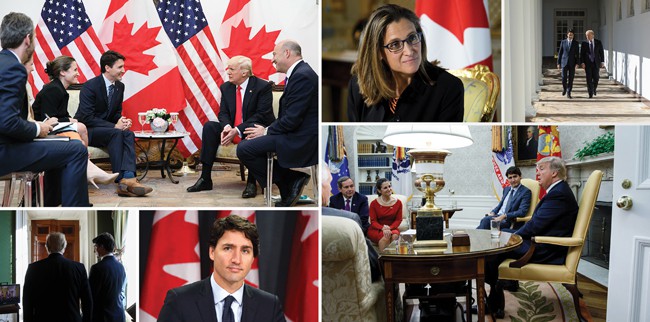
But many of the people interviewed for this article, regardless of their political stripe, had praise for the efforts of the Canadian government and our negotiating team, in particular for their ability to keep their cool under some relentless and at times very personal attacks.
“We’re not as affected in the West as the industry would be, particularly in southern Ontario where you find a lot of manufacturing. So we don’t see that same level of threat up here.” — Mike Trotman, CEO, Trotman Auto Group
“Somebody described it a little bit I guess as the rope-a-dope between George Foreman and Muhammad Ali. Ali just sort of took the punishment and then came out at the end and got the job done,” said David Adams. “I think that’s the case with our government as well. They kept their head down, they negotiated as best they could. Public opinion seems to be supportive of the fact that we just didn’t fold like a cheap suitcase at the first opportunity.”
“President Trump’s level of disrespect for the people he deals with is patently evident,” said John Sutherland, from the NSADA. “Because of that I think he’s very a dangerous individual to have in a very high office in a country of that stature in the world. I think our own political leaders were the statesmen, they were dignified, they were tough and they were courageous. They were restrained, and they didn’t stoop to the depths that Trump is comfortable with.”
“I commend the Canadian negotiating team, and Minister Freeland on the basis that they remained firm on what the objectives were, what they were trying to achieve,” said the CVMA’s Mark Nantais. “You could say, I guess, they tolerated a lot of that frustration, but in the end came up with something that was ultimately, beneficial, or will be beneficial for the auto industry.”
While much work remains in the months ahead to ratify the agreement in all three countries, at least for now, dealers can get back to the business of selling and servicing vehicles.
Canadian auto dealer would like to thank all those who participated in interviews for this important story. Thanks also to Managing Editor Carina Ockedahl, who contributed files to this story.