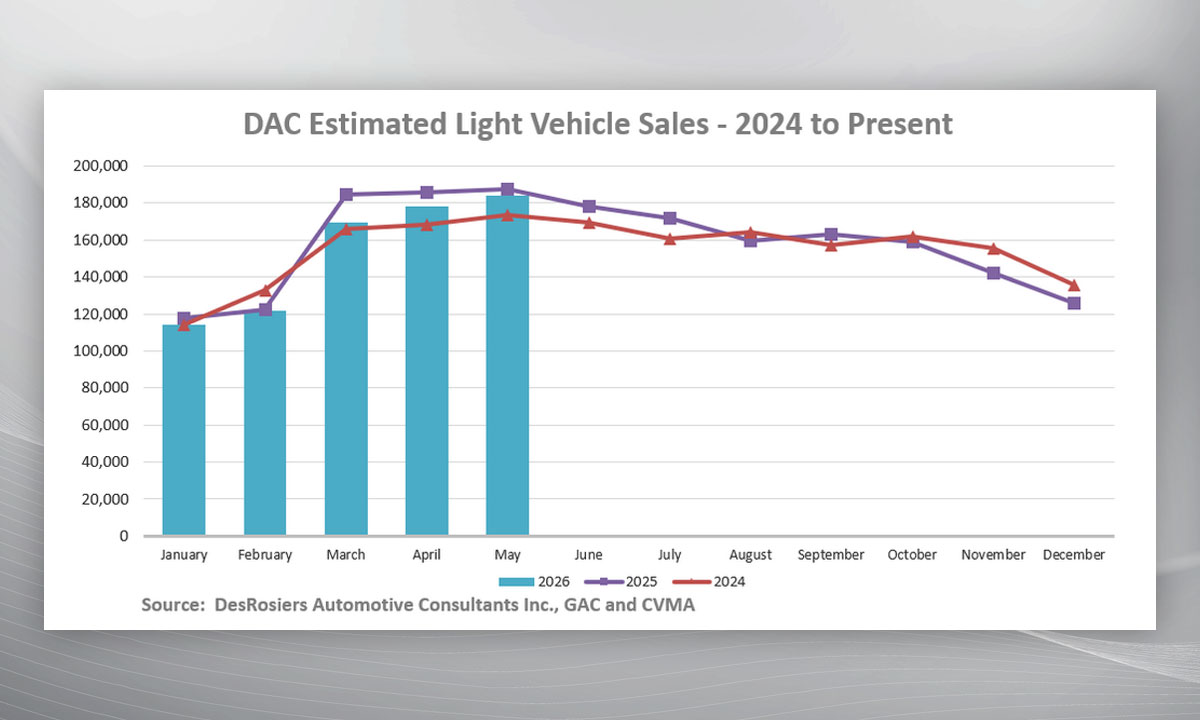
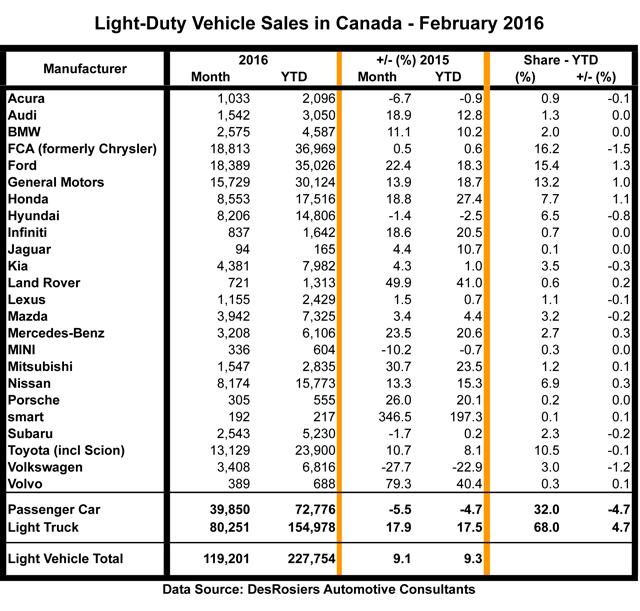
 Auto sales in Canada maintained a hot pace in February, with sales of 119,201 new vehicles setting a new record for the month, surpassing the mark last set in 2008. February sales were up 9.1 per cent from year-ago levels, almost matching January’s 9.6 per cent improvement and already starting speculation about another record year.
The seasonally adjusted annualized sales rate (SAAR) also came close to that of January, topping 1.92 million, according to DesRosiers Automotive Consultants. It’s early days but so far the numbers tend to nullify concerns of a downturn in 2016, at least for the time being.
FCA STILL ON TOP
As it did in January, FCA Canada topped the sales charts for the month but, as was also the case in January, its sales of 18,813 vehicles lagged well behind the overall market improvement, up just 0.5 per cent from last year. Ford’s February sales, on the other hand, were up 22.4 per cent, bringing them within about 500 units of FCA’s.
Year to date, FCA holds a sales lead of fewer than 2,000 vehicles over Ford, compared to more than 7,000 at this point a year ago.
While still well back in third place, General Motors continued to close the gap as well, with a sales increase of 13.9 per cent for the month and 18.7 per cent year-to-date. FCA has given up 1.5 per cent of market share, while Ford gained 1.3 per cent and GM 1.0 per cent, year-to-date.
Toyota (+10.7 per cent) remained unchallenged in fourth place, while Honda (+18.8 per cent) extended its lead in fifth over Hyundai, (-1.4 per cent). Nissan (+ 13.3 per cent) came within 26 units of catching Hyundai, while Kia (+4.3 per cent), Mazda (+ 3.4 per cent) and Volkswagen (-27.7 per cent) filled out the top 10.
TRUCKS AND UTILITIES MAINTAIN MOMENTUM
As has become the norm, sales of trucks, including CUVs and SUVs, accounted for all the February sales gains and more. Their sales were up 17.9 per cent while those of passenger cars continued to fall, this month by 5.5 per cent.
Trucks and utilities are now outselling cars by more than two to one.
Luxury brands, for the most part fared well as well – many of them because of their utility vehicles. With sales up 23.5 per cent, luxury leader Mercedes-Benz closed to just 200 units behind Volkswagen, threatening to take over 10th place overall.
Other luxury or near-luxury brands outpacing the market included Volvo (79.3 per cent) – which benefitted from the arrival of the XC90 – Land Rover (49.9 per cent), Porsche (26.0 per cent), Audi (18.9 per cent), Infiniti (18.6 per cent) and BMW (11.1 per cent).
[NOTE: Data quoted in this report were sourced from DesRosiers Automotive Consultants, Global Automakers of Canada and individual automakers.]