
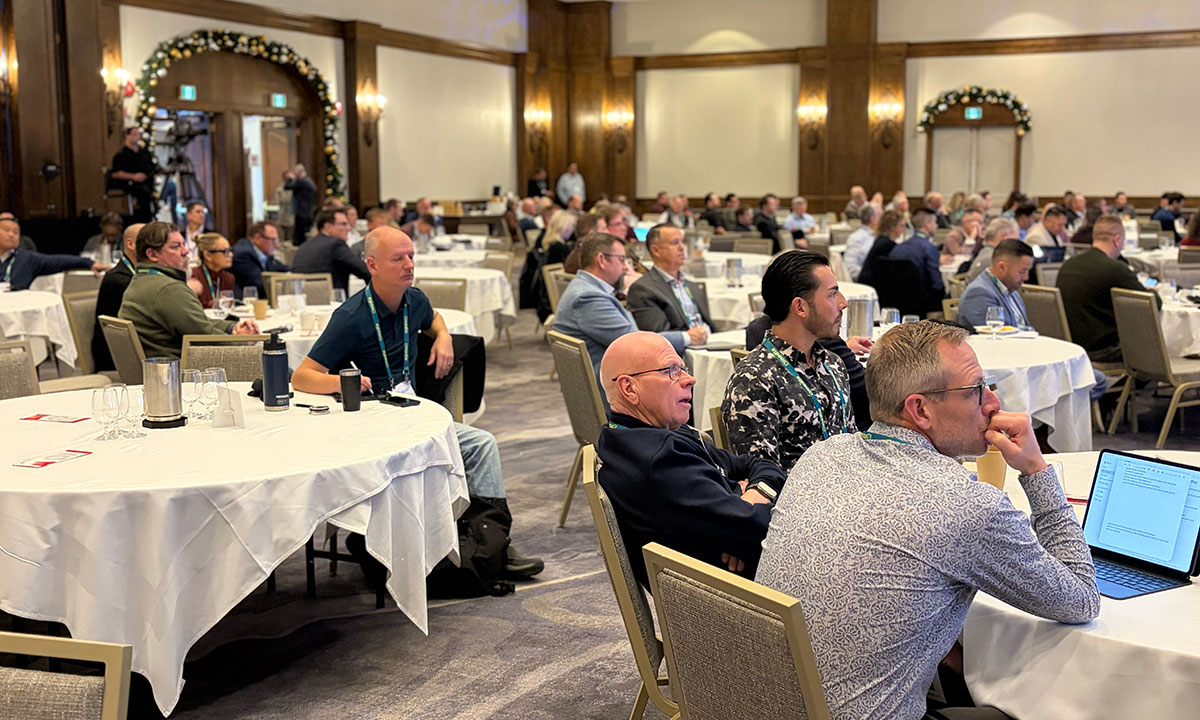
Trade tensions, changing vehicle buyers and the growing influence of artificial intelligence set the agenda for the final conference day of the Western Canadian Dealer Summit at the Fairmont Banff Springs.
Saturday’s sessions brought together national dealer and manufacturer association leaders, consumer researchers and technology experts to examine the pressures facing dealerships and the opportunities ahead.
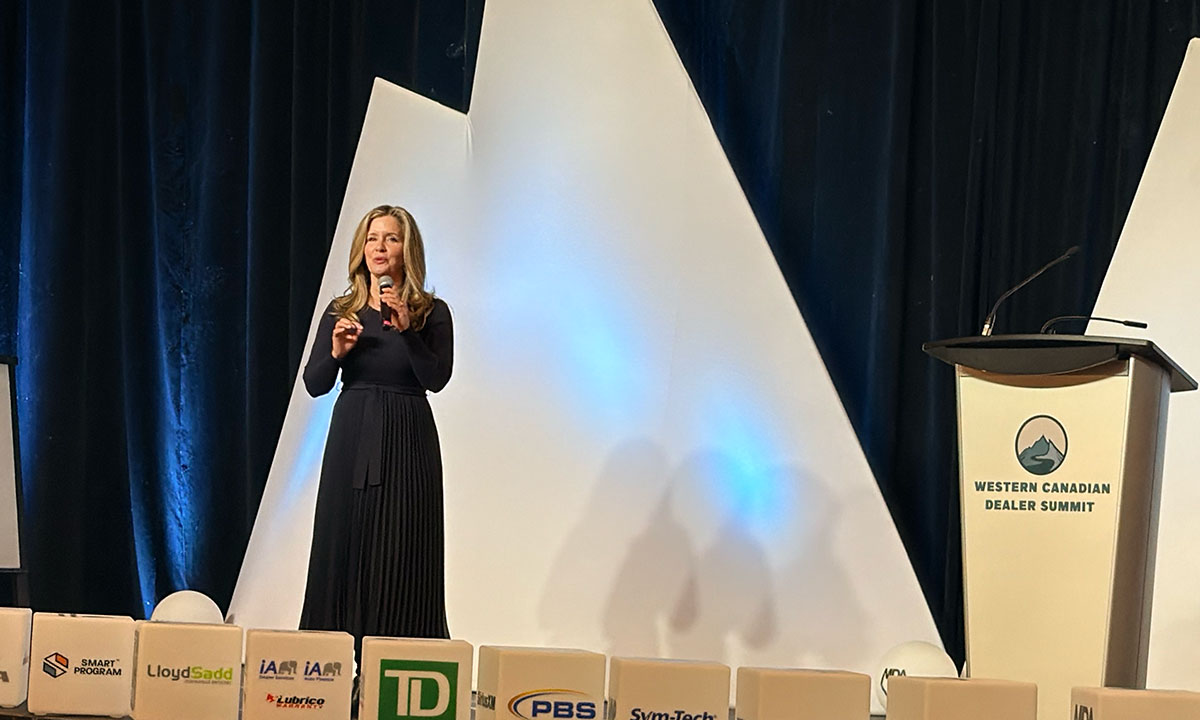
The day closed with a keynote from entrepreneur Darci Lang, and a gala featuring Canadian curling superstar Brad Gushue.
The November 14 program continued the summit’s “Master the Shift” theme, with a full schedule of speakers offering dealers insights into government policy, consumer behaviour, digital marketing and the growing role of AI in automotive retail.

Industry leaders warn of continued uncertainty
Huw Williams, CADA’s Public Affairs, opened the morning with an update on the association’s advocacy efforts in Ottawa, describing an increasingly challenging political and trade environment.
“There has never been a more difficult public policy environment,” said Williams, reflecting on his 30 years representing dealers.
Williams highlighted progress on several CADA priorities, including the federal government’s move to repeal its EV sales mandate, efforts to address technician shortages through immigration policy and work to improve the automotive sector’s competitiveness.
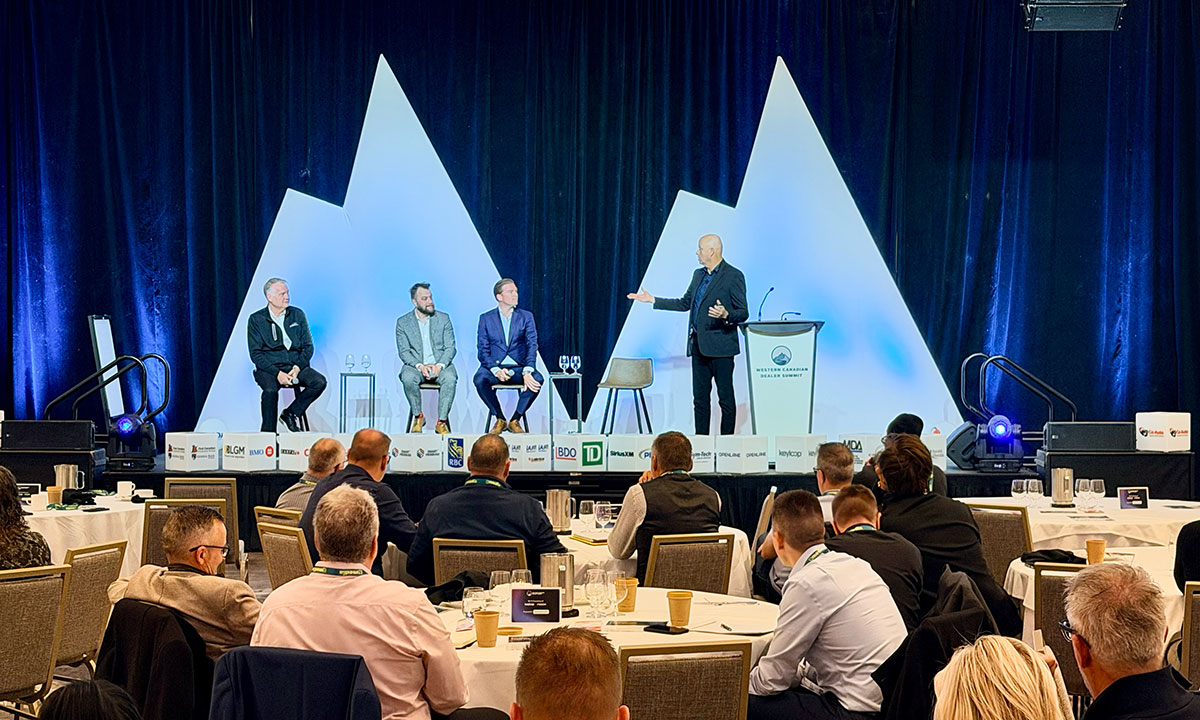
Tim Reuss, CADA; Lucas Malinowski, Global Automakers of Canada; Brian Kingston, Canadian Vehicle Manufacturers’ Association (CMVA) and Huw Williams, CADA
He also stressed the importance of maintaining productive relationships with American officials despite ongoing political tensions. “Even though we are elbows up, we’re open arms in terms of diplomacy,” said Williams.
Williams then moderated an industry association panel featuring CADA President and CEO Tim Reuss, Brian Kingston, President and CEO of the Canadian Vehicle Manufacturers’ Association, and Lucas Malinowski, President and CEO of Global Automakers of Canada. The discussion focused on the progress made in changing federal EV policy, the challenges remaining in Quebec and British Columbia, and the potentially lasting impact of the Canada-U.S. trade dispute.
Kingston said the federal EV mandate had become disconnected from consumer demand. He said manufacturers unable to meet mandated sales ratios faced purchasing credits from competitors or restricting vehicle allocations to dealerships. Kingston said the associations had presented Prime Minister Mark Carney with data showing the gap between actual EV sales and government targets, along with an estimated $980 million in potential compliance costs.
“He understood you can’t just will people to purchase EVs,” said Kingston.
Reuss said the policy shift followed more than two years of coordinated advocacy among dealer and manufacturer associations, which have worked to deliver consistent messages through different channels. But the associations warned that provincial EV mandates remain a concern, particularly where manufacturers could be forced to restrict sales of vehicles consumers still want.
Trade was another major focus. Kingston estimated that manufacturers producing vehicles in Canada had incurred approximately $9 billion in tariff-related costs, raising serious concerns about the future competitiveness of Canadian assembly operations.
Malinowski said manufacturers have been changing their sourcing strategies, bringing more vehicles to Canada from Japan, South Korea and Europe to reduce exposure to U.S. tariffs.
The panel also explored the arrival of Chinese automakers.
While Kingston expressed strong opposition to opening the Canadian market to Chinese imports, Reuss said CADA’s position is more pragmatic. The association wants to ensure that any Chinese brands entering Canada operate through franchised dealers and meet appropriate requirements for parts, service and dealer protections.
Reuss cautioned dealers against expecting a quick return to stable trade relations, even if Canada and the United States reach a new agreement. His advice was to protect customer relationships, manage costs carefully and watch used vehicle valuations for signs of market weakness.
“Look after your customers,” said Reuss. “That’s the best you can do in these circumstances.”
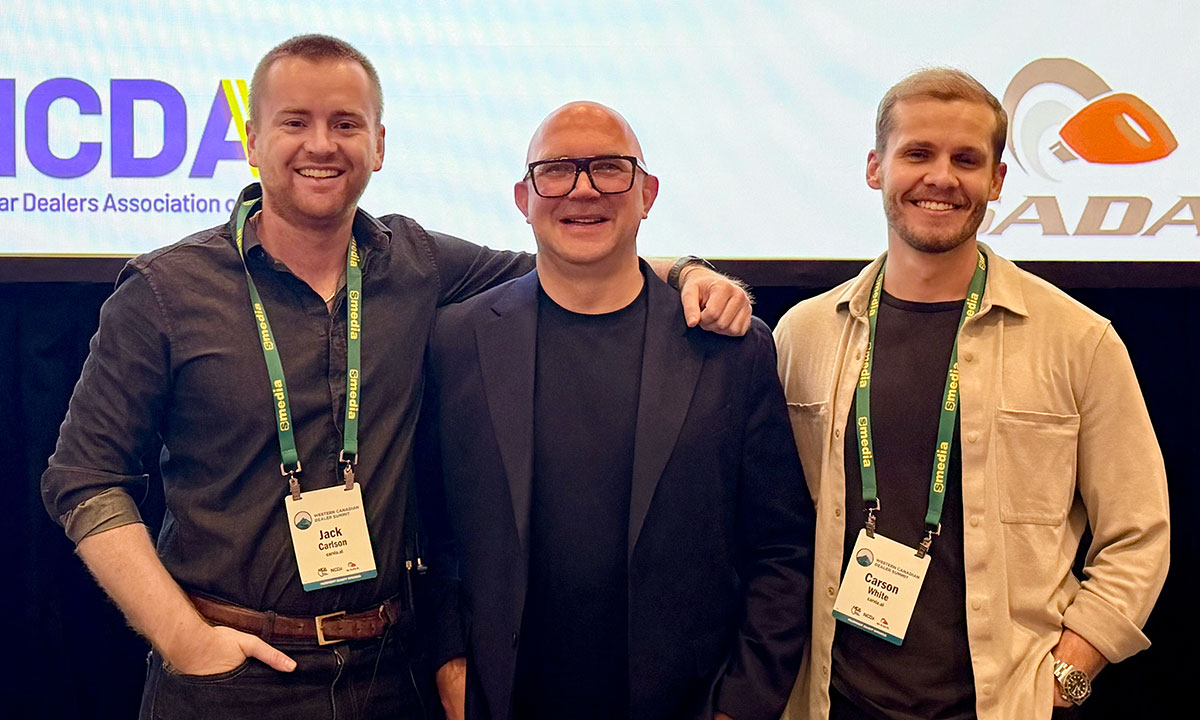
Jack Carlson, Carvia; Mathew Growden and Carson White, Carvia
New research reveals changing buyer expectations
Mathew Growden, founder of The Change Optimist and a former member of Google’s Canadian automotive team, shifted the discussion from government policy to the people buying vehicles.
Drawing on his industry sponsored research effort involving 3,068 respondents, Growden said affordability is forcing Canadians to reconsider their vehicle purchases. According to the research he presented, 64 per cent had changed their purchase plans because of affordability concerns.
But the way consumers research and purchase vehicles is also changing rapidly. Growden said 71 per cent of respondents indicated that online video helped shape their vehicle decisions, while 88 per cent of those using AI found it useful in their search.
Despite the shift toward digital research, dealer websites remain an important part of the journey, and consumers still frequently make their first direct contact with a dealership by walking in or calling.
Growden said response times are becoming increasingly important in determining where consumers buy their vehicles. Clear financing information and an experience that helps customers understand what they are signing also contribute significantly to satisfaction.
The dealer website was examined in greater detail by Carson White, founder of Carvia, who challenged the assumption that shoppers arrive at dealership websites knowing exactly what vehicle they want. White said research showed 75 per cent of Canadian car buyers visited a dealer website during their shopping journey. Rather than simply checking a price, visitors continued to browse inventory, compare vehicles and explore financing options.
Payment calculators were among the most frequently used tools, but White said dealers should not assume that a shopper who fails to submit a lead form has lost interest. His research showed that many customers using online payment tools subsequently called or visited a dealership without completing a form.
That creates a challenge for dealers trying to measure the effectiveness of their digital marketing, since a website can influence a sale without generating a traditional online lead. White said the bigger opportunity is to simplify the shopping experience, provide clearer payment information and allow consumers to engage with the dealership on their own terms.
His Carvia partner, Jack Carlson, then took a closer look at Generation Z buyers, who represented roughly one in ten vehicle purchasers in the research. Carlson said younger consumers discover vehicles differently, relying heavily on social media, particularly TikTok and YouTube, and placing considerable trust in independent reviews and actual vehicle owners.
“Gen Z believes their feed. That’s what they know. That’s what they trust,” said Carlson.
The research showed that 55 per cent of Gen Z buyers purchased used vehicles, reflecting the affordability pressures facing younger consumers.
Yet despite their confidence researching vehicles online, many become less certain once they enter the dealership and begin navigating the transaction. Only 35 per cent knew dealerships offered financing, while just 28 per cent felt very confident they understood their financing after completing the transaction.
Carlson also reported that 80 per cent of Gen Z respondents who financed a vehicle felt some pressure during the process.
His message to dealers was to recognize the importance of these early purchasing experiences. For many younger buyers, the dealership is handling their first vehicle purchase and first major loan.
“It’s really starting the relationship or you’re not starting a relationship,” said Carlson.
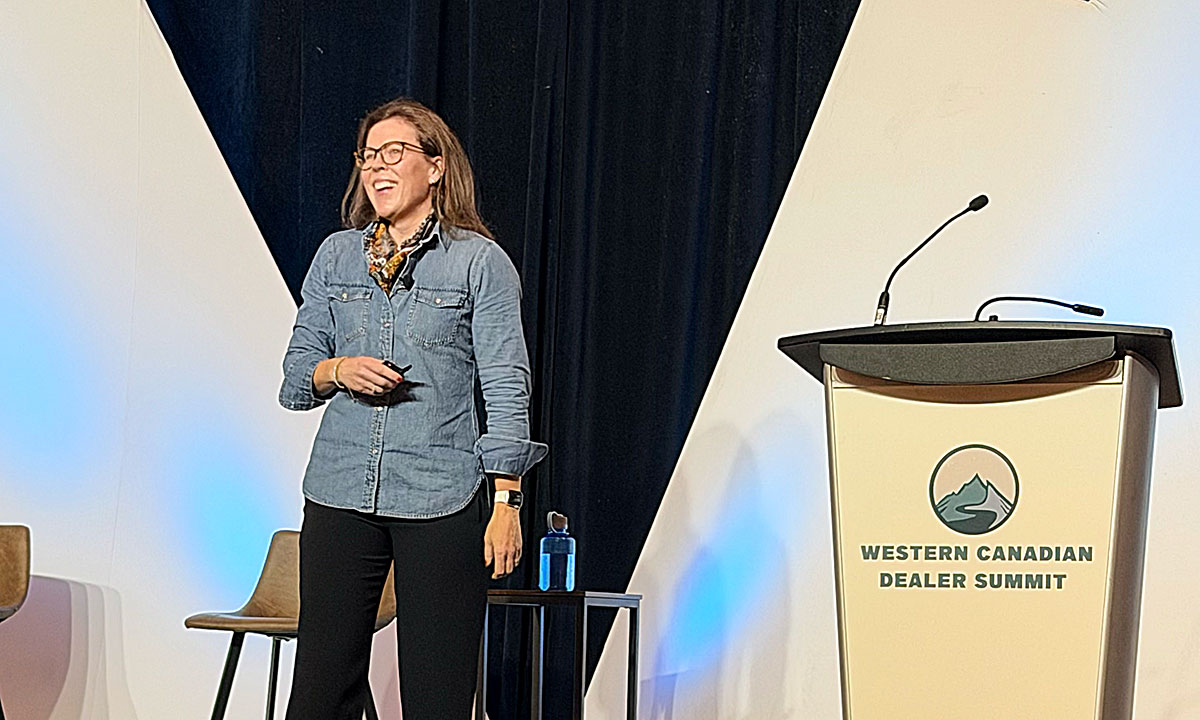
Holly Clarke
AI moves from theory to the showroom
Artificial intelligence was another major theme, with several speakers examining how it is changing customer expectations, digital marketing and dealership operations.
Holly Clarke, who leads ChatGPT Ad Solutions in Canada for OpenAI, explained how conversational AI is becoming part of the vehicle research and purchase journey. Unlike a traditional search query, where consumers enter a few keywords, ChatGPT users can describe their needs in considerable detail, including budgets, preferences, intended vehicle use and other constraints.
Clarke said the platform is developing new opportunities for businesses to connect with consumers through advertising and organic discovery. She encouraged dealers to claim their business profiles in ChatGPT and ensure their websites contain accurate, current and easily accessible information.
Clarke emphasized that advertisers cannot pay to influence ChatGPT’s answers. The advertising system and underlying conversational model operate independently, making consumer trust central to the platform.
For dealers, the immediate opportunity is to ensure their businesses can be accurately discovered and understood as consumers increasingly use AI to compare products and services.
Barry Hillier, CEO of Auto Agentic and a leader of Toronto’s AI Fellowship, challenged dealers to think beyond simply purchasing another AI-enabled software product.
“You have smart tools, but you don’t have an intelligent dealership,” said Hillier.
He argued that many dealerships have accumulated disconnected systems that perform individual tasks but cannot share information effectively. Simply adding AI to those systems will not solve the underlying problem.
The larger opportunity, he said, is connecting dealership data, employees, processes and decision-making so AI can support the entire operation.
Hillier used the example of a busy service advisor facing dozens of repair orders, multiple computer screens and constant telephone calls. In a more connected operation, AI could help prepare information about parts, warranty coverage and previously declined work before the advisor begins dealing with customers.
The goal, he said, is to reduce administrative work and give employees more time to focus on relationships and solving problems.
Hillier encouraged dealers to begin by asking employees where they lose time, which processes create unnecessary work and what information they need earlier to serve customers better. He emphasized that AI should support employees rather than replace their judgment, with people retaining control over important decisions.
Stephen Southin, a leader at Halo and co-founder of PAVE.ai, brought the conversation into the used vehicle department with a presentation that challenged dealers to consider whether they would trust AI to bid on vehicles at auction.
Through a series of hypothetical auction scenarios, Southin demonstrated how AI could help evaluate freight costs, inventory requirements and competitor bidding activity. In one example, an AI agent identified a lower-cost freight option while a dealer was bidding on a vehicle, potentially changing the amount the dealer could afford to pay.
Southin’s point was that dealers do not have to surrender control immediately. They can introduce automation in stages, using AI initially to provide information and recommendations before gradually allowing it to take on more responsibility.
The discussion of digital trust continued with Brian Sencich, Reddit’s Head of Automotive, who explored why consumers increasingly seek independent opinions before making major purchases.
Sencich said consumers are becoming more skeptical of polished marketing messages and AI-generated content, leading many to online communities where they can hear directly from people who own the products they are considering.
He cited Reddit research indicating that 53 per cent of Canadian automotive shoppers on the platform discovered new automotive products or brands there, while 39 per cent used it to verify AI recommendations.
For dealers, he said, understanding where consumers seek independent opinions is becoming an increasingly important part of the digital marketing strategy.
Darci Lang
A different kind of closing message
After a day dominated by data, technology and industry challenges, award-winning entrepreneur and Canadian Speaking Hall of Fame member Darci Lang delivered a more personal message about leadership and perspective.
In her closing keynote, “Invest in Yourself,” Lang drew on her popular “Focus on the 90 per cent” philosophy and her book Lead the 90%, encouraging attendees to concentrate on the positive things in life they can control rather than the frustrations and circumstances they cannot.
Lang also challenged attendees to examine where they invest their energy. Too often, she suggested, people give 90 per cent of themselves to the outside world and leave only 10 per cent for the family and loved ones who matter most.
The uplifting presentation offered a different perspective on leadership, reminding dealers that success involves more than business performance.
The formal conference program was followed by a social hour sponsored by Keyloop, giving attendees a chance to relax and enjoy several interactive activities.
Dealers tested their skills at skiing, snowboarding and race-car driving, while members of the Keyloop team were available to answer questions about the company’s technology platform.
Brad Gushue
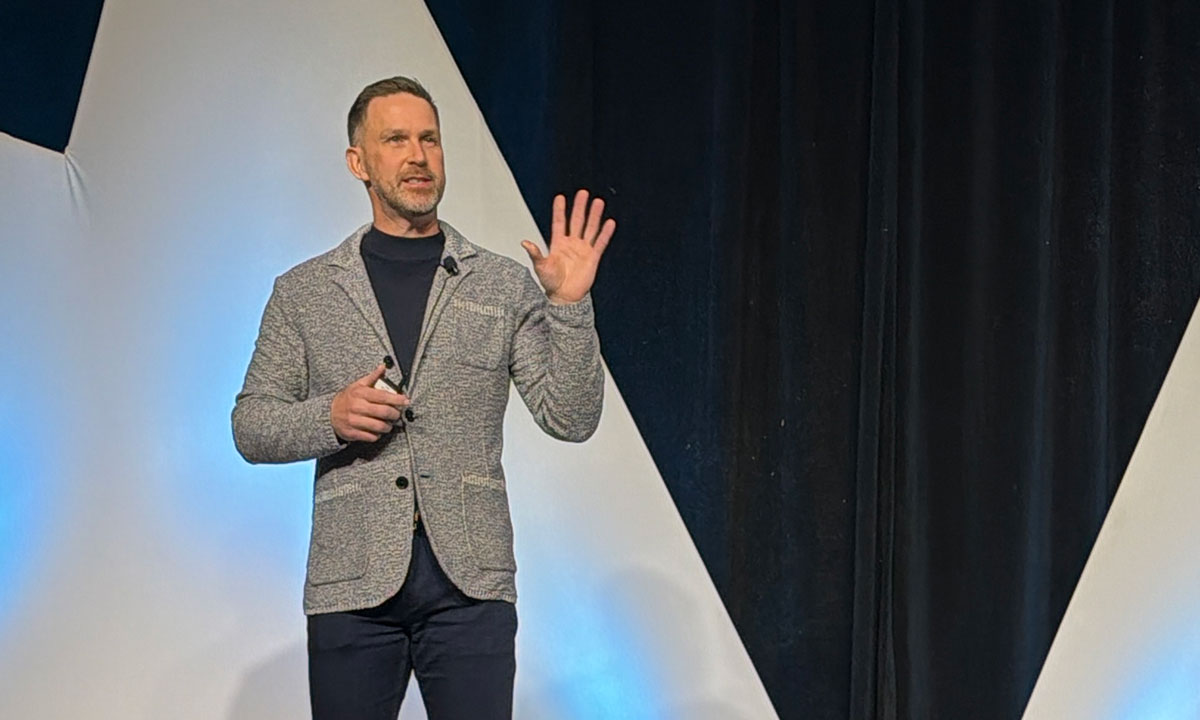
The weekend concluded with a gala dinner featuring Canadian curling superstar Brad Gushue, an Olympic gold medallist and one of the most successful skips in Canadian curling history.
Gushue delivered an inspiring closing address to delegates, providing a fitting finale to a summit that had combined serious industry discussion with opportunities to reconnect, exchange ideas and celebrate the people who make up Western Canada’s automotive retail community.