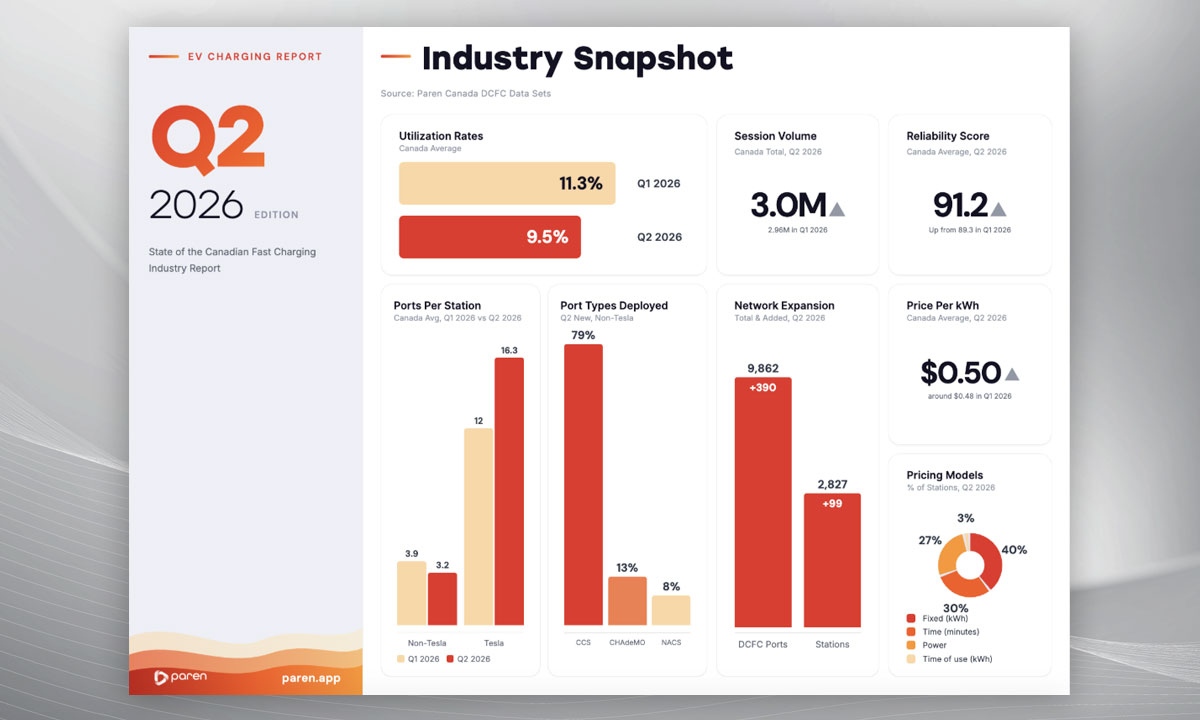
Canada’s public EV fast-charging network continued to expand in the second quarter of 2026, with operators adding capacity faster than drivers are using it, according to Paren’s Canadian EV Fast Charging — Q2 2026 report.
The report found 390 new public DC fast-charging ports opened across 99 stations between April and June, a 30 per cent increase over the same period in 2025. Quebec led the country with 44 new stations, followed by Ontario with 21 and British Columbia with 18.
Tesla remained the largest single deployer, adding 98 new ports during the quarter, although established networks including Circuit Électrique, ChargePoint, On the Run and Flo accounted for much of the remaining growth. Paren noted Tesla continues to build larger sites while gradually representing a smaller share of new installations as other operators expand.
Despite the continued buildout, national utilization fell to 9.5 per cent from 11.3 per cent in the first quarter as charging infrastructure grew faster than demand. Paren attributed the decline largely to the rapid addition of new charging ports, which typically require time to reach higher usage levels, combined with weaker EV sales following reductions to purchase incentives in 2025.
Reliability, however, remained stable. Canada’s national reliability score improved slightly to 91.2, with British Columbia and Ontario both posting scores above 90. British Columbia also recorded the country’s highest utilization rate at 12.4 per cent, ahead of Ontario at 11.2 per cent.
The report also found pricing remained relatively stable nationwide. British Columbia continued to offer the lowest average fast-charging rates at approximately $0.42 per kWh, while Alberta remained the highest at about $0.67 per kWh. Nationally, fixed per-kWh pricing has become the most common billing model, overtaking time-based charging over the past year.
In a guest commentary accompanying the report, EV infrastructure consultant Scott Sharabura said charging investment decisions are made years before stations open, allowing network expansion to continue despite short-term fluctuations in EV demand. He added that Canada’s evolving EV policy framework and an anticipated national charging infrastructure strategy could influence the next phase of investment.