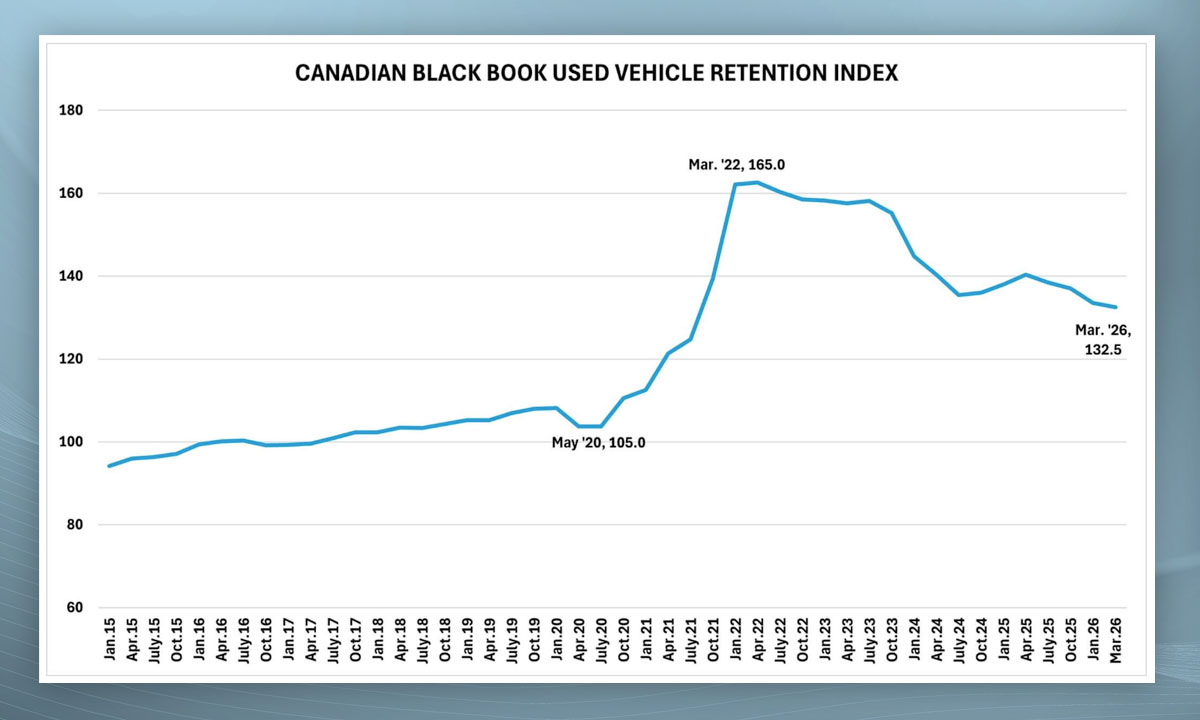
Canadian Black Book’s Used Vehicle Retention Index rose slightly in March, increasing 0.3 points to 132.5, up from 132.2 in February. Year-over-year, the index declined 5.3 per cent.
The modest increase reflects typical seasonal patterns in the wholesale market, where values tend to stabilize or improve in the spring. Daniel Ross, Senior Manager of Industry Insights and Residual Value Strategy at Canadian Black Book, said there was no denying a spring market.
“When we see the prevailing trends of wholesale values pause for this seasonal positivity, there is an expectation of it lasting only for a limited time,” he said. “We understand the negativity in the market this year compared to last, and we are now very recently seeing it on the new vehicle side as well. What has transpired over the last 30 days for used vehicles mostly highlights the impact of the U.S. market.”
Ross said that while our overall retention measure is slightly positive, there is a “distinct inflection point” separating vehicle segments — so much so that mid- and full-size crossovers, as well as pickup trucks, are the only vehicles that experienced positive value trends last month.
“This stresses the impact of tariffs on used vehicles produced outside of the U.S., and the returning used vehicle demand in that country, as American consumers digest high fuel prices (like us), but also the impact of tariffs on new vehicle pricing,” said Ross.
The data points to uneven performance across segments, with gains limited to mid- and full-size crossovers and pickup trucks.
The index remains well below its peak of 165 points in March 2022, following a period of elevated used-vehicle values that began in mid-2020. Canadian Black Book calculates the index using wholesale average values for two- to six-year-old vehicles as a percentage of original MSRP, adjusted for factors including volume, age, mileage and condition.