
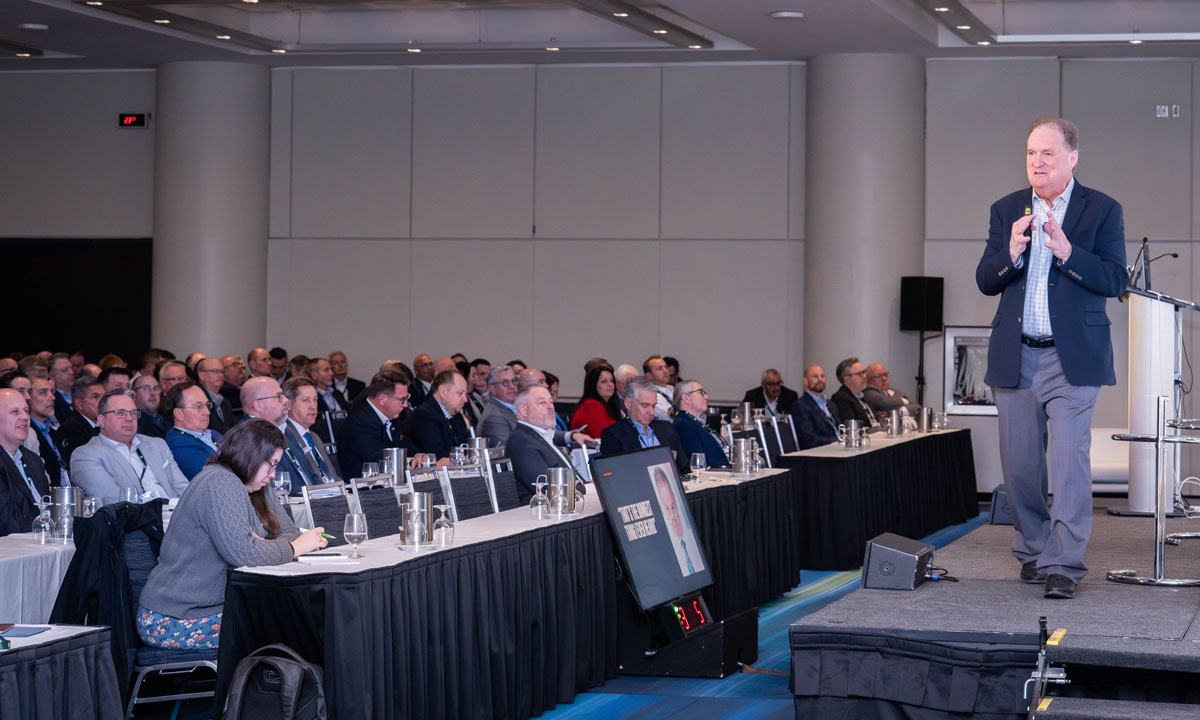
One of the more talked-about sessions on a jam-packed agenda at the recent CADA Summit in Toronto featured a familiar voice. Futurist and author Jim Carroll, a veteran keynote speaker who has advised and addressed organizations ranging from global brands to institutions such as NASA, returned with a presentation designed specifically for Canada’s dealer community.
Carroll opened with humour, but didn’t sugar-coat the backdrop. “It’s a really weird time to be in front of you folks,” he said, teeing-up the central theme of his talk: rapid change colliding with a new level of economic and geopolitical uncertainty. “We talk a lot about agility and the need to respond quickly to change,” he added, noting that it’s no longer enough to simply watch trends; dealers and OEMs need vehicles, processes and people ready for what’s arriving next.
That urgency resonated because Carroll has history with the CADA Summit audience. He reminded dealers he last spoke to the group in 2012 and used that as a benchmark: the biggest mistake businesses make is assuming the future is “far away,” when in reality it tends to show up sooner — and more unevenly — than expected. “We think we have time to deal with all this disruption… We don’t have a lot of time,” he said.
To ground that point, Carroll returned to three statistics he said he has used for years to help audiences understand how quickly knowledge, skills and consumer expectations evolve.
First, he cited a long-running forecast that “65 per cent of kids who are in preschool today will work in a job or career that doesn’t yet exist.”
He offered a personal example of a family member working in drone operations, a role that, not long ago, simply wasn’t part of the labour market. To make the dealership tie-in explicit, he said if the pace of change keeps accelerating, dealers will increasingly be hiring for emerging skills they can’t fully define today.
Second, he argued that formal training struggles to keep pace with real-world innovation, particularly in technical fields. “If you’re taking any type of degree today based on science… it is estimated that half of the knowledge that we get in the very first year, half of that knowledge is obsolete or revised by the time we graduate,” he said.
His point for dealers wasn’t about academia; it was about building teams that can continually retrain, adapt and absorb new tools, especially as vehicle technology becomes more software-driven.
Third, Carroll connected the shrinking “half-life” of technology to vehicle value, positioning today’s car less as a static mechanical product and more as a fast-evolving platform.
“The technology in the car is what defines its value,” he said, describing how customer expectations are being shaped by the same upgrade cycles and interface standards they experience with devices. For dealers, the implication is practical: the showroom conversation, the service relationship and the ownership experience are increasingly centred on software, user experience and feature education, not just traditional performance measures.
Carroll also pressed the audience to think in both near-term and long-term horizons, and to avoid betting the business on a single storyline. On electrification, his message was nuanced: the long-term direction remains clear, but the path looks more behavioural than ideological.
“We realized people don’t shift and change that easily,” he said, adding that the next phase will require easing customers through trade-offs and anxieties rather than demanding instant adoption. “It’s going to be hybrid vehicles,” he said, describing hybrids as a bridge technology that aligns with what dealers are seeing in sales trends and customer hesitation.
Affordability, already a dominant theme for Canadian retailers, was another through-line in his remarks. Carroll described it as both an immediate sales constraint and a strategic planning issue, given the uncertainty around rates, incentives and broader economic direction.
Dealers, he suggested, will need to stay sharply focused on value, clarity and trust as customers weigh higher monthly payments against rapidly changing vehicle technology.
Beyond product mix, Carroll argued that the retail battleground is shifting in subtler ways, particularly in how customers discover brands and businesses.
Dealers have poured years of effort into search and social strategy. Now, he believes the discovery funnel is beginning to reroute through AI tools. “What is happening out there right now is a very significant and subtle shift from search engines to generative engine optimization,” he said, describing how he’s already seen demand signals change as buyers and business decision-makers increasingly use AI assistants to find providers, compare options and form first impressions.
On artificial intelligence more broadly, Carroll warned against both extremes — dismissing it as hype or assuming instant productivity windfalls. “Artificial intelligence is not one thing. It’s many things,” he said.
Some applications, such as machine vision and personalization, are already delivering tangible value; others remain at what he described as the “peak of inflated expectations.” His advice to dealers: pursue near-term, customer-facing use cases and operational improvements, but keep a clear eye on governance, quality and realistic timelines.
Perhaps the most dealer-ready takeaway, though, was leadership mindset in the face of nonstop volatility. Carroll urged the room to avoid being consumed by daily noise and instead concentrate on controllables: customer experience, operational execution and consistent improvement.
“You need to learn how to filter the noise,” he said. He framed the choice starkly: “We have three choices. Number one, we can panic. Number two, we can do nothing. Or number three, we continue to focus on growth, innovate, change, and adapt.”
Carroll closed with a message he returned to more than once: speed and adaptability will be decisive advantages. “The future belongs to those who are fast,” he said. “Volatility is your new normal… and it’s learning to cope with that.”
To download a copy of Carroll’s presentation: click here.
TD Auto Finance is the exclusive sponsor of the CADA Summit.