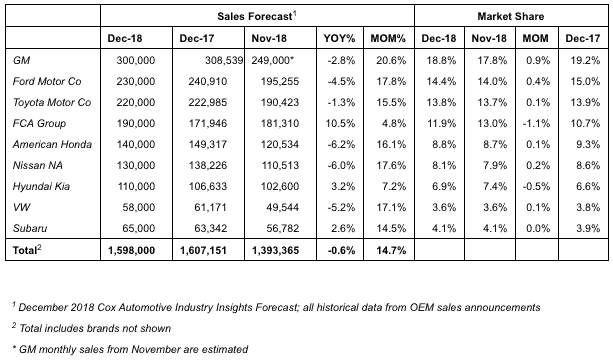
Cox Automotive is expecting the year to close with a strong finish from December U.S. auto sales.
The seasonally adjusted annual rate (SAAR) for new vehicle sales during this period is anticipated to be 17.2 million — down from last year’s 17.3 million pace. But despite this news, Cox Automotive says healthy December sales are to be an “exclamation point” for a “forecast-beating” year that predicts a small increase from 2017.
“There is no denying 2018 was a very good year for the U.S. auto industry,” said Charlie Chesbrough, senior economist, Cox Automotive. “A SAAR above 17 million signals a very strong market. Many economic factors pointed to a slowdown in the second half of the year, but sales remained in high gear, and it looks like they will finish that way as well.”
Retail demand was up slightly in the second half of the year, likely due to low unemployment rates and tax reform. This resulted in an increase in consumer confidence and spending. Lower gas prices have also contributed to this. And the fact that credit is widely available and rates have stabilized has also helped improve the situation.
According to Jonathan Smoke, chief economist at Cox Automotive, “If December incentives are focused on key segments such as SUVs, where there has been growing supply, we think more buyers are ready and happy to step in.”
December is anticipated to offer the highest (or second highest) monthly sales volume for 2018, thanks in large part to holiday incentives and a strong economy.

Consumer interest in the Jeep brand should help boost FCA, while Toyota, Honda, Nissan and Ford are likely to be negatively impacted. They are not the only ones. Some vehicle segments will witness a double-digit drop in sales from 2017, as consumer interest continues to shift from sedans to SUVs and crossovers.
Looking to 2019, interest rates are expected to rise even more and retail sales are expected to decrease. The forecast for light vehicle sales during this period is 16.7 million units.
“Federal Reserve monetary policy of increasing interest rates, up nearly 225 basis points since 2015, is negatively impacting vehicle affordability,” said Chesbrough. “And, when coupled with weakness in home construction and volatility in the stock market, these are growing headwinds for the U.S. auto market.”
“The main negative has been the volatile stock market and the related increase in negative news about the future economic situation,” he adds. “According to a Wall Street Journal/NBC News poll released this week, one-third of Americans say the economy will get worse in 2019, the highest level of wariness in five years.”