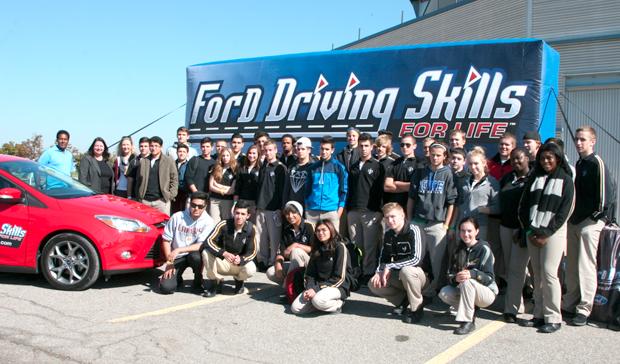
Ford officially launched Driving Skills for Life in Canada in 2014 with events in Toronto (shown) and Calgary during September/October
Distracted driving is fast becoming the number one cause in vehicle crashes and the growth ties in with the explosion in smartphone usage. According to data from the Virginia Tech Transportation Institute, motorists who text message are 23 times more likely to be involved in a crash compared with those who aren’t distracted. For the auto industry as a whole, such alarming statistics also have an impact, not only on human lives but, insurance premiums and also the ability for consumers to actually purchase a vehicle.

Under closed conditions, teens get to really understand the dangers of texting while driving
The situation is especially acute for teenage drivers. Not only are teens the future of our automobile buyer base, they are often identified as the largest single group of smartphone users and those most likely to be involved in vehicle crashes due to inexperience behind the wheel. Data from the Traffic Injury Research Foundation points to motor vehicle collisions being the leading cause of death for Canadians under the age of 24.
To help combat distracted driving and teenage auto related crashes, Ford Motor Company, through its non-profit Ford Motor Company Fund, created the Driving Skills for Life program, designed to teach young motorists the real dangers of distracted driving and if faced with a potential hazard or collision, how to practice safe techniques to avoid it.

Students Alex Morrison and Dave McCut both said the event really changed their views on distracted driving
Starting off in the U.S. in 2002, the program has now gone global, with events taking place in 20 countries (including Canada). Last year, Ford launched a pilot program in Vancouver and in 2014, officially unveiled Driving Skills for Life Canada, with two full day events scheduled in Toronto and also Calgary.
Caroline Hughes, Vice-President of Government Relations at Ford of Canada says that with ever increasing technology packed into today’s vehicles and more congested roadways, the need for teens to understand and execute safe driving practices is more critical than ever. “It can be hard to imagine all the hazards today’s teens face,” says Hughes “not only all the stimulus coming at you in the car but also natural hazards such as snow, ice, gravel and slippery roads.”
Driving Skills for Life puts students in four different controlled driving environments, teaching them the dangers of driving while texting, driving under the influence of alcohol, plus also collision avoidance techniques such as lane changing maneuvers and oversteer (skid) recovery.
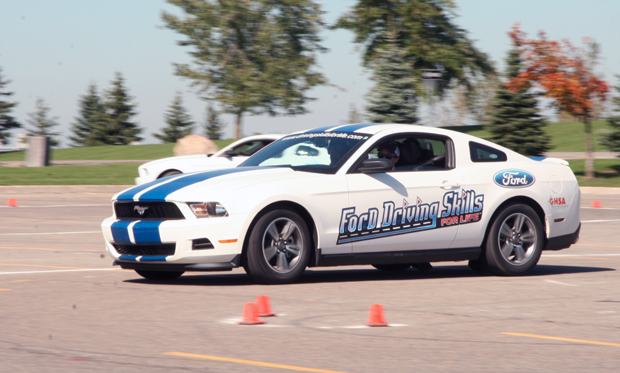
Four different course were set up, including one to practice oversteer recovery
Dave Drimmie, program manager, Driving Skills for Life Canada, says that the essence is for teens to understand just how dangerous distracted driving can be via realistic simulation under closed conditions and to not only comprehend what can happen and how to avoid it but also how to exercise sound judgement behind the wheel. “We want young drivers to understand that when they are driving, they are king of their domain, so if they are distracted by their phone or by their peers in the back they can take actions to stop it and get to where they need to go safely.”
Next year, Ford says it plans to expand Driving Skills for Life, with events taking place from coast-to-coast.
For more details on Driving Skills for Life in Canada visit: https://www.drivingskillsforlife.ca/