DEVELOPMENTS IN TECHNOLOGY MEANS SHORTER, SIMPLER SURVEYS WILL BE WHAT PROVES VALUABLE FOR DEALERSHIPS IN THE FUTURE
 In the auto industry, we’ve been measuring customer satisfaction for decades. Millions of customer surveys have been conducted about the ownership experience, performance, quality, and reliability of vehicles, as well as the experience the customer has at the dealership.
But have we really put into practice what we’ve learned over the years and what’s the way forward? I am not so sure. I think we still need to move forward and progress in the future will focus on two things:
• Paying more attention to the end goal
Customer satisfaction is just one of the components of attaining customer retention and loyalty. This does not diminish the importance of customer satisfaction, since the chances of retaining a dissatisfied customer are significantly less, (unless that adversarial customer can be turned into an ally).
• Leveraging technology to place customer satisfaction in the context of actual customer behaviour
Most CS surveys include three overall measures: satisfaction, willingness to recommend, and intent to return for service or purchase from the dealership again.
Much has been made in recent years about the importance of recommendation. But as many have pointed out, much can happen between a recommendation and an action, even if the measure does reflect the way a customer will put their reputation on the line for you. Likelihood to recommend and intent to return are also somewhat tenuous concepts in today’s world where the purchase decision path can be so quickly and easily altered. Along with better access to survey data, we now have easier access to hard data about what customers actually do — this should be the anchor for all customer satisfaction measurement efforts.
While we can tinker endlessly with surveys and the survey process, the future is not in coming up with a better survey, but how to use the information we have more intelligently.
 SERVICE DEPARTMENTS HOLD THE KEY
It can be argued that your service department holds the key to higher levels of service and sales retention and to a new way of putting customer satisfaction data to work.
Service data provides a much richer source of information, as there are far more transactions to analyse than is the case with sales data since the sales cycle is much longer.
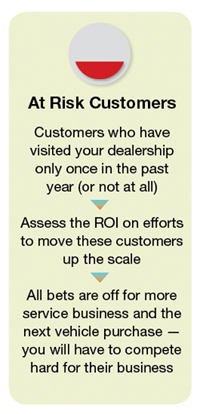
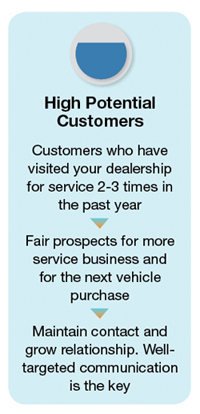
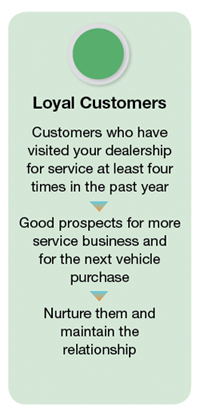
The service department is the key touchpoint with most of your customers.This is where your own customer database comes into play. Instead of looking at your customer base as one large group, break it down based on service business or service “loyalty.” The best service loyalty data would include capturing, for each customer, the total number of service visits to your dealership over the past year.
In truth, the best measure of service loyalty is to look at that number as a proportion of all their service visits, whether to your dealership, other dealerships and to aftermarket service providers. But this information is not always available, so the number of visits to your dealership is a good proxy, assuming an average of four service visits per year.
The first step is to look at your base of customers from a service point of view and divide them into three main groups, as shown in the illustration.
By looking at this data and your customer satisfaction information together, you can get a much clearer picture of the relationship between actual behaviour (what does the customer do?) and what experiences the customer has (what did they witness over time based on survey information?). The more precise and accessible customer satisfaction data available today makes this possible and will help make the information itself much more meaningful.
 OTHER DEVELOPMENTS TO WATCH
There are some other trends in customer satisfaction measurement that will be worth watching in the future.
The temptation to use a single question survey (whether the question relates to satisfaction, recommendation or likelihood to return) will always be there like a siren’s call. It sounds good, but does it really give you the information you need to take action? Even if followed by an open-ended “Why?” question, it’s much more difficult to identify specific things that have gone wrong (or right).
There is certainly a need for shorter and simpler surveys, but surveys that also provide the ability to take action. The academic approach to understanding what drives satisfaction (usually with long, detailed surveys and complex algorithms), will give way to shorter, better and simpler surveys base on the things we have learned as an industry over the years.
The lure of using “big data” (like your service transaction data) needs to be tempered with the recognition that, in many cases, companies only look at the data as a series of independent touchpoints points over time. For both behavioural data and customer satisfaction data, the value of watching a customer over a period of time and tracing the journey will be more apparent than ever.