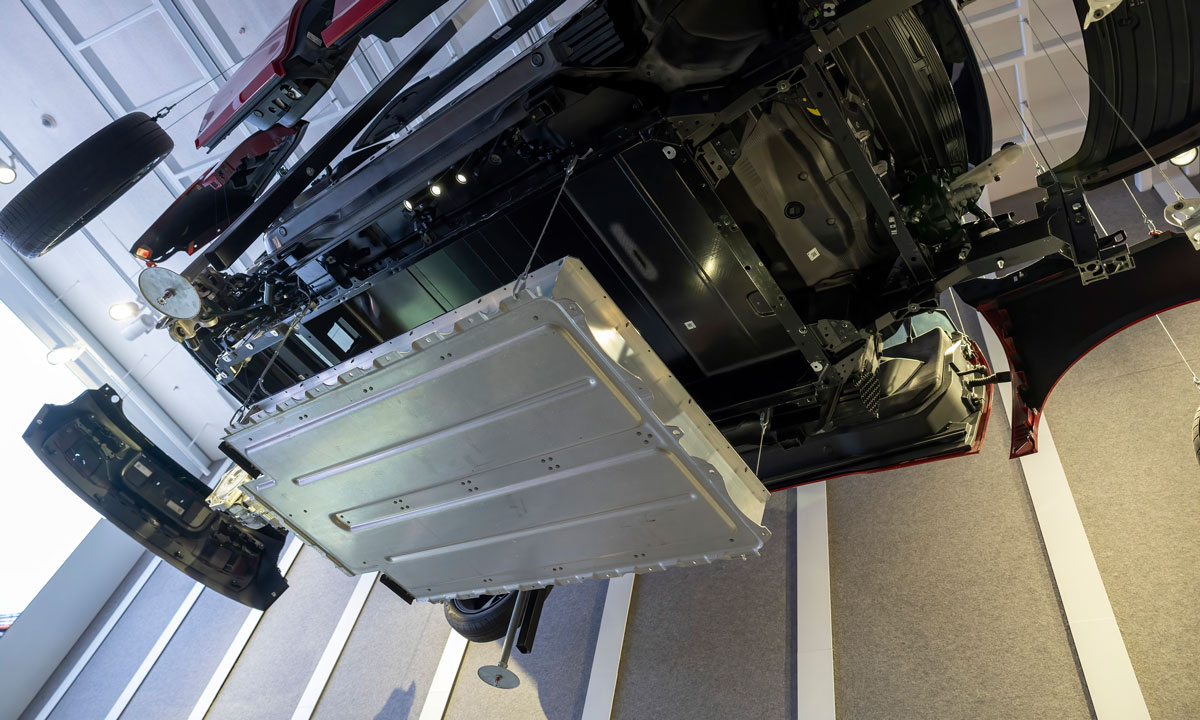
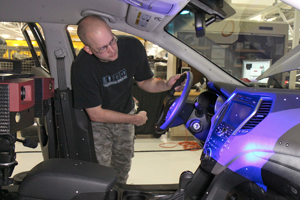
 General Motors’ Competitive Benchmarking team is using red, white and blue light scanning to help it surgically dissect competitor vehicles and improve the quality of its own products.
The high-tech search for what is good and bad is conducted about three dozen times a year globally with models strategically selected that have been re-designed or feature industry-first systems and technologies.
The light scanners mathematically capture precise three-dimensional (3D) images of vehicle structures and components. Complete sets of scans become reverse-engineered computer models for comparing to GM designs.
The lessons learned from such comparisons are being used to drive cost and vehicle mass reductions as well as quality improvements in Chevrolet, Cadillac, Buick and GMC products with each model year. The team also dismantles and scans GM vehicles to validate parts, quality check manufacturing processes and troubleshoot part irregularities.
“3D scanning is a time-efficient and cost-effective way of keeping up with rapid advancements being made all over the industry,” said Larry Pecar, senior supervisor, GM Competitive Benchmarking. “The technology also allows us to gain a better understanding of the reasons for other automakers’ recalls so that we are better able to avoid making the same mistakes.”
GM’s 3D scanning technology projects a red, white or blue light pattern onto the vehicle surface while an advanced camera or sensor captures its contours and records where the object is in space and its orientation.
While any one of these systems can scan small parts to complete vehicles, blue and white light works best at capturing complete vehicle scans, including full exterior surfaces. Blue light scanners can also map vehicle interiors and locations of underhood and underbody components.
White light scanning is a similar photographic process, but it is an older technology and currently used less frequently due to the advanced capability of blue light scanning.
Red light scanning is best for capturing details of components and parts already removed from vehicles. By combining data from red and blue light scans, engineers can capture stand-alone parts and their original position and orientation within the vehicle.
GM also uses 3-D scanning for vehicle design and development. The manipulation of data collected from scans of clay models into digital modeling programs can be uploaded into a computer-controlled milling machine to create a full-scale model. Or, if it is just a portion of the vehicle, the data can be transferred to a 3-D fabricator for a rapid prototype part.
“By comparing the scan of a finished product to the original math model we can identify the source of fit and finish problems. In some cases even squeaks and rattles can be avoided or quickly addressed,” Pecar said. “There is no place for a quality issue to hide.”