LEADERSHIP, FIXED OPERATIONS AND WHY PRICING BELOW MSRP WORKS

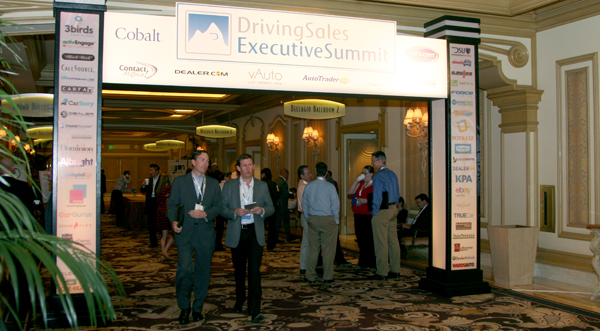
The fifth annual DrivingSales Executive Summit ran from October 13-15
Following the well-received Canadian Breakout session on October 13th, the fifth annual DrivingSales Executive Summit got underway. Event emcee Charlie Vogelheim welcomed a packed audience in the Bellagio Ballroom and talked about what dealers and attendees could expect over the course of the next couple of days. As in previous years, Vogelheim’s attire became increasingly flamboyant. After all, if you’re hosting an event in Las Vegas, you might as well look the part, right?
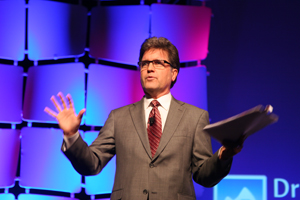
Charlie Vogelheim once again served as emcee
Following Vogelheim, DrivingSales founder and CEO Jared Hamilton took the stage. While Hamilton joked about his fast pace when talking and mentioned he’d slow down a little for the audience, he also took the time to address a topic that isn’t generally emphasized in today’s automotive retailing — fixed operations.
THE FUTURE OF FIXED OPS
Hamilton talked about how the aftermarket currently owns the service repair business and why dealers can benefit so much from a solid fixed ops strategy, especially since profits from fixed operations have doubled since the advent of the Internet. However, he noted that while total sales dollars at dealerships have increased 7.1 per cent in the last two decades, the fixed operations share has declined on average by 0.7 per cent. He also said that on average, dealers in the U.S. are losing around 145 days a year in terms of Repair Orders, which translates to $159,887 for the average dealership!
Hamilton said that there are two major things causing “leakage” of profit from the back end, namely longer service intervals on today’s vehicles and that as the average age of vehicles on the road keeps creeping up, motorists are less likely to service them at the dealership as they get older.
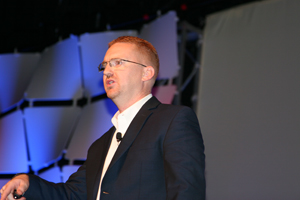
DrivingSales CEO Jared Hamilton talked about the future of fixed ops
Hamilton said dealers can address these problems by employing a fixed ops strategy in their BDCs and by altering their marketing approach — essentially combining both traditional and digital elements under a single umbrella, with a single person ultimately responsible for all of it — an individual that reports directly to the general manager or dealer principal. “Focus on fixed ops first and then new and used vehicles second,” he said.
Hamilton noted that it was very important for dealers to really focus on their mobile strategy when targeting service customers, creating a seamless approach across all devices, whether smartphones, tablets or computers. He also encouraged dealers to step up the game in local markets and focus on reputation, especially since 62 per cent of drivers research the recommendation of technicians in their local market when it comes to service repairs.
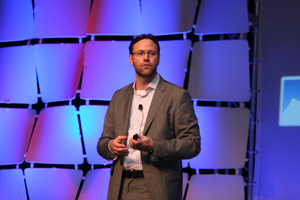
Scott Hernalsteen
SMART STRATEGIES FOR GAINING MORE MARKET SHARE
Scott Hernalsteen, senior director of Enterprise Analytics at Autotrader.com talked about big data and while it represents an awful lot of information for dealers to absorb, we shouldn’t be scared of it. He noted that there’s a great deal of cross-shopping brands when it comes to consumers searching for that ideal vehicle online and said that when it comes to the purchase process, dealers need to emphasize pricing, vehicle description and customer handling to successfully target and engage their audience.
Hernalsteen also noted that the price range shopped by consumers online actually narrows closer to the final purchase and that on average, 76 per cent of shoppers still ultimately pay more for their vehicle than the prices they view online.
He said that for dealers that actually list vehicles below the manufacturer’s suggested retail price (MSRP), the more time consumers are likely to spend looking at them, the further they’re likely to travel to actually buy a car from you specifically. “Dealers who list cars below MSRP capture 20 per cent more buyers,” Hernalsteen said, and of those surveyed by Autotrader, “52 per cent would travel 30 miles or more for a car priced at 10 per cent below MSRP.”
He stressed the need for comprehensive vehicle detail pages (VDPs) with photos and video, and that those dealers who are well-merchandised and price their vehicles below MSRP actually have fewer competitors in their local market and gain a larger share of shoppers. He also said it’s important to have the right mix of new and used inventory side-by-side. “People flip from new to used during the shopping process,” Hernalsteen remarked “so you need to market new and used side-by-side. Price below MSRP and merchandise to the max — it is worth the effort.”
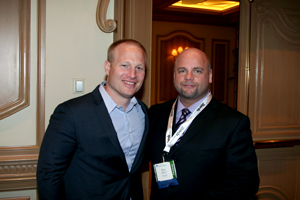
Leif Babin (left) with automotive digital marketing consultant Eric Miltsch
EXTREME OWNERSHIP
One of the most anticipated keynote speakers of the event was Leif Babin, a former U.S. Navy SEAL and co-founder of consulting firm Echelon Front, which specializes in leadership training. Babin talked about leadership and the performance of creating extreme ownership and a high performance winning team. He drew on his own combat experiences, which included duty in Al-Ramadi in Iraq, during some of the most intensive fighting witnessed in that conflict.
He described a situation when he and his team found themselves in a very precarious place, surrounded by heavily armed enemy forces and how they were able to turn the situation around.
Babin said that the key to surviving such problems was to focus on four core objectives — cover and move (as a team), simplify the objective, prioritize and execute the tasks at hand and decentralize the command structure.
In Ramadi, Babin and his team, by following these principles, were able to prepare for the worst possible scenarios, push the envelope and beat the odds. “Insurgent presence in Ramadi was so strong,” he said, “nobody thought we could win.” Nevertheless, the Americans were able to turn the tables and secure neighbourhoods one at a time. He said that by employing a seize, clear, hold and build strategy his team and other U.S. forces on the ground were able to earn the trust of the local people, who ultimately turned against the insurgents which caused enemy attacks to plummet.
“When I visited Ramadi almost three years later,” Babin said, “it was unrecognizable, there were kids playing in the streets, it had been rebuilt and it had become a normal city once again, where people were happy and free.”
He said that the lessons learned from his time spent in Ramadi could be applied to any situation, including our businesses. He said that when it comes to extreme ownership, “you own the solution to your problems.” Babin remarked that it was important to maintain continuous realistic assessment and to always look for ways at “doing it better.”
Babin said working together is absolutely vital and that “you are only as good as the individuals that make up the team.” He cited grueling boat races that formed part of SEAL training, where one crew consistently finished in the lead and another lagged behind. When both of these teams exchanged leaders, the losing team started winning — illustrating just how important it is to have an effective leader.
“Believe in what is possible to win,” he said, “set the standard and do not tolerate anything less than the best — remember it is not what you preach, it’s what you tolerate.”
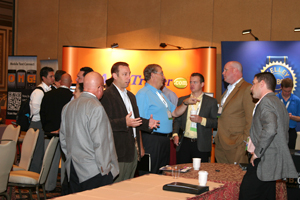
As always, DSES proved the ideal opportunity for dealers, vendors and other industry people to network and share ideas
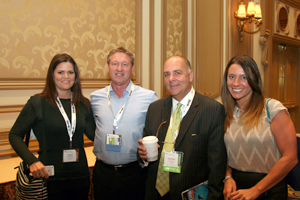
For many in the automotive retailing industry, DSES is seen as the must attend event of the year