Canadian dealers could play an important role in determining whether consumers embrace emerging Chinese automotive brands, according to new research from Clarify Group.
The Vehicle Buyer Opinion Study (VBOS), based on responses from 2,007 Canadians who purchased or leased a new vehicle within the past five years, explores consumer attitudes toward Chinese automotive brands as well as broader vehicle-shopping intentions and preferences.
“By speaking directly to Canadians that have recently gone through the vehicle purchase journey, VBOS provides very specific insights into what is truly impacting the consideration and decisions of Canadian car buyers,” said Darren Slind, President, Clarify Group.
The study was designed by Clarify Group and sponsored by Universus Media Group, publisher of Canadian auto dealer.
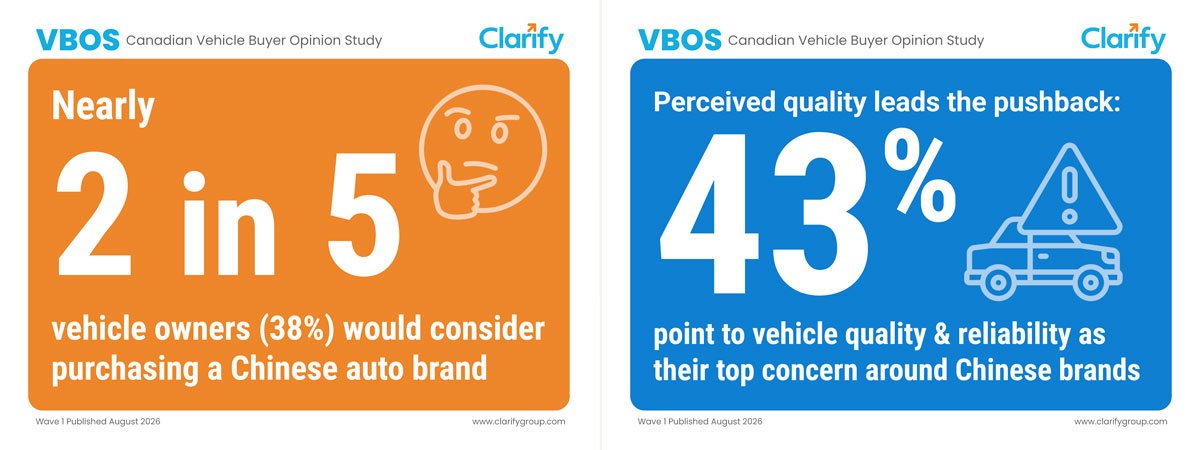
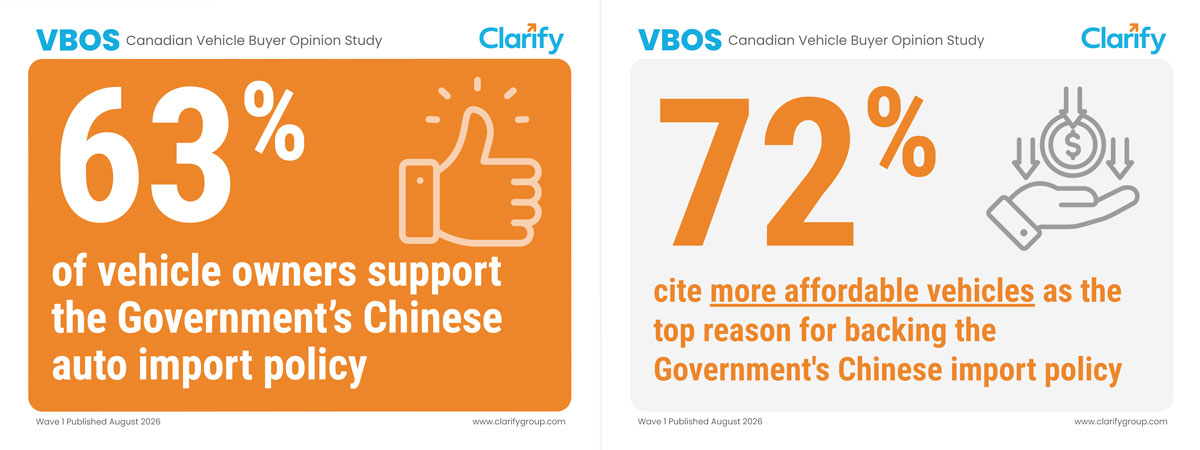
One of its headline findings is that 63 per cent of respondents support the federal government’s recent policy allowing limited imports of Chinese-made EVs, while 38 per cent would consider a Chinese automotive brand for their next vehicle.

Darren Slind
Affordability appears to be a major factor behind that openness. Seventy-two per cent cited more affordable vehicles as a reason for accepting Chinese brands, followed by greater competition and more choice, both at 61 per cent.
“Affordability is a big driver for Canadians these days,” Slind told Canadian auto dealer in a video interview discussing the findings. “So affordability is definitely a key theme that’s coming out in the study.”
But VBOS also identifies a significant challenge for companies hoping to establish Chinese automotive brands in Canada: many prospective buyers know little about them.
Nearly half of respondents — 48 per cent — could not recall the name of a single Chinese OEM brand.
Consumers also expressed concerns about quality and reliability, cited by 43 per cent; service and parts support at 40 per cent; lack of experience with the brands at 39 per cent; suitability for Canadian conditions at 36 per cent; and safety standards at 32 per cent.
Slind said those perceptions will matter as new brands attempt to establish themselves with Canadian consumers. “The Chinese brands do have some work ahead of them in terms of how they overcome — and the dealers that may represent them — how they overcome some of those concerns,” said Slind.
That is where the dealer findings become particularly significant.
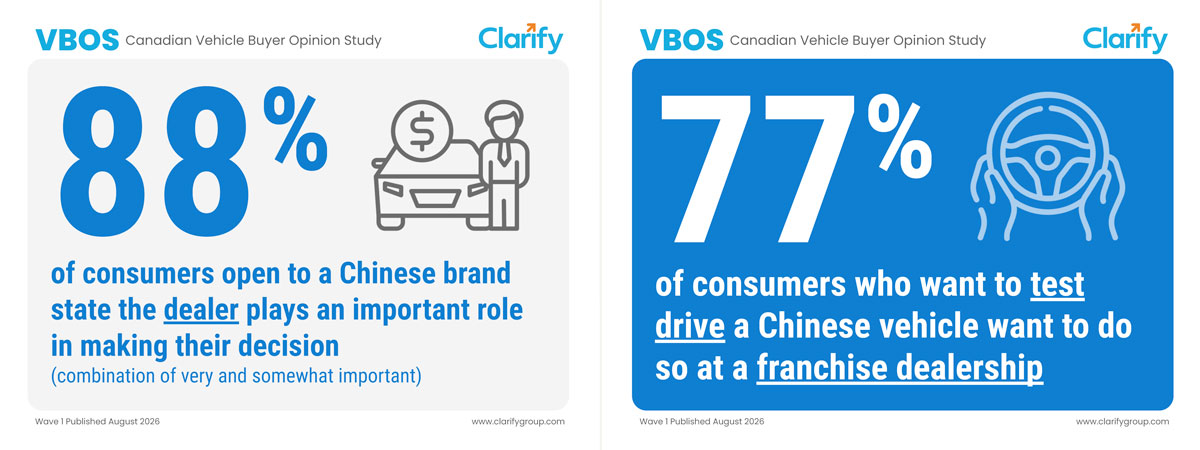
Thirty-nine per cent of respondents said they would likely consider a Chinese brand if their dealer began selling one. Thirty-seven per cent expressed interest in test-driving a Chinese-brand vehicle and, among that group, 77 per cent said they would prefer to do so at their local dealership.
Among respondents who indicated they would consider a Chinese OEM vehicle, 88 per cent said they would rely on their franchise dealer to help them make their decision.
Slind said that represents an encouraging finding for Canadian franchise dealers, particularly those contemplating whether to add one of the emerging brands.
“The statistic that we found that was quite compelling was that 88 per cent of Chinese vehicle considerers will consider the dealer to be either very or somewhat important in making their decision,” said Slind. “And then in terms of implications for Canadian dealers that are contemplating a Chinese vehicle franchise, obviously they have to lead with a really strong test-drive program.”
Niel Hiscox, CEO of Clarify Group, said the findings illustrate that dealers could influence consideration well before consumers arrive at the point of purchase.

Niel Hiscox
“These findings underscore the important role that dealers play in converting interest into consideration, but that work also needs to start further up the funnel as new brands enter the market,” said Hiscox. “Whether selling these new Chinese brand vehicles or competing against them, VBOS provides actionable insights for the industry at a time of great uncertainty.”
For dealers, that uncertainty cuts both ways. Some dealer groups are examining the potential opportunity presented by incoming Chinese brands, while others will ultimately compete against them with their existing franchises.
VBOS was designed in part to help answer those questions. Beyond the national findings, the full study examines consumer perceptions, purchase intentions and consideration across different regions and demographic groups, allowing dealers and OEMs to look more closely at how attitudes vary across the country.
Slind said those deeper cuts can produce significantly different results from the national averages.
“When you get inside that data, you start looking at all these variables by region, you see big changes on things like perception, intent and consideration,” said Slind.
The research also examines broader vehicle-purchase intentions, including timing, body style, powertrain and budget and payment preferences, along with perceptions of vehicles from different global regions.
The study was fielded between June 23 and July 10, 2026. Respondents were sourced from Leger Opinion (LEO), with nationally representative coverage by province or region, age and gender.
Dealers, OEMs and other automotive industry organizations interested in obtaining the full Vehicle Buyer Opinion Study or arranging a private briefing with the research team can contact Clarify Group or visit clarifygroup.com/vbos.