U.S. new-vehicle sales lost some momentum in July but continued to show resilience despite economic headwinds, according to Cox Automotive.
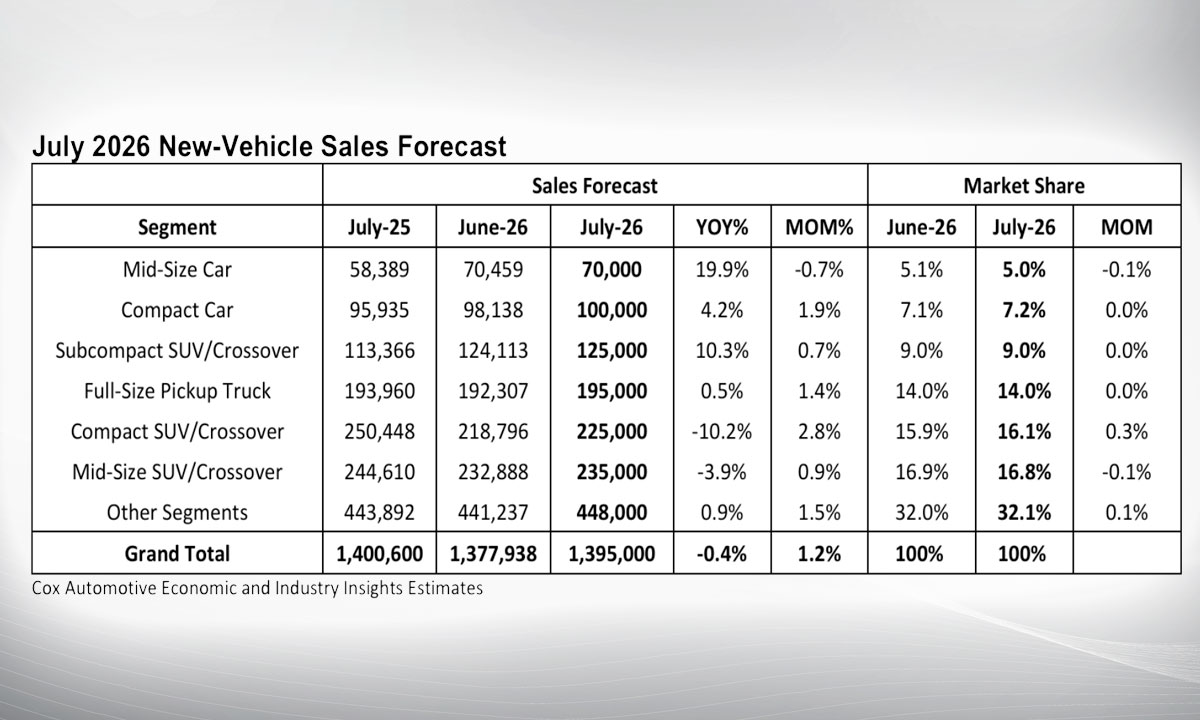
Initial estimates released by the company show July sales reached 1.36 million units, representing a seasonally adjusted annual rate (SAAR) of 16.3 million. The result fell short of Cox Automotive’s earlier forecast of 16.7 million and was down 1.8 per cent from July 2025.
Year-to-date, sales are tracking at a 16.0-million-unit pace, slightly ahead of the firm’s full-year forecast of 15.8 million.
Cox Automotive attributed the weaker-than-expected July performance primarily to softer retail demand. Retail sales declined 1.7 per cent year over year, while domestic truck sales also underperformed expectations. Fleet sales softened from June after posting gains of more than 10 per cent the previous month, suggesting some demand may have been pulled forward.
Despite the slower month, Cox Automotive said maintaining a 16.3-million SAAR amid economic uncertainty and five consecutive months of higher energy costs demonstrates underlying strength in vehicle demand.
Before July results were finalized, the firm had forecast the strongest sales pace of 2026, citing pent-up consumer demand and record stock market gains as key drivers.
“July sales are holding up despite significant economic uncertainty,” said Charlie Chesbrough, Senior Economist at Cox Automotive, in a statement. “Stubbornly high gas prices – with no relief in sight – and historically weak consumer confidence have not discouraged new-vehicle buyers, as might be expected. The market today is being driven by more affluent buyers, so they may be less impacted by inflationary pressures and economic uncertainty. If the economy and stock market can maintain their current growing but volatile path, vehicle sales will likely follow.”
Cox Automotive said July’s results point to a market that is moderating after a stronger-than-expected second quarter while remaining on track for a relatively stable second half of the year.