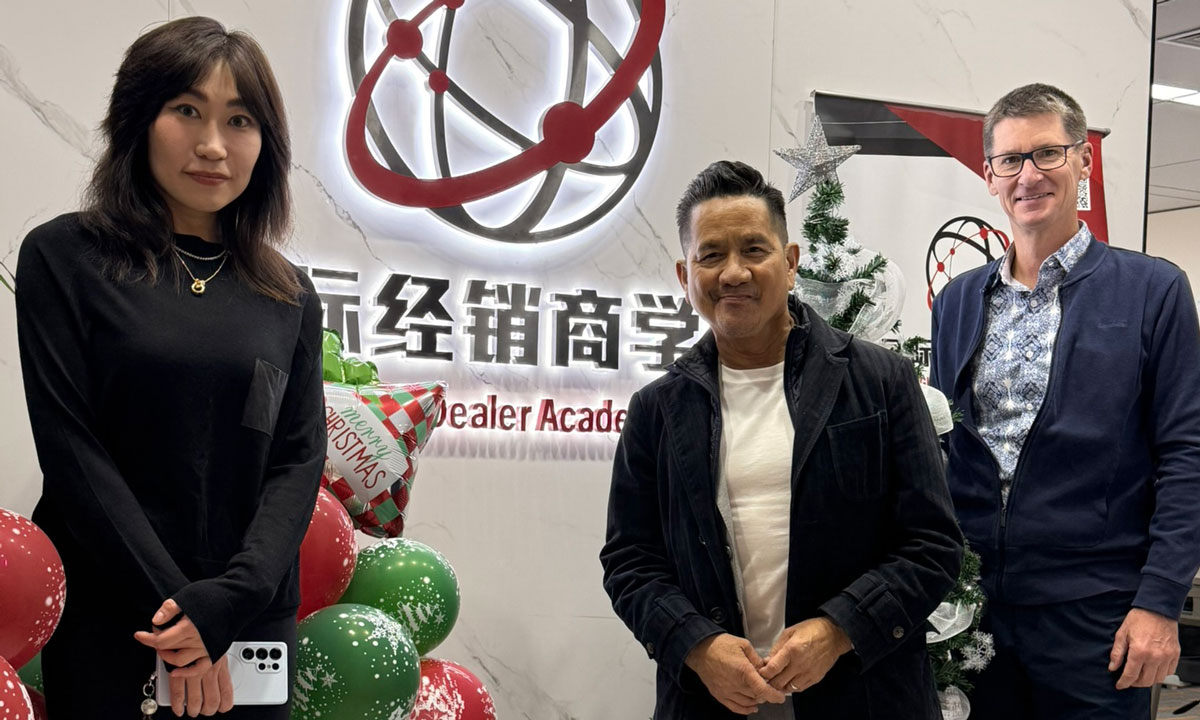
Justin Poy says Canada has something China’s fast-growing auto retail sector needs: decades of dealership management experience.
Through the Global Dealer Academy, Poy and his partners are working with Georgian College in Barrie, Ont., to deliver a licensed Canadian automotive retail curriculum in China, where many dealers are facing margin pressure, growing competition and the need to build profit beyond the new vehicle sale.
Poy is the Founding Partner and President of Canadian Operations for the Global Dealer Academy. The program was co-developed through his Hong Kong-based company, North American Automotive Alliance Asia Pacific Ltd., or NAAAAP, under an exclusive agreement with Georgian College’s Automotive Business School of Canada.
Poy said it was important for NAAAAP to be formally associated both with the Motor Vehicle Retailers of Ontario (MVRO) in Canada and the China Automobile Dealers Association (CADA) in Beijing. “Without both associations, this platform would have been challenging to establish in China,” he said.
Poy also brings more than 20 years of experience in Canadian automotive retail marketing through his role as President and Creative Director of The Justin Poy Agency.
The Global Dealer Academy is designed to train dealership leaders, managers and future automotive retail professionals in what Poy describes as the “mature market” model of dealership operations. That includes the full ownership cycle familiar to Canadian dealers: new vehicle sales, pre-owned, service, parts, F&I, retention, trade-ins and repeat purchase.
Poy’s understanding of the market was shaped in part by years of industry visits and exchanges involving Ontario dealer representatives, including activity connected to the MVRO and its relationship-building with the Chinese dealer association. Those visits gave Canadian industry participants a closer look at China’s rapidly expanding auto retail sector.
“The biggest shock we had was how they sell cars,” said Poy.
China’s automotive industry has advanced at extraordinary speed, especially in EVs and what the market calls new energy vehicles. But Poy said the retail side of the business has not always matured at the same pace.
He compares it to China’s mobile phone infrastructure. In North America, the telecom sector moved from landlines to mobile networks over a long period. China, by contrast, moved rapidly into digital and mobile systems without the same long buildout of landline infrastructure.
Poy sees a similar pattern in automotive. China did not spend generations developing a mass-market internal combustion retail model before moving into electrification. It moved quickly into new energy vehicles, with advanced products and technology, while parts of the retail model are still catching up.
That helps explain what may seem like a contradiction to Canadian dealers: China can be highly advanced in vehicle hardware, battery technology, connectivity and EV production, while still developing the dealership systems that support recurring revenue, fixed operations and full lifecycle profitability.
In China, Poy said, many consumers were buying their first-ever vehicle. Demand was strong, vehicles were moving, and dealerships could often operate successfully by focusing heavily on the sale itself. There was less immediate pressure to develop the same revenue ecosystem Canadian dealers rely on, including fixed operations, leasing, financing, pre-owned vehicle management, service retention and F&I products.
That model is now under pressure.
Poy said COVID, price competition and margin compression exposed weaknesses in dealership business models that depend too heavily on new vehicle sales. In Canada, dealers generally understand that the new vehicle transaction is only one part of the business. In China, he said many stores are still learning how to capture profit across the full customer lifecycle.
“Most dealerships in China now are deriving 90 per cent of all of their revenue from new car sales,” he said. “There’s no way we’d survive here if we did that.”
That is where the Global Dealer Academy is intended to fit.
The program includes Automotive Dealership Essentials, Dealership Management, New and Pre-owned Car Sales Management, and Parts and Service Management. Each completed course earns the student a certificate from Georgian Global (the international affiliate of Georgian College) and Beijing-based CADA. Participants who complete the full suite are considered fully certified under the program.
The Automotive Dealership Essentials course provides the foundation. It introduces dealership operations and the broader customer journey, including the “infinity loop,” a model that maps the ownership cycle from purchase through service, retention, trade-in and repurchase.
Canadian dealers may consider that lifecycle approach standard practice, but Poy said it is still a developing concept in parts of China’s retail auto market.
In many Chinese dealerships, he said, departments remain siloed. Service may not be closely connected to sales. Pre-owned may not be fully integrated into the new vehicle operation. Trade-ins may be treated as a problem rather than a profit opportunity.
For a Canadian dealer, that would mean letting a major part of the deal walk out the door.
Poy said the academy’s goal is not to tell Chinese dealers they are doing business the wrong way. It is to show how dealership models have evolved in mature markets and how those systems can help stabilize profitability when new vehicle margins tighten.
Building the program has required more than translating Canadian content into Chinese. The curriculum has had to be localized for the realities of the Chinese market, where leasing, insurance, F&I products and dealership processes can differ significantly from Canada.
The delivery platform also had to be built specifically for China. Poy said a standard North American learning-management platform would not work for regulatory, technology and user-behaviour reasons. In Canada, students are commonly tracked by email. In China, many users rely more heavily on WeChat. NAAAAP built its own proprietary platform to support the program digitally and at scale.
Scale is a major part of the strategy. Poy estimates there are roughly 20 million people working in China’s automotive retail sector who could benefit from this type of training. A classroom-based model, even across dozens of cities, would not be fast enough.
The first priority is to train dealership owners, senior leaders and regional managers who can become early adopters and internal champions. From there, the training can move deeper into dealer groups, some of which operate at a scale far beyond anything seen in Canada.
The business structure behind the initiative also reflects the complexity of operating in China. Poy said it is difficult to structure business, move money and operate across borders without careful planning. NAAAAP was established in Hong Kong, with a related operating structure designed to support activity in mainland China.
That complexity is one reason Poy believes Canadian companies need to be realistic about China. The opportunity can be significant, but the operating environment is not simple.
For Georgian College, the initiative represents an export of Canadian education and expertise. For Poy, that is one of the most important parts of the story.
Canada often thinks about exports in terms of natural resources, manufactured goods or vehicles. Poy said knowledge should be part of that conversation too.
“Why are we not exporting one of Canada’s greatest assets?” he said. “And that is our knowledge.”
Poy frames the opportunity as a form of exchange. China has advanced quickly on vehicle technology, new energy vehicles and manufacturing scale. Canada has decades of experience in dealership systems, customer retention, fixed operations, pre-owned, F&I and retail profitability.
In simpler terms, China has the hardware. Canada has the soft product.
As Chinese OEMs look outward, the next phase of competition may not only be about who can build the most advanced or affordable EV. It may also be about who understands how to sell, service and retain customers profitably over time.
That is where Poy believes Canada has something important to offer.
What Canadian dealers should know before doing business with China
As Canadian dealers explore relationships with Chinese OEMs, Justin Poy says they should be prepared for a business environment that operates very differently from Canada’s.
First, Canadian dealers should understand their own value. Chinese OEMs may bring advanced technology, competitive EVs and global ambition, but Canadian dealers bring local market knowledge and a mature operating model.
Second, dealers should sharpen their due diligence. Poy cautions dealers not to assume every Chinese OEM will operate like a familiar North American, Japanese, Korean or European brand. Parts supply, warranty support, service infrastructure, technical training, software updates and long-term OEM commitment should all be examined carefully.
Third, dealers should understand the business culture. In Canada, a first meeting often moves quickly from introductions to product, pricing and terms. In China, the early stage may involve dinners, social time and relationship-building before business specifics are discussed.
Finally, dealers should understand the practical challenge of getting business done across borders. Poy’s own experience setting up NAAAAP through Hong Kong illustrates that point. Operating in China may require careful attention to corporate structure, payment flows, government relationships, intellectual property, software rules and local compliance.
None of that makes the opportunity impossible, but it does mean dealers should not treat a China-related franchise discussion like a standard brand-add conversation. Poy’s advice is clear: Canadian dealers should bring confidence, patience and sharper-than-usual due diligence to the table.