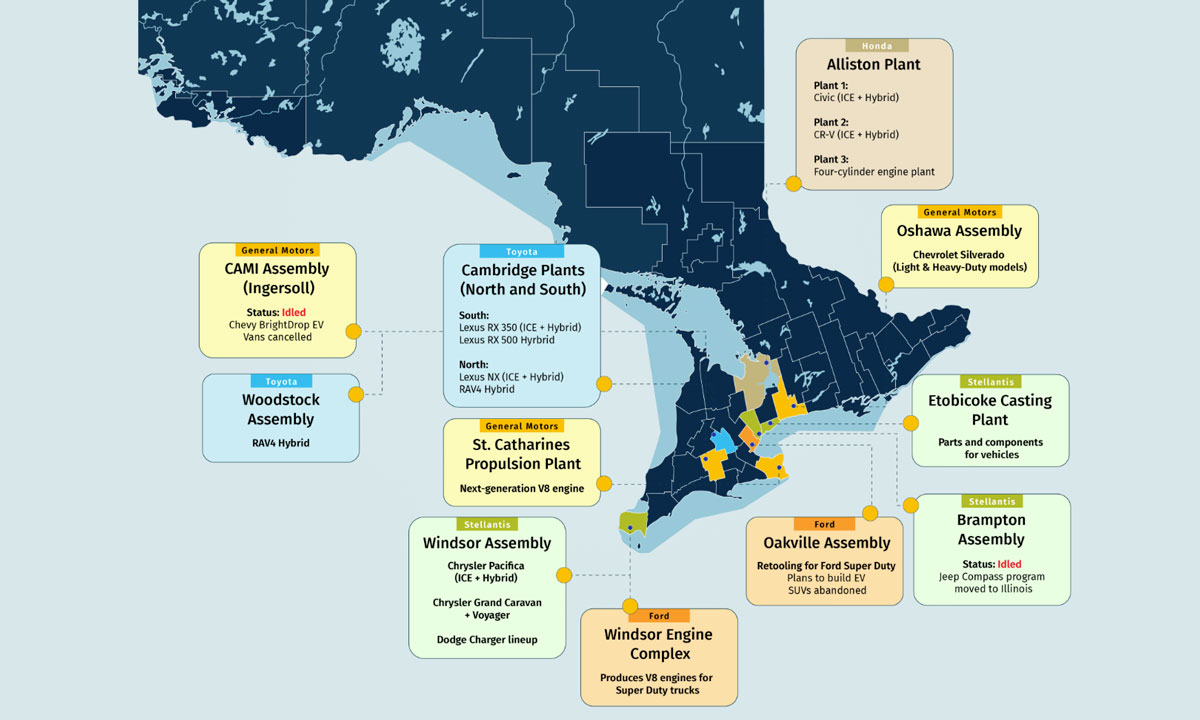
Canada’s automotive industry could either expand production to two million vehicles annually or lose assembly operations entirely by 2040, depending on trade policy, EV adoption and global competition, RBC Thought Leadership said in a new report examining the sector’s future.
The report, part of RBC’s Growth Project initiative, said the industry remains under pressure from U.S. tariffs, shifting supply chains and the rapid evolution of software-driven vehicle technology. Canada’s auto sector currently employs about 125,000 workers and represents roughly 10 per cent of the country’s exports.
RBC outlined four possible scenarios for the industry through 2040, ranging from a “Fast Lane” outcome where North American integration strengthens and Canadian production rises, to an “Off-Ramp” scenario where domestic assembly plants close entirely.
The report said slower-than-expected EV adoption is stranding billions in investments while advances in artificial intelligence, autonomy and software are reshaping where value is created in vehicle manufacturing.
“Vehicles are becoming technology platforms, with a growing share of value embedded in software, electronics, batteries, and systems integration,” the report stated.
RBC also highlighted the growing threat posed by Chinese automakers, which surpassed Japanese rivals as the world’s largest vehicle sellers in 2025 after expanding global market share to roughly 35 per cent over the past 25 years.
The report said Canada’s long-term competitiveness will depend on preserving tariff-free access to the U.S. market, strengthening critical mineral supply chains, expanding clean energy infrastructure and attracting higher-value software and engineering mandates.
RBC warned that focusing only on assembly volumes could leave Canada vulnerable as automation and software increasingly determine automotive value creation.