
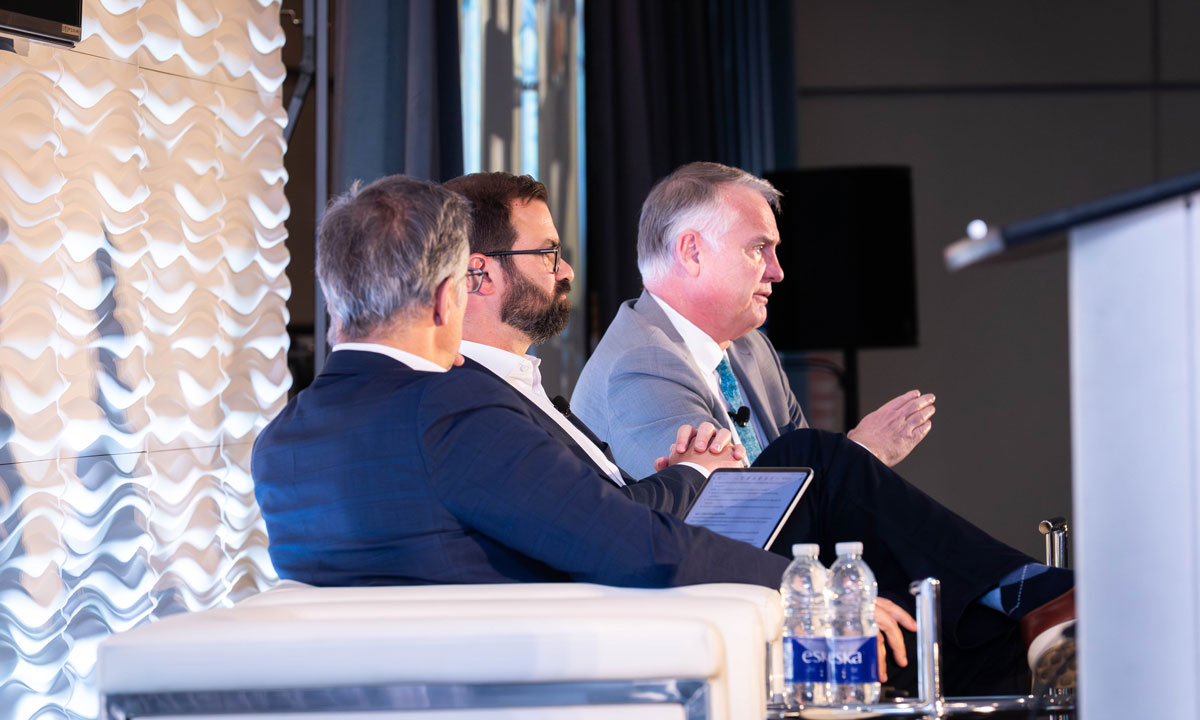
As Canadian dealers prepare for the imminent arrival of Chinese automakers, a standing-room-only international panel at the CADA Summit offered a timely preview of what that transition can look like on the ground.
Moderated by Neil Hiscox, publisher of Canadian auto dealer, the session brought together Tim Reuss, President and CEO of the Canadian Automobile Dealers Association (CADA), and James Voortman, CEO of the Australian Automotive Dealer Association (AADA), which represents Australia’s 3,700 franchised new car and truck dealers.
Voortman’s remarks drew particular attention from Canadian retailers looking for early insights into how Chinese OEMs enter a mature market, how they behave, and what the longer-term implications may be for dealers and consumers.
Australia’s rapid shift
Voortman said Australia’s divergence from Canada accelerated after domestic vehicle manufacturing ended in 2015, fundamentally changing the industry’s structure and opening the market further to global competition.
Australia’s long-standing economic relationship with China has also positioned it at the forefront of China’s automotive expansion. Voortman said Chinese brands have moved from a negligible foothold to a major force in a remarkably short period.
“Particularly in the last five years we’ve seen growth from 0.2 per cent to 20 per cent of the market coming from China,” said Voortman, describing rapid brand proliferation and intensified competition.
Voortman told delegates that, so far, many dealers have benefited from the influx of new Chinese entrants, particularly through increased product choice and affordability.
He said the arrival of the Chinese OEMs helped dealers with profitability, but cautioned that the current upside may not be permanent. He warned of two structural risks: legacy brands potentially exiting as competition intensifies, and consolidation within China itself that could see some new entrants withdraw from export markets.
“What does that mean for dealers, but also for consumers who purchase those vehicles?” he asked.
Reuss said CADA has closely studied Australia’s experience as a potential case study for what can happen when a country’s manufacturing footprint weakens and market access broadens.
Last summer, Reuss said CADA raised what it called the “Australia scenario” directly with U.S. politicians and trade officials, arguing that if Canada cannot sustain a vibrant manufacturing base, it could face similar pressures toward greater openness in the name of affordability.
Reuss also addressed Canada’s recent quota-based adjustment allowing the import of some Chinese-made EVs, tied to Chinese retaliation on agricultural exports, emphasizing that it was driven less by auto policy than by broader trade realities. He noted the initial quota is capped at 49,000 vehicles, with modest growth over five years.
Voortman suggested that even limited openings can quickly create consumer expectations, especially if Chinese products deliver strong value.
“The Chinese really do deliver products at a much superior price point,” he said, adding that once consumers gain access, restricting supply could become politically difficult.
Canadian dealers were also keenly interested in whether Chinese OEMs will embrace the franchise model. Voortman offered a clear observation from Australia’s experience.
“Without fail, every single one of them has decided to employ a franchise model in Australia,” he said, including brands that have pursued direct-to-consumer approaches elsewhere.
He said the franchise choice reflects both speed and risk-sharing, allowing OEMs to tap dealer expertise while scaling quickly.

Both Voortman and Reuss acknowledged that early-market behaviour can involve friction and learning curves. Voortman cited shifting incentive programs, regulatory misunderstandings and the absence of formal dealer councils as areas of concern.
“We do not have one Chinese dealer council in Australia,” he said, calling that an important issue for dealer representation.
Reuss said CADA has been engaging directly with prospective entrants to reinforce Canadian franchise norms, including contract consistency and protections around market exclusivity.
A recurring theme was the importance of dealer caution when selecting new partners. Voortman advised dealers to spread risk and assess ownership structures, profitability and long-term commitment.
He also flagged aftersales as a potential weak point, noting some Chinese brands have been marked down in dealer satisfaction surveys for inadequate parts and service investment.
The panel closed with a broader reflection: Chinese OEM entry is increasingly viewed as a question of when, not if. And dealers will need information, partnerships and global intelligence to navigate it.
Reuss said CADA is planning further dealer education, including upcoming China study tours with dealers, while Voortman emphasized the value of closer international association collaboration.