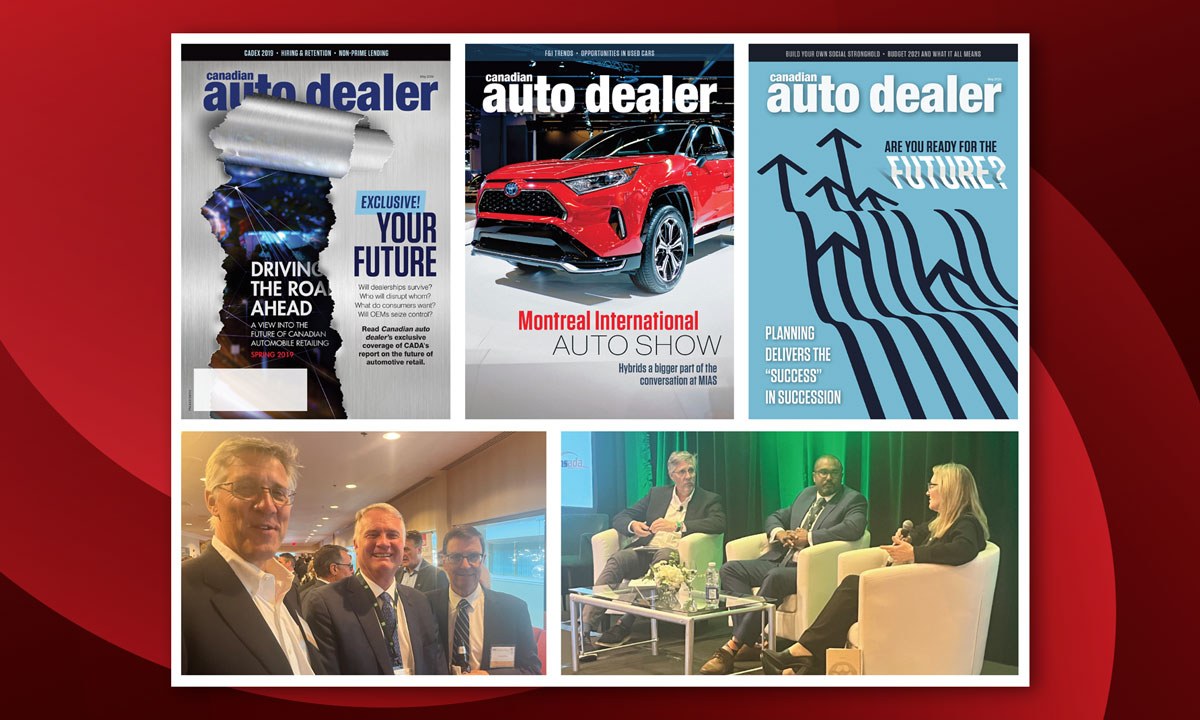
This is a big year for our team. Our baby is turning twenty.
When we mailed the very first issue of Canadian auto dealer in late 2005, the world we wrote about looked and felt very different. The hot topics were “employee pricing,” record gas prices, and a brand-new Toyota assembly plant announced for Woodstock, Ontario. Most Canadians were still buying cars, not crossovers. Hybrids were exotic.
And yet, in some important ways, nothing has changed at all.
Back then, Canada was selling around 1.6 million new vehicles a year. Today, after the ups and downs of a global financial crisis, an oil-price rollercoaster, and a pandemic, we’re back in roughly the same volume range — and moving higher again. The numbers move, but the core of the business is remarkably familiar: franchised new-car dealers spread across every region of the country, turning metal and technology into mobility and livelihoods.
If you looked at the top of the sales charts in 2005, you would recognize many of the names. The Detroit Three still held the lion’s share of the market, but Toyota and Honda were growing quickly. Fast-forward twenty years and the leaderboard has changed less than you might expect, but the picture around it has changed completely.
Instead of compact cars and minivans, the chart is dominated by compact SUVs and crossovers. Trucks and utility vehicles now account for almost nine out of ten new vehicles sold in Canada. In 2005, they were just under half the market. In other words, the “car business” has quietly become the truck and crossover business.
The technology story has shifted just as dramatically. When we launched this magazine, the big environmental news was a voluntary greenhouse gas agreement between Ottawa and the automakers. It was the Kyoto Accord era, and regulators were still deciding how to tackle vehicle emissions. The Prius and the Civic Hybrid were the poster children for fuel efficiency, and you could count the number of plug-in vehicles on Canadian roads on one hand.
Today, roughly one in seven new vehicles registered in Canada last year was a battery-electric or plug-in hybrid. We know now — which we certainly didn’t twenty years ago — that the future is electric. But we also understand that the path to that future will take time. It will not be uniform in its adoption, either by segment or geography. We’ve moved from federal and provincial EV mandates to the recognition (we hope, and I believe) that we can’t mandate an unrealistic schedule to reach that future.
The retail experience has transformed even more.
In 2005, having a website and some online classifieds was considered progressive. Most customers still flipped through the Saturday newspaper and visited two or three showrooms before making a decision. Marketing plans revolved around newspaper ads, radio schedules and television spots.
Today, many customers arrive at your store with a specific vehicle already in mind, a payment-calculator screenshot on their phone, and a pre-approval from an online lender. They have watched walkaround videos, read online reviews, compared insurance quotes and even configured payment plans before setting foot in the dealership. Your website, CRM, digital retailing tools and data feeds are as critical as your showroom tile and service drive.
And yet, when I think about the past twenty years of Canadian auto dealer, the constants stand out as much as the change.
First, the franchised dealer model has proved remarkably resilient. Over the years we’ve heard predictions that direct sales, subscriptions, online-only retail and other new approaches would disrupt dealers out of existence. Instead, dealers have absorbed each new wave of change and added it to their toolkit. You’ve incorporated online retailing, built EV-ready facilities, learned to handle over-the-air updates and software-defined vehicles, and continued to sit at the centre of the customer relationship.
Second, this is still a people business. Our earliest issues talked about succession planning, recruiting technicians and building strong management teams. Those topics could be lifted straight into this anniversary edition without changing much more than the dates. The tools have evolved — from newspaper classifieds and faxed résumés to LinkedIn, online job boards and immigration programs — but the challenge is the same: finding, training and keeping great people.
Third, dealers remain economic and social anchors in their communities. Twenty years ago we were already highlighting the automotive sector’s contribution to Canadian GDP, tax revenues and employment. Today, CADA’s economic-impact work confirms just how significant your contribution has become. New-car dealers support hundreds of thousands of jobs and tens of billions of dollars in GDP. You sponsor arenas, festivals and fundraisers. You provide some of the best-paid skilled trades and sales careers in your towns and cities. That has not changed; if anything, it has grown.
Finally, your ability to adapt is still your biggest competitive advantage. New OEMs, new propulsion systems, new regulatory pressures, new capital structures and new customer expectations keep arriving, and dealers keep doing what they have always done: showing up every morning and figuring out how to serve their customers better than anyone else can.
As we celebrate our twentieth anniversary, I am incredibly proud that we’ve been able to tell your stories through all of this change. From that first issue in 2005 to this one, our mission has been simple: to help Canada’s new-car dealers navigate a business that never stops changing.
Thank you for reading, for challenging us, for supporting us, and for letting us be part of your world for the past twenty years.
We look forward to telling the next chapter of your story.