DEALER DEBATES, MARKET TRENDS AND EFFICIENT MOBILITY
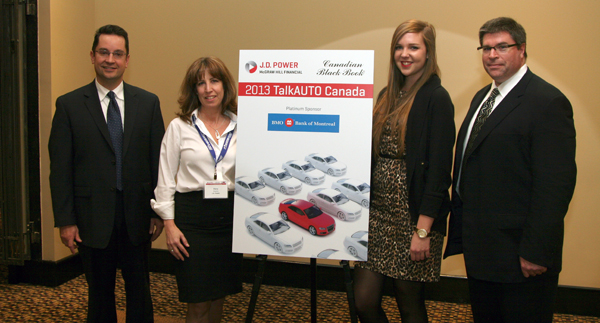
Following on from Mike Nieuwkuyk’s presentation, was Josh Bailey, vice-president, Research and Editorial with Canadian Black Book, who gave an overview of Canadian vehicle market trends.
Bailey started out talking a little about the company and its expansion from traditionally a wholesale business into the retail side of the market in the last few years. In terms of market observations regarding used vehicles, Bailey said that with vehicles lasting longer, the market is placing more emphasis on residuals for older cars (7-8 years). He said that over the last decade he’s seen changes in depreciation rates. “Generally speaking, it used to be pretty linear,” he said. Following the recession of 2008-09 however, he’s seen dramatic changes with much greater fluctuation.
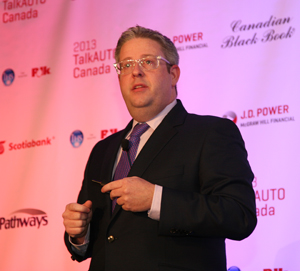
Josh Bailey
He said that currently, the market for used vehicles remains undersupplied and that it will be some time before we see a situation where stocks are plentiful. Bailey said that rising fuel prices are likely to continue placing emphasis on compact cars, making larger vehicles such as trucks, harder to sell. He also said a potential concern relates to the job market in Canada and how that could impact vehicle sales. He said it’s not so much about employment numbers but the “quality” of that employment. “We have more people in positions where they are working part time or on contract,” he said. “If there is any hiccup in the economy, those people are susceptible of being let go. The rosy number (the government portrays) therefore isn’t really a rosy number.”
HEARTY DEALER DISCUSSION
One of the key highlights of the inaugural TalkAUTO event last year was the dealer discussion panel. And, considering that lively debate and audience interaction is often a good thing, it probably wasn’t surprising that it returned for a second time.
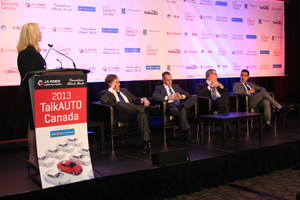
Dealer discussion panel proved lively and in-depth
Moderated by Allison Goodwin, director of Pre-Owned Vehicle Services at Roy Speed & Ross, this year’s panel consisted of Christopher Pfaff, president of Pfaff Automotive Partners, Shawn Morris, vice-president of operations, Grand Touring Automobiles, Hugh Sisley, owner and president of Sisley Honda and Francesco Policaro, general manager, Porsche Centre Oakville.
Lasting for almost an hour, the discussion covered topics ranging from technology challenges, to the importance of used car operations, transparency and the changing role of salespeople.
All the panelists acknowledged that changes are happening in the car business like never before and that customer expectations are higher than ever. Christopher Pfaff said that in terms of technology in today’s vehicles and being able to show customers what features a vehicle has, it’s important for the dealership to plan a time that’s convenient for both the store and the customer. Pfaff says the group’s stores have tackled this by placing a strong emphasis on appointment times and second deliveries, with dealership staff able to go to a customer’s house or place of business.
Shawn Morris said that such practices can also help foster a more personal (and personalized) relationship with the customer, especially when the dealership is able to take that service to the next level by going to the customer’s residence and taking the time to go through the features of the vehicle with them.
Hugh Sisley said that today, even customers shopping for mainstream vehicles, have high expectations as much as luxury buyers. He said that while grosses on volume vehicles don’t usually permit personal follow up experiences, the second delivery process is still critical and stores can invite new customers back for a second delivery workshop. He said it’s important, since when most customers pick up the car they just don’t have time nor often the inclination to be explained all the features the vehicle has.
Francesco Policaro said it was important for dealers to be able to understand different personalities when it comes to customers and to tailor an experience that is appropriate to them. He noted that some might prefer having dealership staff come to them, while others prefer to come into the store for a workshop. He said that dealers who operate multiple franchises can take advantage of the fact that much of the technology within vehicles is very similar, so inviting customers who’ve purchased different brand vehicles collectively to a workshop can also be a good way in explaining how a specific technology works.
A big shift that’s happened in the industry over the last 25 years, especially in terms of franchised dealerships, has been the growth in the used car market. Christopher Pfaff noted that when he started in the business in the mid-1980s, his father’s store was 90 per cent new vehicles. “It’s become a great opportunity,” he said. “It sells more parts and it sells new cars.”
Certified Pre-Owned (CPO) cars have become increasingly important for many dealers when it comes to their used inventory. Francesco Policaro said the onus is on stores to re-condition vehicles before they sell them not afterward. He said it was important to treat customers the same way whether they’re buying new or used and that CPO customers can contribute significantly to service retention.
Shawn Morris said there has been a growing emphasis on used vehicles because dealers have 100 per cent control over the process and that it feeds all other departments at the store. “For us, used cars are part of our strategic plan,” he said. “The biggest challenge we have is that we need to be more focused on the retail side (as opposed to wholesale) and trade-ins.”
Hugh Sisley noted that at his store, the grosses on used cars make them an attractive proposition (.6 to 1 ratio of new versus used). Nevertheless, he said that the business is challenging. He noted that today there are so many different channels that impact used prices and because CPO programs vary so much between manufacturers, it can be difficult for dealers to understand them, let alone customers.
In terms of transparency and the changing role of sales staff, all the panelists acknowledged that it was more about consultation and meeting the customer’s needs than simply making sales. “Don’t try to know more than the customer,” said Shawn Morris. “With today’s technology you don’t know what they know. You need to listen, understand them and try to emotionally connect with them — both the core value of the brand and the dealership.”
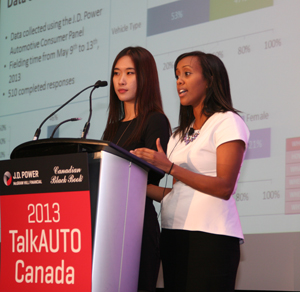
Melissa Gu and Sarah Mebrahtu
AUDIENCE QUESTIONS
A major highlight and a source of interest for the discussion panel this year were the audience fielded questions, which covered topics ranging from dealership consolidation to long term financing. Where the latter was concerned, the panelists acknowledged that longer term finance contracts are not good for the industry, nor ultimately for customers, fueling negative equity and reducing the ability for customers to trade vehicles. Hugh Sisley labeled the practice “suicide,” while Francesco Policaro said that such contracts don’t take into account changes in customers’ circumstances or lifestyle. He said that even today, for stores like Porsche Centre Oakville “the holy grail” is still 24-48 month leases.
An interesting presentation was given by the two winners of the J.D. Power and Georgian College Research Analyst Program — post graduate students Melissa Gu and Sarah Mebrahtu. As a result of their efforts, Gu and Mebrahtu were offered the chance to speak at TalkAUTO this year, presenting findings from their research on Canadians and Fuel Economy: The Dollars and Sense. They analyzed and discussed topical issues facing the industry today, such as early buyer behaviour, technology adoption among consumers and the perception of fuel economy among Canadians.
EMPHASIZING ELECTRIC
This year’s keynote session was electrifying, literally, as Eduardo Villaverde, president and CEO of BMW Group Canada, talked about future mobility. He explained about the growth in the global population, how it will impact the planet’s resources, not to mention the ability for large companies to conduct business.
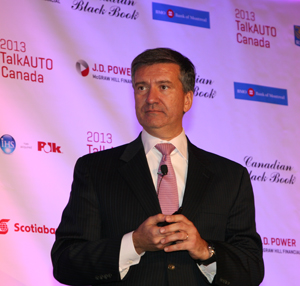
Eduardo Villaverde
He noted that despite efforts to cut global emissions they continue to rise and those from vehicles remain a major part of the problem, especially in the world’s megacities. He talked about a major shift happening in the concept of personal mobility, where, among consumers, the idea of efficiency and minimizing environmental impact are becoming ever more important.
Closer to home, Villaverde said that in traditionally car-oriented Canada, such a shift is happening too. “Seventy-two per cent of young Canadians are prepared to go into mobile transportation — a combination of going from A-B via bus, bicycle or car or car sharing,” he said. “That compares to 33 per cent of Canadians aged 45 or older.”
He talked about rapid population growth in places like Toronto and how that is going to impact transportation needs. And it is these needs that are fueling demand for electric vehicles.
Unveiling the battery electric BMW i3 for the first time in Canada, Villaverde said that for BMW, this vehicle represents the future, not only in terms of product but also service.
He referenced such features as a personalized purchasing process, home charging, partnerships with public charging station operators and a DriveNow car sharing program. The i3 is scheduled to go on sale during the first half of 2014.
Following Villaverde’s speech and a chance for attendees to get a good look at the i3, the afternoon breakout sessions got underway.
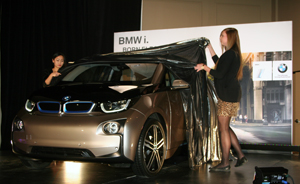
BMW’s new all electric vehicle, the i3, made it’s official Canadian debut at TalkAUTO
This year, there were four to choose from under two timeslots, which gave attendees the chance to attend one during each slot (1.45 pm and 2.45 pm). The sessions were A Generation Apart: Understanding the Next Generation Buyer; Under the Couch Cushions: Retail Growth Opportunities; Using Media to Your Advantage and It was the Best of Terms, It was the Worst of Terms, Long Term Auto Financing in the Canadian Market.
Canadian auto dealer had a chance to attend two of the sessions. In A Generation Apart: Understanding the Next Generation Buyer, presenter Kurt Tiltack, managing partner and Toronto-based management consulting firm Pathways Inc. talked about the generational divide and how those in business today need to learn to connect with younger buyers. He asked the audience to split into groups and write down key factors that came to mind to define the four generations who are active consumers today (traditionalists, Baby Boomers, Generation X and Generation Y).
Tiltack said there are certain events in history and culture that each group identifies with and it’s important for us to appreciate them and be able to connect with others on that level, as that is key to driving relationships and also business.
CAN WE RECOVER?
Brian Murphy, senior manager, Power Information Network, Canada, J.D. Power, talked about the impact of long-term auto financing on the industry. He said that the current culture of longer contracts and lower payment terms is not only fueling negative equity but for dealers it also presents issues in terms of loyalty. He said that with people keeping cars longer there is greater risk for dealers in losing customers, whether for service or buying a new car, since history shows that after five years, customer loyalty towards a dealership tends to fall off rapidly.
He said that when interest rates rise, manufacturers will no longer be able to afford to offer incentives that run up to 15 per cent of the value of a vehicle and that buyers will tighten their belts, essentially creating a perfect storm. “We need to consider whether this is the right thing to do,” he said, arguing that for dealers, offering 96 month financing means they are essentially shooting themselves in the foot.
In terms of potential solutions, Murphy referred to the successful business model employed by many luxury brands — short term leasing. “Leases are fantastic,” he said. “A customer acquires a car for less money with a warranty. The dealer gets a pristine car back for CPO use and they turn around and offer the customer a brand new one. It is a fantastic business model, provided you can deal with residual value risk. It is fantastic for consumers, for dealers and for the industry as a whole.”