A shortage of young, qualified people is a major issue affecting the auto business today. Yet, if dealers can throw support behind school and college training programs, the future can
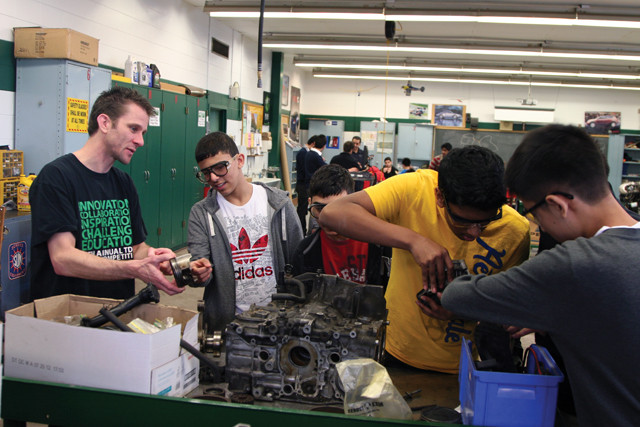
Joel McDonald teaches students at Agincourt Collegiate
Today, it can be argued that our industry faces more challenges than at any time in its history. There’s greater competition among dealers and manufacturers for consumer business, both in terms of vehicle sales and service, plus there are more regulations than ever before to contend with. For many dealers, slimmer profit margins are also requiring new (and creative) approaches for generating revenue. Yet perhaps an even bigger challenge is where the next generation of good people is going to come from. Many dealers we’ve talked to have said there is a huge shortage when it comes to qualified people and they are sorely needed if the industry is to continue to prosper in the future. Furthermore, with many schools cutting back on automotive programs and less government support funding education that provides the skills and tools necessary for a successful career in this business, the situation doesn’t too look good.
DEDICATED PROGRAMS
There is hope, however. In the last 25 years we’ve seen the development of Canadian programs specifically tailored to students for pursuing successful careers in the automotive industry. The Automotive Business School of Canada (formerly the Canadian Automotive Institute) at Georgian College, in Barrie, Ont. comes to mind. Founded in 1985, the school has become the premier provider of management based courses tailored to the auto industry and works with OEMs, organizations and dealers to prepare students for successful careers. The program includes a full-time two-year diploma in Automotive Business, a full-time Bachelor of Business, Automotive Management four-year degree, as well as a Certificate of Achievement — Automotive Studies — Sales Leadership (a part-time credit program, designed either for those already working in the industry to further their skills, or for students aspiring to a career in the automotive industry). The part-time programs are designed so that students are able to maintain their current jobs and receive academic credits for the courses they complete.
Georgian’s full-time programs incorporate co-op terms, leveraged from the school’s relationships with manufacturers, industry organizations and dealers. These paid terms are structured so that by the time students graduate from the program, they will already have a total of one year’s real work experience under their belt, making them well prepared as they embark upon their careers. Georgian itself is Canada’s largest co-op college and in the automotive program, the school says that over 70 per cent of students who’ve completed the course find full-time positions with one of their co-op employers upon graduating. Canadian auto dealer talked with some of the students about why they choose the auto business as their career path and what they hope to achieve.
 Kevin Leung, who is on the two-year diploma program, also works as a marketing assistant for the school. He says he’s always loved cars and the networking opportunities the program presents. “Our co-ops give us a chance to work with what could be our future employers, if we connect with them and we work hard, they can often hire us or refer us to others. It makes me feel happy that I will find a career in the future, that I won’t be stuck.”
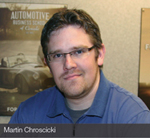 Martin Chroscicki, enrolled at the school as a mature student, having already worked at an automotive repair shop, a dealership and then an automotive supplier. He heard about the two-year diploma through his job and signed up. “I can’t say enough, I really enjoy the program. I’m thinking of switching to the four-year degree and that will help build a better job placement for the future. There are a ton of jobs out there,” he says. “I hope to do on-road sales and perhaps own my own store some day.”
 Farhan Khalid, who actually hails from London, UK, did a level 2 IMI program with Jaguar Land Rover at 16 and then went on to become a certified light vehicle technician. He had the opportunity to further his education in Canada and heard about the Automotive Business School of Canada. “I’d already worked on the technical side and wanted to try something different.” says Khalid. The Automotive Business diploma has provided tremendous opportunity. “I worked as a product specialist at the [Canadian International AutoShow] for Kia, it was great that I got the opportunity.” Khalid says what he likes about the school is that it is focused on bringing a level of professionalism to the industry. He said that once he finishes his studies he’d like to become a service manager. “It’s an ideal role for my experience,” he says.
 Chanelle Gonthier, who calls Montreal home, comes from an automotive background and loves cars, business and people. “I’m in the four-year degree program,” she says. “I like the fact that we get to meet so many people in the industry. With a general degree you don’t get the same opportunity.”
 Rob Scott, who is also in the four-year Bachelor of Business with a major in Automotive Management, says he likes that it is a university degree program but in the smaller setting of a college. “Everybody on faculty knows you,” he says. “There is just so much opportunity to go above and beyond. It’s one thing to have a business degree and get a job. It is another to graduate with a degree that has a major along with real work experience. It makes you that much more competitive in the job market.”
HANDS-ON
On the technical side, with cutbacks in technical training programs through colleges, and high schools doing the same with shop classes, a shortage of young blood is proving an increasing problem in fixed operations, whether in vehicle service or collision repair. Yet, for those students that do take the plunge, the results can be very rewarding. Take the case of Hansen Cao and Huzaifa Misbah. Both young men are high school students from Agincourt Collegiate in Scarborough, Ont. enrolled in the school’s automotive technical program. Cao and Misbah participated in this year’s Toronto Automotive Technology Competition, which coincided with the Canadian International AutoShow.
Competing against two-person teams from 16 other high schools, the two were declared the overall winners. As a result they have both received scholarships to Centennial College to further their studies and have also secured a place in the National Automotive Technology Competition in New York, which takes place this April. There, Cao and Misbah will be representing Canada against teams from all over the U.S. The stakes are high but both young men come across as very excited, despite the intense pressure they’ll face.
Misbah says that automotive technical training wasn’t his first choice when he enrolled in high school. “I wanted to be an engineer but when I took the grade 10 automotive shop class and met my teacher Mr. [Mark] Solomon, it was really hands-on and I enjoyed that.” He says that Hansen Cao has been a big influence and it was Cao who inspired him to get involved with the skills competition. “In grade 11 we had Mr. Joel McDonald as our teacher. I originally saw it as an extra class, but I found the way in which we did the training [using donated and actual working vehicles] was very rewarding.”
Cao says that technology is his passion but like Misbah, until he took the Grade 10 shop class at Agincourt, he wasn’t really sure of the exact career path he wanted to take. “I have to blame Mr. Solomon, he really showed me a new way of learning — how an engine works, doing oil changes, wheel balancing etc.” This year was actually Cao’s second time in the Toronto skills competition, “the first time I competed we finished seventh overall, out of 20 teams,” he says. “This time there were 17 teams and Huzaifa and I finished first — it was an excellent feeling.”
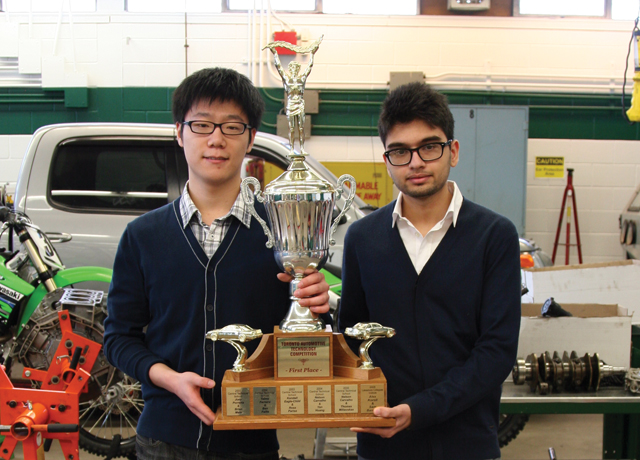
Agincourt Collegiate students Hansen Cao and Huzaifa Misbah, pose with their award for winning this year’s Toronto Automotive Technology Competition
Both Cao and Misbah are shining examples of how today’s youth can really make a difference to the future of the automotive service industry and are blessed by strong support at the high school level. Mark Solomon, who is department head of technology at Agincourt, is a qualified master technician himself, having spent many years working at a Nissan dealership. However, he felt his future lay in teaching after a co-op student at the dealership pointed out one day that “I would make a better teacher than what he had at school.” Solomon says that his new career has proven very rewarding. “You get to help students in so many ways. We work hard but I love what I do. Running a department, I want to make sure that we really learn stuff that is relevant to the vehicles and the industry. This is an academic school (one of the top five in the Toronto District School Board). We have national, award-winning programs in science, math and music, so why not vehicle technical training?”
SUPPORT AT THE DEALER LEVEL
While it’s encouraging to see young people enthusiastic about the industry, providing the support to enable them to succeed is critical, today more than ever. And a good deal of that support comes from dealers, who partner with institutions on co-op
programs, hire graduates and donate vehicles, tools and equipment to schools to help the students learn and take part in competitions such as the TATC. Mark Bozian, CEO of the Brimell Group (which includes Brimell Toyota Scion in Scarborough, Ont.), says its important to reach out and get these kids involved. “It’s important for the community we represent,” he says “and important because they are the future.” Bozian and his staff have partnered with the ACE (Academic and Career Entrance) employment program in Ontario, which connects both youth and adults who haven’t finished high school with businesses that are willing to provide them with the opportunity to learn.” The programs typically last six to eight weeks and at the end, Brimell Toyota or the Brimell Collision Centre do their best to hire students as permanent staff. Bozian says that it is important for dealers to showcase the opportunities
available in the auto industry. “You can make a tremendous living in this business,” he says “but it requires a holistic approach to convey the message. I’ve encouraged fellow dealers to get involved. It does take work but when you see what can happen when students you support win national competitions, it’s incredibly rewarding.”