Today, more franchised dealers are looking at the used car market and armed with new strategies and tools, the opportunities to boost business have arguably never been better

For franchised dealers, volatility in the new vehicle market over the last few years has been enough to give anyone the jitters. While the auto industry has weathered the economic storm fairly well, reflected in recent sales numbers which rank among the best on record, a combination of lower profit margins on new vehicles and fewer lease buyers means many dealers are having to look elsewhere to maintain and grow their business.
One area which has seen renewed interest among franchised stores is used cars and there are several reasons for this. Firstly, quality improvements mean that the average car or truck lasts far longer today than it did 20 or 30 years ago, potentially resulting in more transactions over the course of its lifetime. Secondly, tools are available today that can take much of the risk out of the used car buying and selling process, meaning dealers can be armed with the information and ability to buy the best cars for their market, minimizing turnaround and maximizing profit at sale time.
CONSISTENT MARKET
Industry observers have noted that over the last few years, the used car market has remained fairly consistent. Last year there was talk of a shortage of used vehicles occurring in 2013 but so far it hasn’t really materialized. One trend that has been noted, certainly at auctions is that consignment volumes continue to grow. Sources Canadian auto dealer talked to said they are up year after year and that has increased because more dealers are becoming aware of the processes to maximize the bottom line. Another trend, is that dealer groups have continued to grow in size and number, enabling them to take a more sophisticated approach to remarketing, either by eliminating wholesalers from the process, or, if they’re big enough, putting their own people in place so they have more direct control over the buying and selling.

Josh Bailey
Another trend that has been emerging, is that of U.S. buyers purchasing cars in the Canadian market, especially lower priced, older vehicles. “We’ve seen dealers from Michigan purchasing cars from as far away as Newfoundland and Alberta,” said one source, “so there must be good demand.” Growth in interest for older cars among franchised dealers, particularly in the U.S., appears to be a trend that’s on the upswing. With vehicles lasting longer and proving more reliable, older cars aren’t considered the scraps they once were in the market, plus for credit challenged buyers or those with limited budgets, an older car that’s been reconditioned by a franchised dealer can bring in new, often younger buyers and promote the opportunity for long-term customer retention.
However, many industry experts caution that dealers need to be fully aware of what they’re getting into when it comes to older vehicles. They emphasize the need for dealers to do their homework and know what they’re looking for because choosing the wrong vehicles could very well have a negative impact customer satisfaction.
Additionally, the growth in online auctions and access to data has also changed the used car buying and selling process, especially on the wholesale side. Dealers are increasingly looking to focus managers on retail sales, with the wholesale role becoming more about analytics — tracking the right cars and managing data through timelines.
FOCUSING ON TRADE-INS
Gino Cote, president of specialist used vehicle management firm Evolution Automobiles in Brossard, Que., says that one area in particular where dealers can increase profits is on trade-ins. “It can be harder at auctions because you have more people bidding on a car, so there is greater competition but with a trade-in the car is on your lot, giving you the greater opportunity.” He says that sometimes, customers won’t question the price for a trade-in but he also cautions that dealers need to be aware of cars that are in demand within their own market, so they can choose vehicles which will sit in inventory for less time and will sell for more money. He also says that Certified Pre-Owned programs can be a good way to drive profits, since customers often perceive CPO used vehicles to provide better value and will negotiate less on the price.
Josh Bailey, vice president, research and editorial for Canadian Black Book, says that an environment with fewer lease vehicles has been tough for dealers. “When GM and Chrysler lease portfolios ran out in August 2012, that took 160,000 cars out of the market.” He also says that tighter lending rules have hamstrung those still in the leasing business, putting pressure on dealers. Also, the scarcity of used cars, plus the incentives on new vehicles, mean that in many cases, there isn’t a great deal of price differentiation between the two. “In terms of pricing, the difference can be as little as $20 a month for used versus new, though on used cars, buyers are often still able to finance for shorter terms.” He says that in order to help alleviate the issue of scarce, good quality used cars, dealers need to be online. “That’s where the action is,” he says.

Dale Pollak
NEW TOOLS
Traditionally, the factors of which used cars to buy, for how much and where from have often proved challenging for dealers, however, with the advent of online auctions, real time market data and digital tools, such as mobile apps, concessionaires today have access to information and vehicle selection that a decade ago was barely fathomable.
TRADER Corporation, which offers Canada’s largest inventory of new and used vehicles, has, via its partnership with vAuto in the U.S. and the resulting VelociT portfolio of solutions, provided a new state-of-the art Provisioning tool that allows dealers to be far more effective in getting the right cars, at the right price, from the right sources.
“It takes real time data from our website and combines it with features in the Provisioning tool to deliver an appropriate stocking strategy,” says TRADER’s Director of Digital Product Solutions, Jill Hadfield. “For us, the big differentiator has been the real time data because it helps dealers understand the market and locate the right cars.”
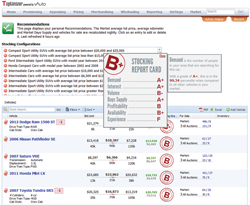
vAuto Provisioning
Dale Pollak, founder of vAuto, says that the Provisioning tool has provided dealers with a quantum leap in ability when it comes to finding the right used cars. “What is really important is that it provides each car with a grading system, a bit like a school report report card,” he says.
Each report card is made up of seven (six in Canada) sub grades — demand, specific version (year, make, model and trim), retail volume, market days supply, profitability, availability and the dealership’s past history of that particular type of vehicle. “You take the average of each of those sub scores and get an overall grade,” says Pollak. “From a dealer’s perspective if you can get cars that have say, A- or B+ overall scores, these will tend to be higher performers in terms of how they gross.”
Pollak says that the grading system has not only been able to provide which cars dealers need to source but also accurate pricing information based on real time data. Furthermore, because vAuto is tied in with feeds from both major and minor auctions, it can show what day and time the desired car is going to run, as well as provide the condition and CarProof report. “It enables dealers to place a proxy bid, right then and there,” he says.
The Provisioning tool has been available in the U.S. for over a year and was introduced to Canada last month. TRADER’s Jill Hadfield says that feedback from early adopters has been good. “Dealers are excited about it,” she says. “vAuto customers in the U.S. have been able to apply new practices with this tool and improve their turn rate and sourcing.”