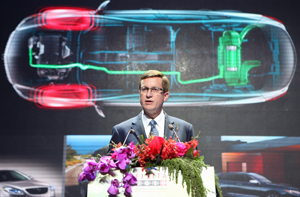
 General Motors is accelerating the development of electrified vehicles in China, according to Jon Lauckner, who is GM’s Chief Technology Officer, as well as vice president of GM’s global R&D and president of GM Ventures.
“China has made electrification a key strategy,” Lauckner said yesterday. “Electrified vehicles will play a critical role in efforts to conserve and ultimately displace petroleum as the major source of transportation energy,” Lauckner made these remarks during an address speech at the FISITA 2012 World Automotive Congress in Beijing.
In September 2011, GM China opened the Advanced Materials Lab in Shanghai. The facility, which is part of the GM China Advanced Technical Center, (a joint venture with SAIC) is engaged in cutting-edge research on battery technology and lightweight materials.
“We will apply innovative technologies to cell design and fabrication, test and validate advanced cell materials provided by suppliers, and ultimately integrate battery cells into future battery systems for our vehicles,” said Lauckner. “We believe the further development of lithium-ion battery technology is possible through improvements in cell chemistry, cell and pack design, and optimization of thermal management.”
GM’s goal is to improve the energy density of its batteries so that they are smaller, lighter and less costly than today’s batteries. In the long term, the automaker believes there is potential to double the energy density of battery packs in electric vehicles.
“Greater adoption of electrified vehicles requires a greater breadth of offerings; cost reductions in technology for more competitive pricing compared to conventional vehicles; and, of course, more infrastructure for convenient charging,” Lauckner declared.
Customers must be able to charge in a convenient and safe manner at their home, workplace or in public. This requires common standards and stakeholder collaboration between the automotive industry, multiple levels of government, regulatory agencies and power providers.
GM says that it’s global strategy is to provide consumers a variety of choices through a range of vehicles with electrified powertrains, which range from mild hybrids such as the eAssist system, which uses an electric motor to boost performance and economy of internal combustion powertrains on cars like the Buick LaCrosse, to full, dual-mode gas/electric hybrids like the Cadillac Escalade, extended range electric vehicles such as the Chevrolet Volt and pure battery electrics such as the Chevrolet Spark EV.
According to Lauckner, one other important area where GM is applying electrification and connected vehicle technology is on urban mobility solutions. GM has showcased in China its vision for sustainable urban transportation through products such as the EN-V (Electric Networked-Vehicle) concept, which introduced the world to a new automobile DNA based on electrification and connectivity. The concept was a focal point of the SAIC-GM Pavilion at Expo 2010 in Shanghai.
Earlier this year, GM signed a memorandum of understanding with the Sino-Singapore Tianjin Eco-City Investment and Development Co. Ltd. and the Tianjin Eco-City Administrative Committee to collaborate on assessing the real-world application of GM’s EN-V 2.0 concept in Tianjin Eco-City.