
Buying new technology may be the easy part. Making it work with existing systems, getting employees to use it and demonstrating a return on the investment remain persistent challenges for Canadian car dealers.
That tension runs through the second annual Canadian Automotive Retail Technology Study (CARTS), just released by the Canadian Automobile Dealers Association (CADA). Dealers are more receptive to new tools than they were a year ago, but the difficulties of putting them to work are also growing.
 The study, conducted for CADA by Clarify Group with RBC Automotive Finance as its exclusive sponsor, measures the experiences of both dealership decision-makers and the employees who use technology every day.
Darren Slind, Co-Founder and President of Clarify Group, said one of the most encouraging findings is the shift in dealers’ attitudes toward technology.

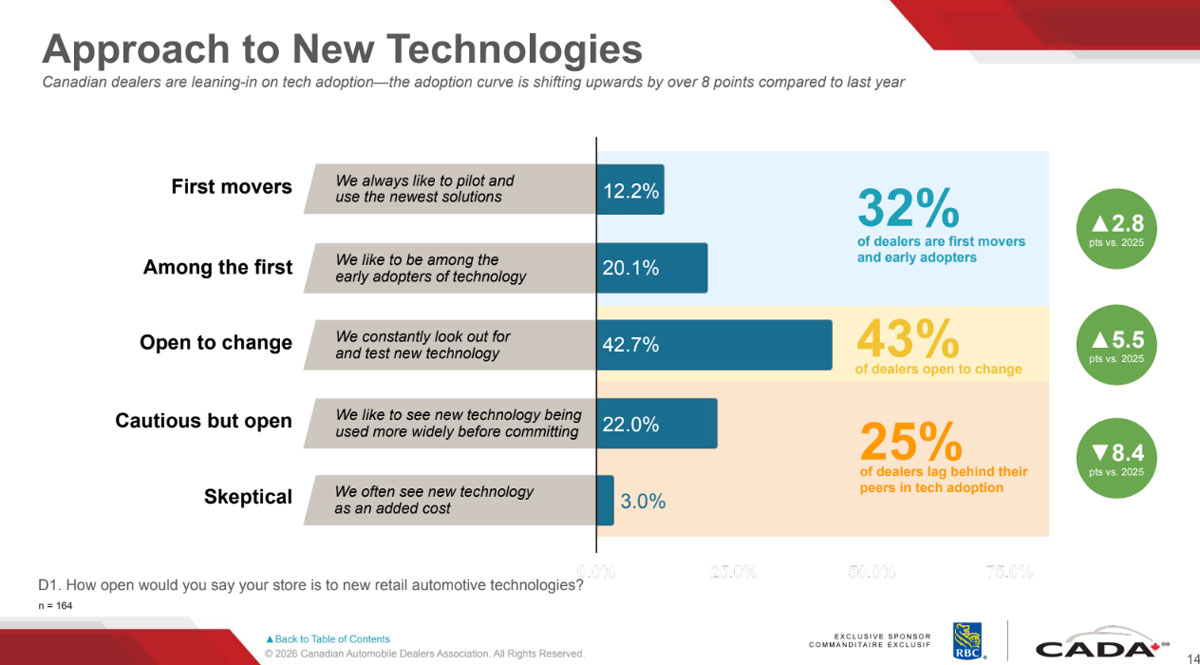
Three-quarters of dealership decision-makers now describe themselves as first movers, early adopters or open to change. The proportion identifying as cautious or skeptical has fallen from 33 per cent to 25 per cent.
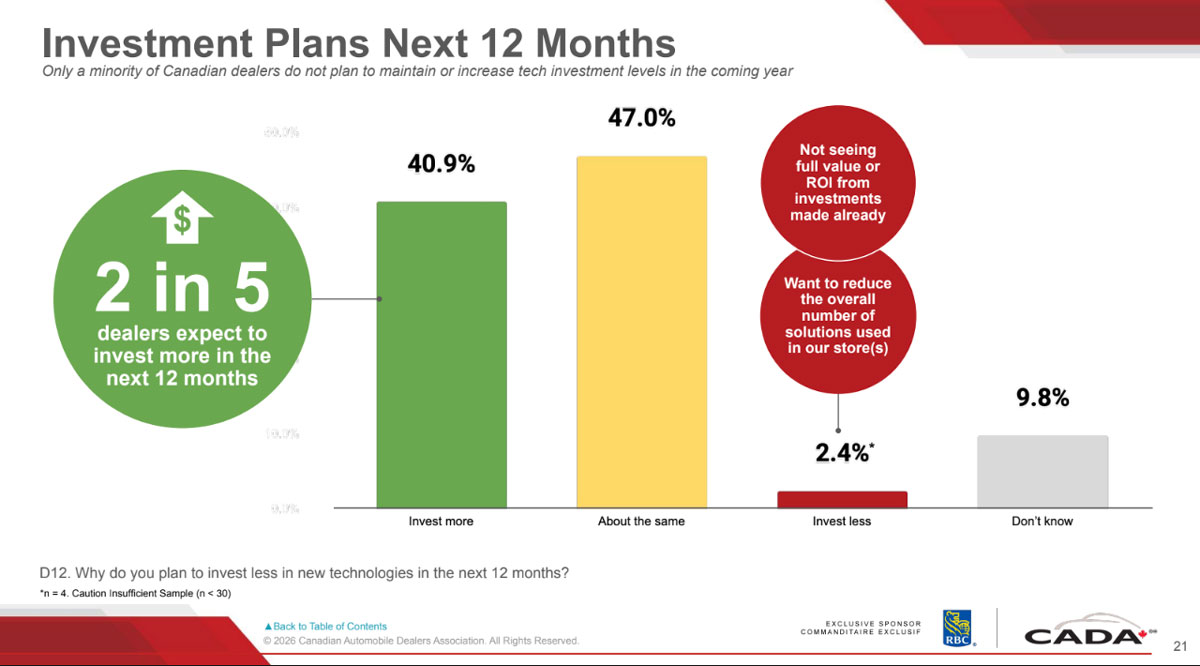
Another 88 per cent intend to maintain or increase their technology investments over the next 12 months, including 41 per cent who plan to spend more. “They are definitely showing signs of leaning in 2026,” said Slind.
Where dealers are investing
Customer-facing technologies are attracting much of that investment.
Appointment management, customer messaging, lead management and CRM solutions rank among the leading priorities. Dealers are also showing growing interest in inventory merchandising tools and data analytics.
Slind said the emphasis on customer engagement reflects changing consumer behaviour, particularly the expectation that dealerships will respond quickly to inquiries, even outside traditional business hours.
Consumers can research and shop for vehicles around the clock. Dealers increasingly need technology that allows them to keep pace. But adding new tools does not necessarily make running a dealership easier. In fact, the study suggests the opposite may be occurring.
Sixty per cent of dealership decision-makers reported challenges integrating new technology into daily operations, an increase of more than five percentage points from last year. Another 59 per cent struggle to justify the investment or measure its return, up nearly 11 points. Almost half cited difficulties obtaining the right level of training and support.
Slind said he believes that more dealers are actively experimenting with new technologies. “If more of them are on the adoption curve, you’re likely going to get more adoption friction because there’s more activity,” said Slind.
The complicated tech stack
For many dealers, the challenges extend beyond implementing any one application.
The study examined the growing number of software subscriptions and technology providers dealerships must manage. Twenty-six per cent of dealers reported having at least 10 software subscriptions, while 18 per cent are dealing with 10 or more separate vendors.
That creates challenges with integration, data sharing, contracts, payments and ongoing support. Not surprisingly, 31 per cent of dealers would like to simplify their technology stack rather than continue adding applications.
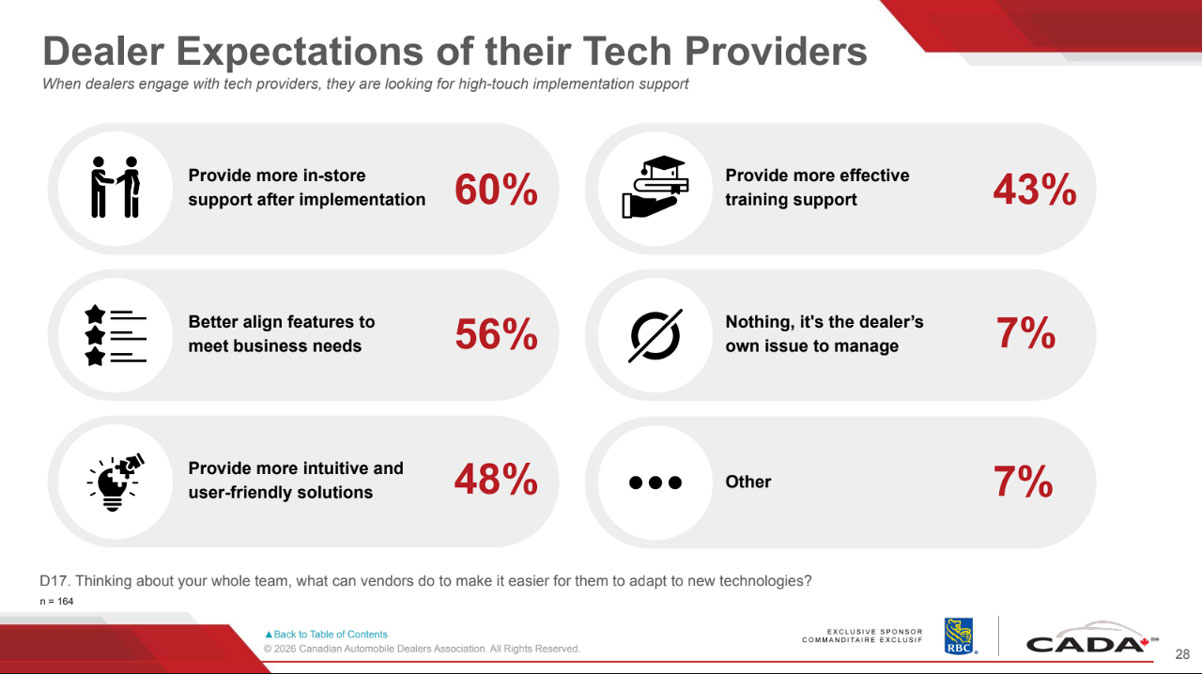
The findings also send a message to vendors: 60 per cent of dealers want more in-store support following implementation, while 56 per cent want solutions better aligned with their business needs.
There is some encouraging news.
Employee satisfaction improved across all three technology categories measured in both years. CRM satisfaction increased 42 index points, DMS rose 16 points, and dealer websites improved seven points. Slind believes those improvements suggest dealers and technology providers are beginning to understand each other’s expectations more clearly.
“There’s clearly more alignment now between the provider’s offering and what is meeting a dealer expectation,” he said.
He also believes improving the relationship requires effort from both sides. Dealers need to communicate their requirements clearly, while providers must understand how their products fit into actual dealership workflows.
“They need to talk more than they’ve been talking,” said Slind.
AI moves into daily operations
Artificial intelligence is another major theme of the 2026 study. Seventy-three per cent of dealership decision-makers reported using AI somewhere in their operations.
The leading applications include inbound sales lead handling at 37 per cent, service appointment scheduling at 24 per cent, F&I fraud detection at 23 per cent and financial analysis at 22 per cent.
These departmental findings establish a new baseline, allowing future studies to track how AI use develops across dealerships. But the research also identified a troubling gap.
Fewer than 15 per cent of dealership employees reported that their store places restrictions on the use of generic AI tools. The remainder either reported no restrictions or were unaware of any policies. That raises concerns about employees potentially exposing confidential customer, financial or operational information through publicly accessible AI applications.
“Closing that governance gap must be an urgent priority for our members in 2027,” said Tim Reuss, CADA’s President and CEO, in his opening remarks in the report.
CADA has also developed its AI Navigator newsletter and related guidance to help dealers adopt AI more responsibly.
Robotics on the horizon
The study also ventured into an emerging area of dealership technology: robotics. Adoption remains limited, but dealer interest is considerable. Nearly 13 per cent of dealers already use robotic scanners in service drives, while another 42 per cent are open to the technology.
Only three per cent currently report using robotic tire replacement or wheel alignment technology, but 43 per cent are open to considering it. Another 37 per cent are open to robotic parts delivery.
Slind sees potential applications in fixed operations, where labour shortages and technician productivity remain persistent challenges. For example, having robots deliver parts directly to technicians could reduce time spent walking between service bays and parts counters.
His advice is not necessarily to rush out and purchase robotics, but to monitor developments and understand their potential.
Making better technology decisions
For dealers considering their next technology purchase, Slind said the study’s recommendations offer a practical starting point.
“Start with the business problem, not the feature list,” he said.
Dealers should define what they want to accomplish, how they will measure success and what resources they need before committing to another application.
He also recommends making integration a condition of purchase, reviewing overlapping software subscriptions and involving the employees who will actually use a solution during its evaluation and pilot stages.
Rather than discovering months after implementation that a system doesn’t work as expected, dealers should ensure it fits their operations before making a long-term commitment.
The broader message from CARTS is that enthusiasm for technology is growing, but purchasing decisions are only the beginning.
The full 2026 CARTS report, including detailed findings and recommendations, is available through CADA’s website.