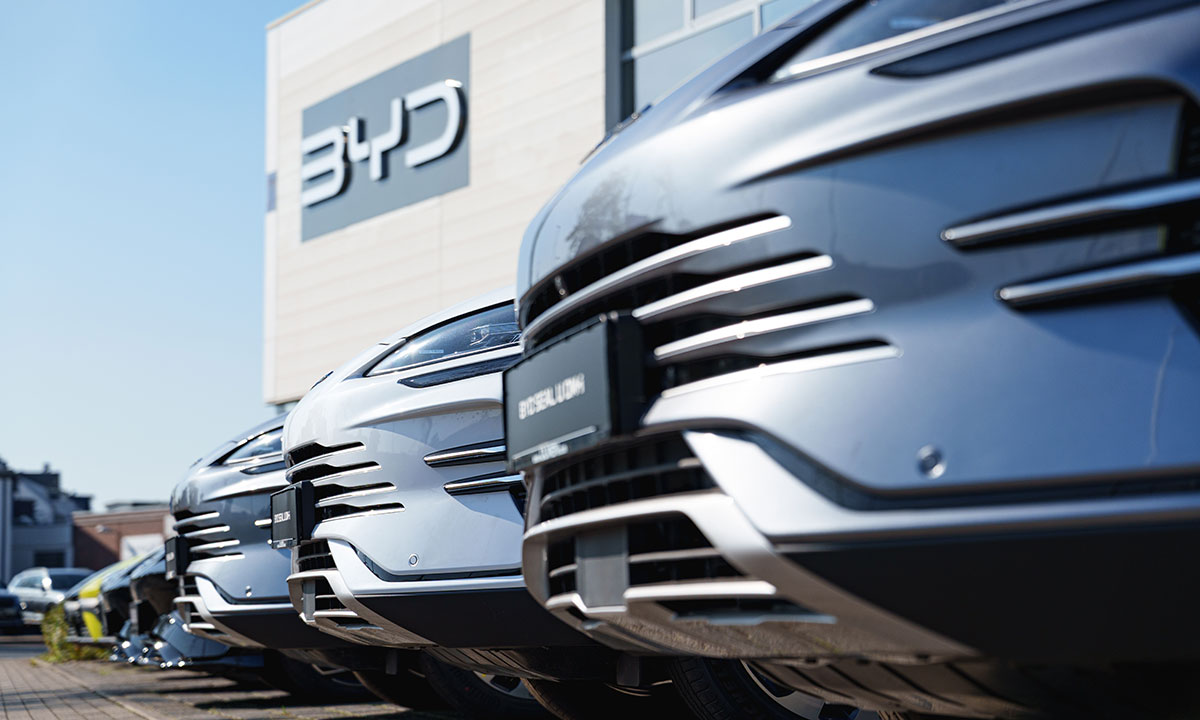
New data shows how dealers can prepare for Chinese brand competition.
Chinese OEMs are coming. Our current estimate puts their arrival in early 2027, and that leaves very little time for dealers to prepare.
But this isn’t just a question for dealers who will end up carrying these new franchises. It’s a question for every dealer in this country, regardless of brand. Whether you sell a Chinese nameplate or compete against one down the street, the data tells us Canadians are already leaning in — and that raises an important question: Are you ready?
New findings from Clarify’s Vehicle Buyer Opinion Study (VBOS), sponsored by Universus Media Group, give us a clearer picture than we’ve had before of how Canadian new vehicle owners feel about Chinese brands entering the market.
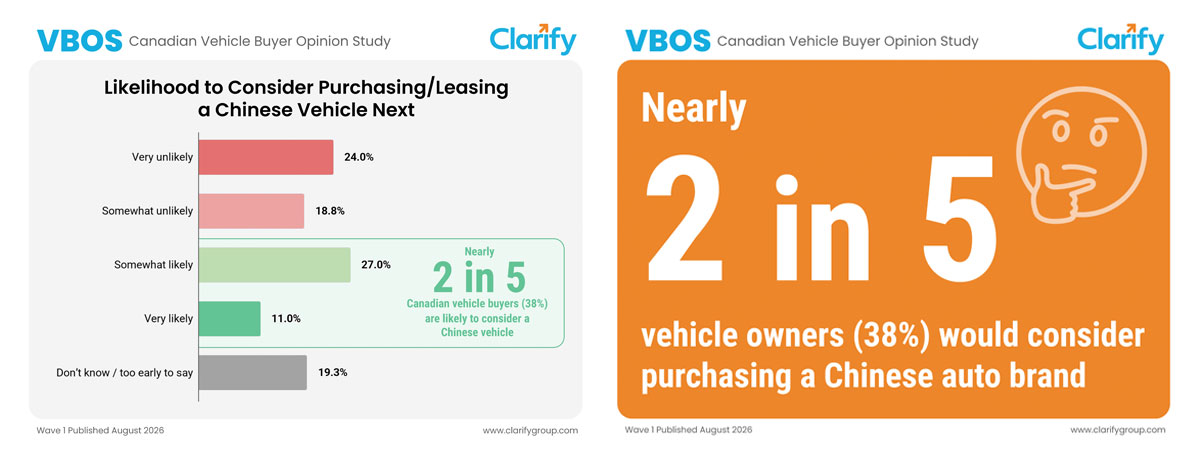
The topline numbers alone should get every dealer principal’s attention: 63 per cent of Canadians who have purchased or leased a new vehicle within the past five years say they support the government’s policy to allow Chinese brands into the country, and 38 per cent say they would consider buying one as their next vehicle.

So what does this mean for dealerships, and what will your role be? VBOS insights tell us a lot.
1. Awareness is low — and that’s a double-edged sword
Even when prompted, 48 per cent of Canadian owners say they have not heard of any Chinese auto brand. For dealers who will be selling these brands, that’s a lot of awareness ground to make up.
It might be tempting for dealers competing against these brands to read that number as good news — low awareness sounds like a low threat. But consider that alongside the nearly two in five owners who would consider a Chinese-made vehicle anyway.
That’s a lot of curiosity riding on very little familiarity, and curiosity drives behaviour. Expect it to pull traffic away from legacy brand websites, social channels and showrooms as Canadians go looking to see these vehicles and learn more for themselves.
Whether that traffic comes back to you will depend on how well your dealership is prepared to compare against what customers find.
Even when prompted, 48 per cent of Canadian owners say they have not heard of any Chinese auto brand. For dealers who will be selling these brands, that’s a lot of awareness ground to make up.
2. Perceptions are lagging
Right now, Chinese brands lag the industry average on key attributes such as reliability and safety. Many Canadians also perceive Chinese vehicles as more budget-oriented than vehicles from other global regions.
For dealers who will be selling these brands, that’s a significant uphill battle. Strategic marketing and PR will be needed to shift those perceptions — and shift them quickly.
But dealers shouldn’t assume this is purely a head-office marketing problem for someone else to solve. The showroom floor is where these perceptions will be confirmed or overcome. Every walkaround, every conversation about crash testing and every explanation of what’s under the hood — or the floor — is a chance to directly counter the idea that these vehicles are somehow lesser.
That work will fall to dealers and their sales teams as much as to any national advertising campaign.
For dealers competing against Chinese OEMs, this is an opening. These perception gaps, however temporary they may prove to be, give brands and dealers an advantage today if they are prepared to make reliability, safety and long-term trust central to how they position themselves against the new entrants.
3. Dealers will play a big role
Here’s the number that should matter most to everyone reading this: 88 per cent of Canadian vehicle owners open to a Chinese brand say the dealer will play an important role in their decision-making, combining those who consider the dealer somewhat or very important.
On the flip side, fewer than 11 per cent of these consumers say they want to bypass the dealer altogether in favour of a direct-to-OEM, fully digital purchase.
Put those two numbers together and the message for our industry is encouraging. Despite everything we hear about disruption and direct-sales models, Canadians overwhelmingly still want a dealer involved when it comes to considering a Chinese brand.
That means many customers — including some of yours — are going to lean on the dealer they already trust to help them decide whether to stay loyal or try something new. Whether you retain those customers or watch them walk will come down to whether your team is prepared and properly trained to protect that trust when the moment comes.
Canadians are curious, but they’re not well-informed, and they’re going to lean on dealers to help them sort it out.
Why does this matter?
Put these findings together and a pattern emerges. Canadians are curious, but they’re not well-informed, and they’re going to lean on dealers to help them sort it out. That’s an enormous amount of influence sitting with the retail side of the business at exactly the moment the ground is shifting.
Consider one more number: 37 per cent of those surveyed say they’re interested in test-driving a Chinese model, and the majority of those consumers intend to do so at their local franchise dealer.
That’s a remarkable figure given how few Canadians can even name a Chinese brand today. It’s the curiosity factor showing up again, this time as foot traffic and steering-wheel time. And nearly every one of those test drives is going to happen with a dealer standing beside the vehicle, not through an app or home delivery.
That’s the moment when awareness turns into a real opinion, when perceptions around safety, reliability and value can be challenged in person, and when the relationship a dealer builds during 20 to 30 minutes behind the wheel can help determine whether a customer stays or goes.
Very few others in this equation will have that kind of access to the customer at exactly the moment it matters most.
What we know for certain is that the market is about to get more competitive, and the runway to prepare is short. Dealers who arm themselves with the right data and strategy now, well ahead of the first Chinese OEM showroom openings, will be better positioned to come out ahead.
Buckle up.
A note on the data: The statistics cited above are drawn from the Vehicle Buyer Opinion Study (VBOS) by Clarify Group, sponsored by Universus Media Group. The full data set is available for purchase.