A new CADA initiative aims to help Canadian dealers navigate AI adoption with insights and real-world lessons from their peers
In the February 2026 edition of Canadian auto dealer, one of our columnists Barry Hillier wrote about the AI tsunami that dealers were about to encounter at the annual NADA convention in Las Vegas.
I attended NADA. Barry was right on the money. You couldn’t walk ten feet through the convention center without hearing or seeing the words “AI” or “AI enabled” everywhere.
We know from the 2025 CADA Canadian Automotive Retail Technology (CART) Study that 3 in 5 Canadian dealer leaders (59.8 per cent) report at least some form of AI deployment within their operation, most commonly in marketing and sales.
We also know from the CART Study, however, that nearly a third of these dealers (29.6 per cent) have yet to see any meaningful business gain from this AI adoption effort.
As Barry succinctly remarked: “AI will reshape automotive retail… and the advantage will not come from moving fastest, but from engaging intelligently… AI will not reward those who adopted first or waited longest… it will reward dealers who stayed actively engaged, learned continuously, and made informed decisions as the technology evolved.”
It is in this spirit that the CADA Industry Relations Committee formed an AI Sub-Committee late last year to support Canadian dealers on their AI adoption journey with continuous learning drawn from peers and other industry experts to enable more informed decisions.
The AI Sub-Committee consists of seven dealer principals from across Canada — from heads of multi-store groups to thriving single-point operators.
The Sub-Committee dealers all share the desire to lean in on AI and its potential to deliver meaningful gains to the efficiency and effectiveness of automotive dealerships, and the mandate to share these insights and leading practices with their CADA peers.
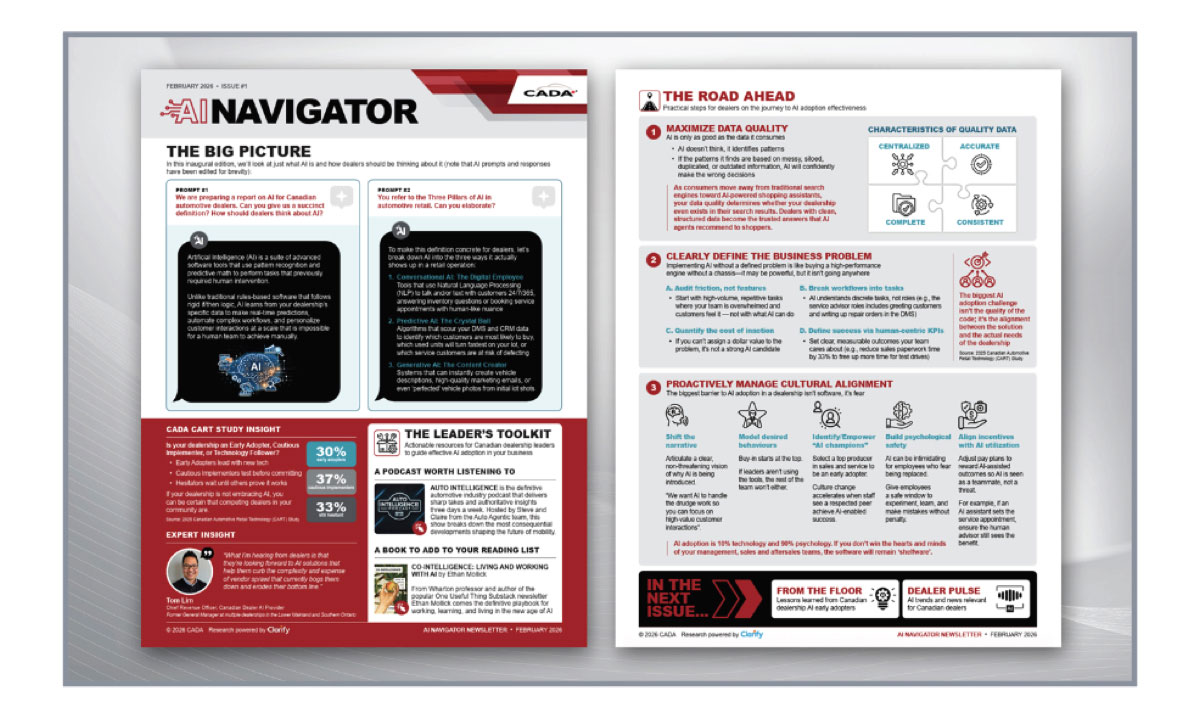
A key deliverable of the Sub-Committee is the AI Navigator newsletter, the first edition published in late February via email to all CADA members and via the CADA website.
AI Navigator is specifically for dealers, by dealers. It is not by tech providers for dealers. This distinction is critical.
In fact, the lead content developer on the Clarify team is a recent (and successful) general manager for multiple luxury and volume brand dealerships over the last two decades.
While Sub-Committee members did not directly author its content, they shaped AI Navigator’s overall strategy and content priorities, and are facilitating access to some of the best AI adoption examples to be featured in the ‘From the Floor’ section of each newsletter. Peer-to-peer learning is a key component of the newsletter.
It is worth mentioning that the Sub-Committee feels strongly the newsletter must feature not only dealership “AI quick wins” but also the stories about projects that “didn’t quite work out the way we thought it would,” and the “knowing what I now know” lessons learned.
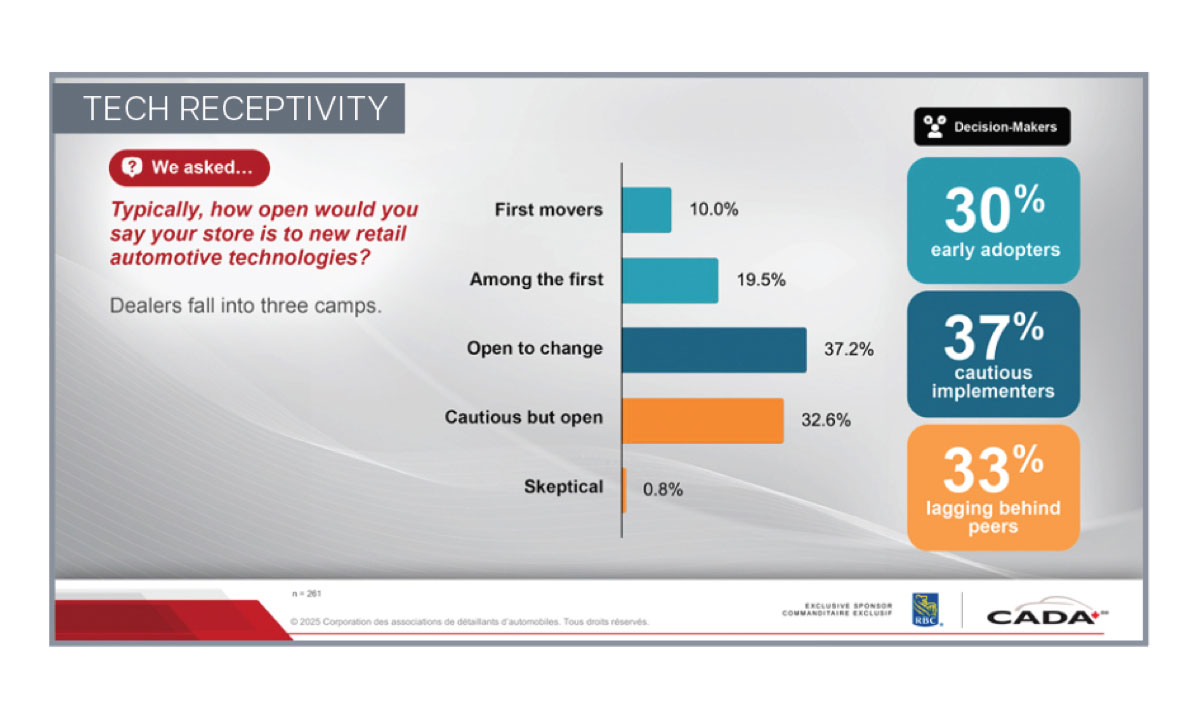
For a topic so vast and constantly changing as AI — and given the wide range of dealer receptivity to technology adoption — the decision was made to take a crawl-walk-run content approach.
With the majority of Canadian dealers on the “AI cautious” adoption continuum, the need for AI Navigator is clear. But it is also clear that if we dive into the AI deep end without first learning how to float, then paddle, then swim in the shallow end of the pool, the Sub-Committee won’t succeed in its mandate to support CADA members on their AI adoption journeys.
And so the first edition introduced three key success factors (admittedly three of many) that Canadian dealers need to be thinking about and planning for as they begin (or accelerate) their AI adoption journeys:
Maximize dealership data quality — AI is only as good as the data it consumes.
The classic case of “garbage in, garbage out.” When it comes to dealer data quality, we’re talking about everything from customer records in our CRM, to the accuracy and completeness of vehicle listings on our website, to the way we manage and respond to online customer reviews.
Clearly define the business problem — Implementing AI without a defined problem is like buying a high-performance engine without a chassis — it may be powerful, but it isn’t going anywhere.
The biggest AI adoption challenge isn’t the quality of the code; it’s the alignment between the solution and the actual needs of the dealership.
Proactively manage cultural alignment — The biggest barrier to AI adoption in a dealership isn’t software, it’s fear.
AI adoption is 10 per cent technology and 90 per cent psychology. If dealers don’t win the hearts and minds of their management, sales, and aftersales teams, the software will very likely remain ‘shelfware.’
In subsequent issues of AI Navigator, we’ll dive deeper into each of these AI critical success factors with specific examples of how Canadian dealer principals are setting themselves up for success.
If you have any specific AI-related questions or topic suggestions, or know any dealer peers with interesting perspectives on AI adoption efforts, we’d love to hear from you! Please reach out.
As Barry Hillier observed, when it comes to AI effectiveness within a dealership: “Early understanding matters more than early adoption.”
There’s no time like the present!