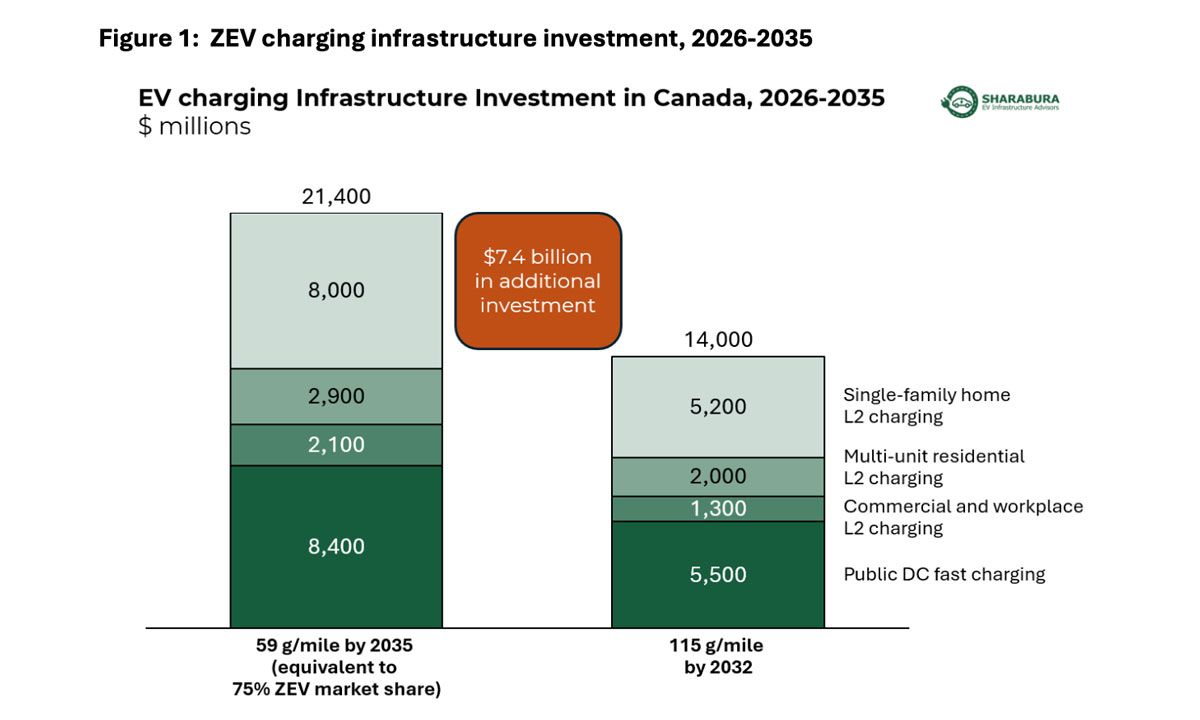
A stronger federal greenhouse gas emissions standard for light-duty vehicles could help attract $21 billion in zero-emission vehicle charging infrastructure investment across Canada by 2035, according to a new analysis by the Canadian Charging Infrastructure Council (CCIC).
The policy brief, prepared for CCIC by Sharabura EV Infrastructure Advisors, compares two regulatory scenarios and concludes that a more stringent emissions standard would generate roughly $7 billion more in charging infrastructure investment than a weaker alternative over the next decade.
According to the report, a stronger standard would support approximately $10 billion in public charging infrastructure, including DC fast chargers and Level 2 chargers, along with an additional $11 billion in residential Level 2 charging for single-family and multi-family housing. Under a weaker regulatory framework, total investment would fall to about $14 billion.
CCIC said the difference depends largely on whether investors have confidence that Canada’s vehicle emissions regulations will provide a stable, long-term signal supporting continued zero-emission vehicle adoption through 2035.
“Private investors and property owners are ready to fund this $21 billion dollar build-out — but financing the deployments Canada needs requires a reliable, long-term demand signal on ZEV adoption,” said Travis Allan, President and CEO of CCIC, in a statement.
The organization estimates that between 50 and 65 per cent of charging infrastructure investment would flow to Canadian skilled trades, utilities and local suppliers. It also said most of the funding is expected to come from private-sector investors rather than governments, provided long-term policy certainty remains in place.
The report comes as the federal government continues work on its vehicle emissions framework and broader auto and electricity strategies aimed at supporting Canada’s transition to zero-emission transportation.