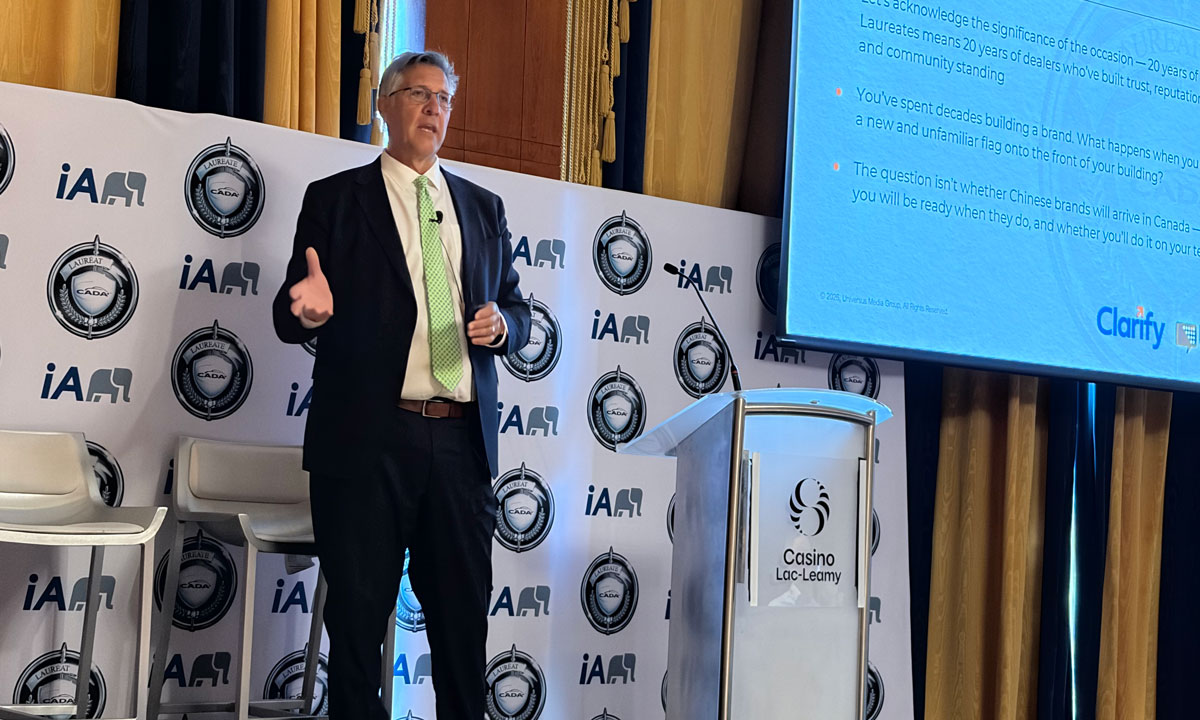
Dealers weighing whether to represent a Chinese OEM were urged to look beyond product, pricing and contracts during a business session in Gatineau, Que. featuring a gathering of CADA Laureate award winners.
Niel Hiscox, CEO of Clarify Group, and publisher of Canadian auto dealer, said Chinese brands could create real opportunities for Canadian retailers, but also raise new questions around reputation, staff communications, community trust, political risk, parts support and long-term dealer protections.
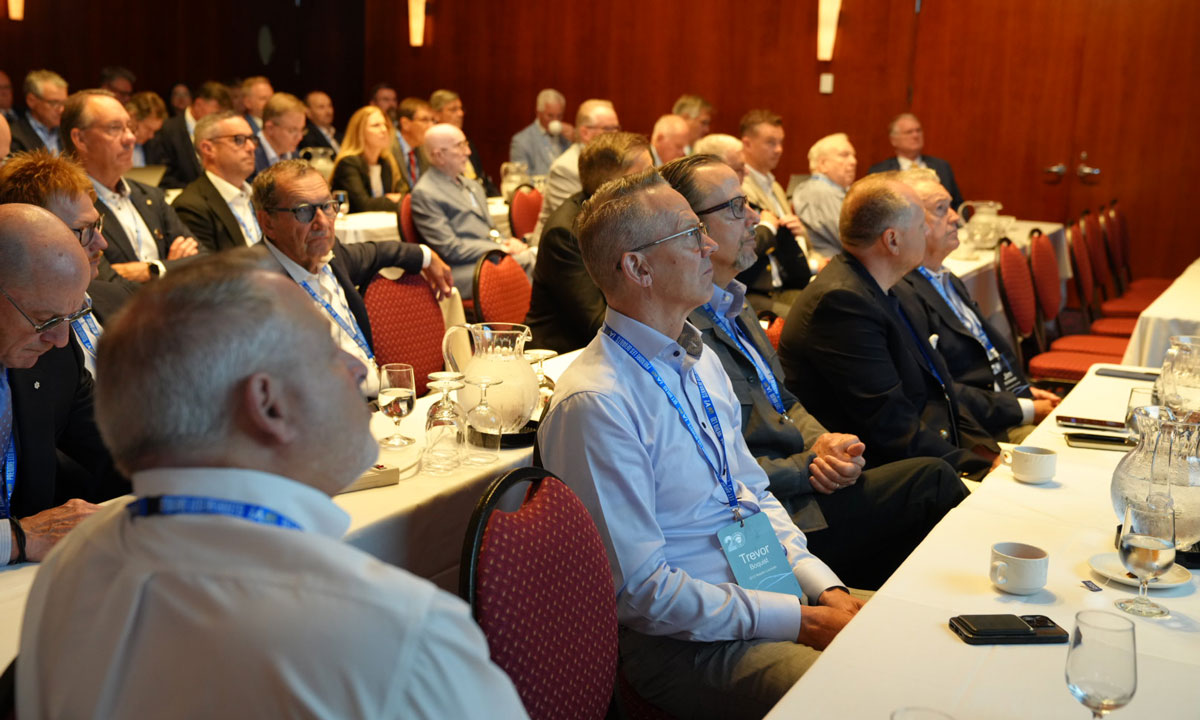
The session generated strong dealer engagement during the business program held as part of the Canadian Automobile Dealers Association Laureate program’s 20th anniversary gathering. It came as more dealers are trying to understand what the arrival of Chinese automakers could mean for their businesses, their existing franchises and their local brands.
Hiscox said many dealers are already watching the issue closely, and some are signing Memorandums of Understanding or speaking directly with Chinese OEMs. “We’re all looking to see what happens next at a point when we’re all very short on detail,” said Hiscox.
He told CADA Laureates his goal was not to tell dealers whether they should pursue Chinese brands, but to encourage them to think through issues that may not appear on a typical dealership due-diligence checklist.
“You guys are far better equipped to evaluate the vehicles, to evaluate the contracts, to evaluate some of the challenges,” said Hiscox. “I think it’s possible some of the things I’m going to talk about aren’t necessarily at the top of the list of consideration.”
Those issues, he said, include reputation, communications, employee readiness, customer perception and the broader political context surrounding China.
Hiscox said the arrival of Chinese brands differs from earlier waves of international automakers entering North America.
“Part of the challenge you really are facing in attaching yourself to a Chinese brand, you’re importing an entire country’s reputation,” said Hiscox.
He said Japanese and Korean automakers also faced perception challenges when they entered North America, but Chinese brands are arriving in a much more complex environment.
“Chinese OEMs are coming in the context of a country that has a very pronounced reputation, for both good and bad, and one that is very much in Canadians’ minds,” said Hiscox.
At the same time, he acknowledged why many dealers are interested. Dealers who have travelled to China or studied the market often come away impressed by the products, technology and manufacturing capabilities.
Hiscox said some dealers return from China with a reaction of: “Oh my God, it’s like going into the future.”
“From a product standpoint it is, from a manufacturing standpoint it is, but there are definitely a host of challenges,” he said.
Hiscox said dealers should expect customer questions and public scrutiny in three broad areas: geopolitical anxiety, labour and ethical sourcing, and data privacy or surveillance concerns.
One of the central challenges, he said, is reputational association. “Simply by proximity, your name goes next to theirs,” said Hiscox. “If a Chinese OEM faces controversy, your name is adjacent to that.”
He said the public discussion around connected vehicles, data and surveillance could be particularly difficult for dealers to manage. Hiscox referred to the “spy car narrative” circulating among some opponents of Chinese EVs and connected vehicles.
“This spy car narrative is an easy one for opponents of Chinese vehicles to hang on because it’s actually a very difficult one to undo,” said Hiscox.
He said the issue for dealers is not only whether a particular claim is accurate, but whether the claim begins to shape consumer perception. “There’s reputational risk even if there isn’t necessarily truth in it,” said Hiscox.
That matters, he said, because many CADA Laureates and other dealer leaders have spent decades building trust in their communities. “You guys are the absolute pillars of representing what a car dealer can be in terms of a connection to the community,” said Hiscox. “In some communities, and not all, but some communities are going to be more sensitive.”
Hiscox said dealers also need to consider the impact on employees. Many dealership staff members have built their professional identities around the store and its reputation, and some may have their own concerns about adding a Chinese brand.
“It’s not a reason not to do it,” said Hiscox. “But it is important that you’re thinking about it and you’re talking to them.”
Hiscox was careful to balance the risks with the potential upside. “Of course the reason to do this — and you guys are called dealers for a reason — there’s opportunities,” he said.
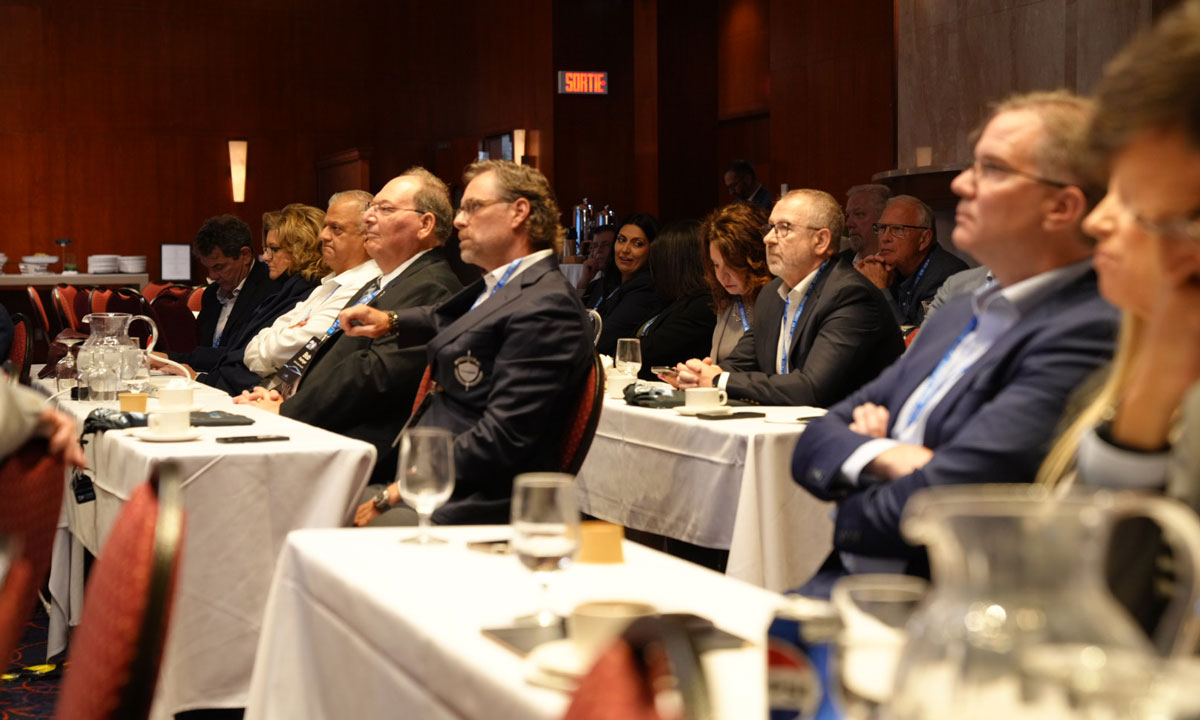
He said Canada is an open market, and that dealers representing Chinese brands could position themselves as supporters of competition and consumer choice. He also said there may be first-mover advantages if Canada receives some products before the United States.
“When does Canada ever get a chance to get product before the U.S.?” said Hiscox. “This is a source of some real potential pride.”
The biggest opportunity, he said, may be the trust dealers have already established.
“While Canadian consumers may not know and trust a Chinese brand, they know and trust you,” said Hiscox. “At the heart of it is your opportunity.”
He said the Chinese OEMs he has spoken with understand the importance of dealers in reaching Canadian customers.
“Their path to reach your communities is through your brand,” said Hiscox.
Hiscox urged dealers to conduct their own brand audit before signing with a Chinese OEM. “How will a Chinese brand be perceived not by Canadian consumers, but by your market?” he said.
He encouraged dealers to speak directly with some of their best customers before making a final decision, and to ask how they would view the dealership representing a Chinese brand.
He also warned against treating all Chinese automakers as if they are the same. “There are nationally-owned OEMs, there are state-owned OEMs, there are private OEMs, there are companies that are as different from each other as GM is from Toyota,” said Hiscox. “It’s important to dig in and understand some of those differences.”
Hiscox said dealers should also prepare a messaging strategy before they sign, and should lead with the dealership’s own values rather than simply the vehicle’s features.
He said that may be difficult because the products themselves can be compelling. “The drivetrains are more advanced, the price points are remarkable, the in-car tech is remarkable,” said Hiscox. “It’s going to be a real temptation to lead with features, but you’ve got to think about that value story.”
He said employees need to be treated as the first and most important communications audience.
“Your staff really is your first PR audience,” said Hiscox. “They are your most credible messengers, but they are also your most vulnerable point of exposure.”
He said employees will be asked questions by customers, friends, neighbours and community members, and dealers should not assume staff will automatically know how to respond. “You need to give them language they can use,” said Hiscox. “You need to test that language.”
He also urged dealers to prepare local media Q&As, ensure their websites and digital platforms are ready before any launch, monitor social media sentiment and establish a crisis-response protocol.
The discussion that followed showed dealers are actively wrestling with the Chinese OEM issue.
One dealer asked about lessons from Australia, where Chinese brands have already gained traction. Hiscox said one Australian dealer told him sales had gone well and targets had been exceeded, but the OEM responded by adding more stores to the same area of responsibility.
The story, Hiscox said, illustrates how some Chinese OEMs may operate with different assumptions than Canadian dealers are used to.
He said there has also been a learning curve for some Chinese companies around the Canadian expectation that every dealer in a network signs the same dealer agreement.
Hiscox also reminded dealers that Canada is a mature market, so any new entrant’s growth will come from existing market share.
“If somebody gains 10 per cent share, it’s coming out of somebody else’s hide,” said Hiscox.
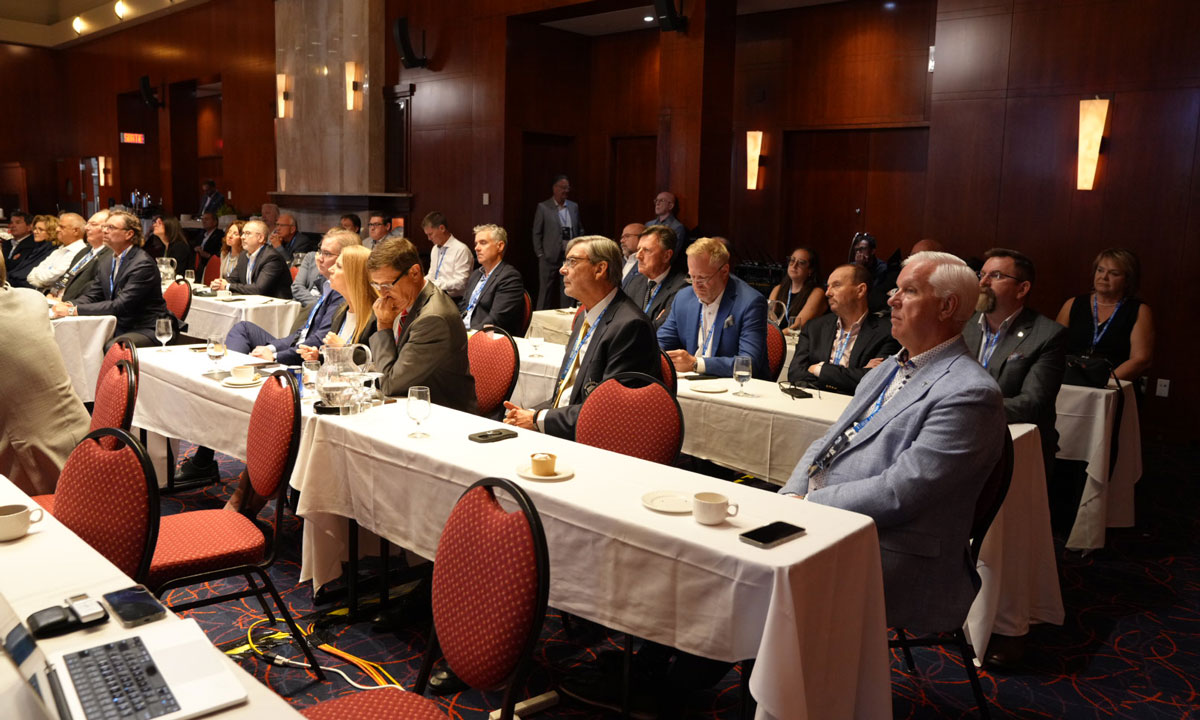
Dealers raised the concern that Canada could become “Australia revisited,” noting the rapid growth of Chinese brands in that market. They also asked about the potential impact of CUSMA negotiations and Canadian import limits.
Hiscox said there remains confusion in the market about the 49,000-vehicle threshold and how it will be applied, including whether it applies only to EVs or more broadly. He said constrained volume could create challenges for dealers trying to justify the investment required to build a new brand.
CADA President and CEO Tim Reuss used the discussion to clarify CADA’s approach to Chinese automakers.
He said the association is not promoting Chinese brands, but it is also not trying to block them. “Our mandate is to provide you with as much information, knowledge and insights as possible so that you’re able to make informed decisions,” said Reuss.
Reuss said CADA’s executive considered the issue several years ago and concluded that simply opposing Chinese brands could push them toward a direct-to-consumer or agency model if they do enter the Canadian market. Instead, CADA has chosen to engage with prospective entrants and explain the importance of the franchised dealer model.
Reuss said CADA has also been speaking with dealer associations and dealers in other markets, including Australia, South America, Europe and China, to understand what Canadian dealers should learn from their experiences.
He said CADA has been direct with potential entrants. “Are you going to work with franchise dealers?” said Reuss.
Reuss said CADA’s China study tours are not designed to put dealers in front of potential brands, but to help Canadian dealers understand the market, products and business practices that may be coming.
Dealers at the session also discussed how differently some Chinese OEMs appear to operate. Some who are studying opportunities said the manufacturers can move with an extreme sense of urgency compared with the traditional OEM processes dealers are used to.
That urgency may create opportunity, but it also raises questions around contracts, territory, parts distribution, launch planning, staff training and whether the OEMs fully understand the long-term expectations of Canadian franchised retailers.
The discussion also touched on the broader geopolitical context. One dealer said manufacturers are pressing Ottawa to keep Chinese vehicles out, while the United States is also making Chinese EVs part of the larger trade discussion.
Reuss said if Canada changes course on China, there could also be consequences from China for other Canadian exports, including canola and other key products.
Hiscox closed by telling Laureates they have the credibility and community trust to make these launches successful if they choose to proceed, but only if they prepare properly.
“Every dealer in this room is here because you’ve demonstrated leadership, innovation, integrity, and built community trust,” said Hiscox. “You are exactly the right people to make these launches successful if you choose to go ahead with them. Do it with the rigour you’ve done everything else.”
iA Dealer Services is the exclusive sponsor of the CADA Laureate Awards program, and has been since the program’s inception more than 20 years ago.