 The Government of Canada has recently announced plans to impose a federal carbon pollution pricing system on provinces that do not yet have one — or did not propose a system that meets government standards.
“Pollution pricing encourages Canadians and businesses to innovate, invest in clean technologies, and take advantage of long-term growth opportunities,” said Bill Morneau, Canada’s Minister of Finance, in a news release. “Our plan will cut pollution and grow the economy, for the benefit of all Canadians.”
The tax, which will directly impact provinces like Ontario, Saskatchewan, Manitoba and New Brunswick, has been described by the government as part of its plan to address climate change and to grow the economy.
This means that, under the Greenhouse Gas Pollution Pricing Act, which was adopted in June 2018, these provinces will be subject to:
- a regulatory charge on fuel starting in April 2019, and
- a regulatory system for large industries in Canada that compete internationally will be applied in January 2019 — save for the Yukon and Nunavut, which will see the industry-related pricing system and carbon tax (for large companies) applied in July 2019.
The provinces that will be impacted by the federal system for large industries (otherwise known as the Output-based Pricing System or OBPS), are Ontario, Manitoba, New Brunswick, Prince Edward Island, Yukon, Nunavut, and partially Saskatchewan.
What to expect from the carbon tax
Under the federal carbon pollution pricing system, or carbon tax system, certain types of fuel are charged at $20/t CO2e, based on 2019 rates. This translates to a cost of:
- Gasoline: 4.42 ¢/L
- Light fuel oil: 5.37 ¢/L
- Natural gas: 3.91 ¢/m3
- Propane: 3.10 ¢/L
In other words, the price of fuel will rise 4.42 cents per litre in Ontario, Saskatchewan, Manitoba and New Brunswick.
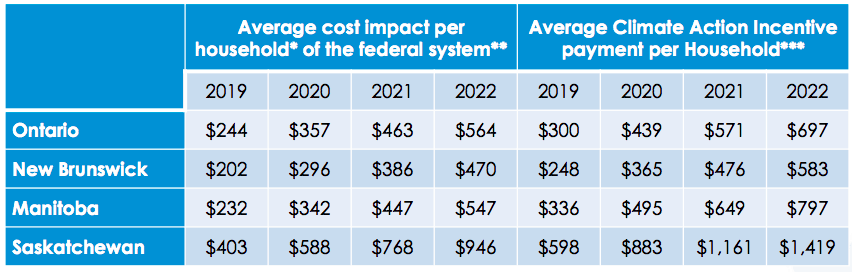
Once the carbon tax is applied, the government estimates the average cost per household (of 2.6 people) in these provinces to be between $202 and $403 in 2019, with the cost rising each year.
For example, consumers in Ontario will see an average cost per household of $244 in 2019; $357 in 2020; $463 in 2021; and $564 in 2022.
In comparison, Saskatchewan will see a cost of $403 in 2019; $588 in 2020; $768 in 2021; and $946 in 2022.
Proceeds returned to provinces?
In provinces like Ontario, Saskatchewan, Manitoba and New Brunswick, the government has argued that about 90 per cent of the fuel charge tax proceeds will be returned to consumers residing in these provinces through “Climate Action Incentive payments”.
The remaining 10 per cent is expected to support colleges, universities, schools, hospitals, Indigenous communities and more.
The incentive payments will be received as part of the tax assessment, which means consumers will have to file the request with their tax returns every year.
What can large industries expect?
For large companies in Canada that are competing internationally, the OBPS tax will be: $20/tonne in 2019; $30/tonne in 2020; $40/tonne in 2021; and $50/tonne in 2022.
According to the government, these companies can purchase credits “from industrial facilities that beat their standard” — in other words, they can buy from companies that have credits to spare.
There are no incentive proceeds for large industries, as the money will be used to “support future climate actions in the jurisdiction in which the revenue is raised,” according to CBC.
Provincial reactions, dealer concerns
Certain provinces are far from pleased with the news of a carbon tax. Ontario Premiere Doug Ford, said the plan was “another tax grab from Justin Trudeau’s Liberals,” according to CBC.
Saskatchewan Premier Scott Moe called the pricing system a “shell game” and a “cynical vote-buying scheme”.
There is also concern that the carbon tax will be passed on to the consumer, which could impact their decision to purchase a new vehicle.
“The proposed plan has left many provincial government officials worried the tax will be levied at the supplier level, and then passed on to consumers in a non-transparent way,” said Huw Williams, CADA’s Public Affairs Director.
The Canadian Automobile Dealers Association (CADA) will be meeting with environment and provincial officials to better understand the situation. They are also working with provincial associations to develop a comprehensive approach to the carbon tax plan.