
Six months ago, there was hope, if not prediction, that 2018 could be the third consecutive record year for new-vehicle sales in Canada. Not any more.
With a 1.6% drop in sales from the same month last year, August is the sixth consecutive month of sales declines, leaving year-to-date sales down 0.8% — a deficit of almost 12,000 units — with no sign of turnaround in the final quarter.
David Adams, president of the Global Automakers of Canada (GAC), attributed the extended period of gradual decline to “higher interest rates and the fact that we are at the beginning of the end of a very good, protracted cycle of sales growth.”
Still, August’s tally of 180,942 vehicles sold is the second-highest ever for the month and its SAAR (Seasonally Adjusted Annualized Sales Rate) was right on 2.0-million, according to DesRosiers Automotive Consultants (DAC).
Year-to-date sales of 1,392,936 units through the first three quarters are second only to last year for the same period. Plus, they’re about 4.4% ahead of 2016’s figures, which are currently second-best.
So, while the trend-line is slightly downward, it is far from being a bad year. And chances are good that it will be the second-best ever.
It’s far from a homogenous market, however. While overall sales were down, there were more gainers than losers, in terms of brands — including a few with impressive increases.
There was virtually no change in the now-normal car-truck split, however. Light truck sales, including those of SUVs, were up by 2.6%, claiming 70.2% of the market, while passenger-car sales fell by 10.6%, to a 29.8% market share. That’s a 2.7% shift in market share from cars to trucks from a year ago.
Ford forges ahead
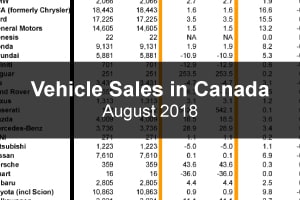
Ford sold 29,230 new vehicles in August, an increase of 7.1% from a year ago, to both maintain and extend its number-one ranking. Sales of 212,167 units year-to-date are down 1.2% from this point last year, close to the market norm, and Ford’s market share remains steady at 15.3%.
In second-place, General Motors’ sold 26,066 vehicles in August, down 10.1% from a very big month a year ago. Year-to-date, however, GM’s sales are up 0.4% and it has gained 0.2% in market share, to 14.8%.
For the second consecutive month, Toyota ranked third in sales, with 18,378 vehicles sold — an increase of 2.4%. Its year-to-date sales are up by 2.0% as well, boosting market share by 0.2% to 10.0%, although it remains in fourth place overall, well behind FCA.
Fiat Chrysler Automobiles (FCA), followed up a dramatic sales decline in July with another significant drop – 9.6% – in August, again ceding its usual third-place ranking to Toyota. While its 168,233 sales through the first eight months maintain that position for the year-to-date, they are down 13.6% from a year ago and FCA has given up 1.8% in market share to 12.1%.
Honda was back to its usual fifth-place ranking in August, with sales of 16,777 units up 0.3% from the same month last year. Cumulative sales of 124,303 vehicles over the first eight months are up 0.5% and Honda’s market share increased by 0,1$ to 8.9%.
Movement in the middle
Hyundai maintained sixth place for the month with 13,123 sales, up 9.8% from a year ago, although poorer results early in the year pulled year-to-date numbers down by 3.6%. As a result, Hyundai remains seventh in the overall rankings, with a 0.2% decline in market share to 6.3%.
Nissan ranked seventh for the month, with 12,145 sales, up 1.5% from a year ago. It is still sixth year-to-date, however, with total sales up 1.9%, and a 0.2% gain in market share to 6.8%.
For the third month in a row, Kia ranked eighth in August, in spite of a 3.6% sales decline. Year-to-date sales are up by 0.9%, however, bumping market share by 0.1% to 3.8% and almost, but not quite, overtaking Mazda for eighth overall.
Mazda’s ranked ninth for the month, with sales up 0.3%, and the Japanese brand maintained its eighth place year-to-date ranking with a 5.1% increase and a 0.2% share boost to 3.8%.
For the second consecutive month, Volkswagen’s sales declined in August, this time by 22.2%, relegating it to 10th place. It’s also 10th for the year-to-date with cumulative sales up 5.6% and a 0.2% increase in market share to 3.4%.
Subaru now stands clearly in 11th place, well ahead of Mercedes-Benz for both the month and the year-to-date.
The battle further down the luxury rankings fell to BMW this month, slightly ahead of Audi, also reversing their positions in BMW’s favour year-to-date — fewer than 100 units apart.
Winners and losers
On a percentage basis, the biggest winners in March were Genesis (+136.4%), Volvo (+44.6%), Mitsubishi (+17.8%) and Acura {+13.1%).
The biggest losers, in percentage terms, were Maserati (-33.3%), Volkswagen (-22.2%), Mercedes-Benz (-20.5%) and General Motors (-10.1%).
By Gerry Malloy