2015 TALKAUTO CANADA: PEERING INTO THE FUTURE OF THE CANADIAN AUTOMOTIVE RETAIL INDUSTRY
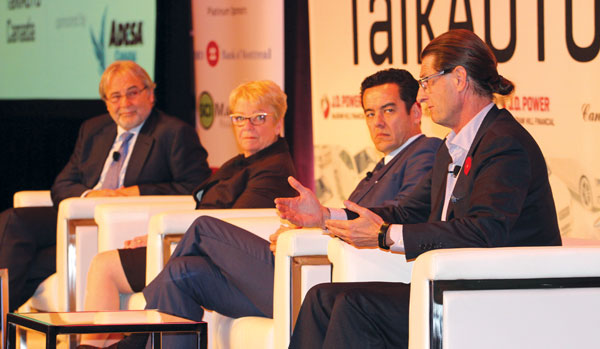
The dealer panel tackled issues related to transparency, millennials and employee satisfaction
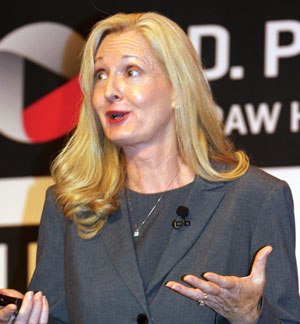
Renee Stephens, Vice-President of Auto Quality at J.D. Power
IT WAS A PACKED HOUSE at the 2015 TalkAUTO Canada conference — so packed that organizers ran out of chairs.
Nearly 400 attendees arrived at the Toronto Congress Centre on Nov. 10, 2015 to hear from auto industry experts on the future of automotive retail in Canada.
Raymond O’Kane, Vice-President, OEM Strategy and Development, Automotive Finance for the Bank of Montreal, said the event has become more popular each year.
This was the fourth installment of TalkAUTO, hosted by J.D. Power and Canadian Black Book, which delivers a jam-packed day of keynote presentations, panel discussions and workshops.
Hot topics of the day included the path towards autonomous vehicles, dealership consolidation, managing personnel and branding, among others. And typical with past TalkAUTO conferences, presentations were supported by data.
EXPERT FORECASTS
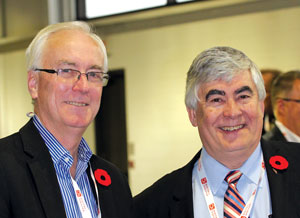
Al Galloway of Subaru Canada (left) and Chuck Seguin, Canadian auto dealer columnist
Jeff Schuster, Senior Vice-President of Forecasting for LMC Automotive, began by sharing his outlook on the Canadian automotive market. Schuster was bullish on Canada’s automotive retail future.
Not only are Canadians buying more vehicles, but also they are buying more SUVs and premium vehicles, said Schuster. He also sees an explosion of around 215 new vehicles launching into the market from 2017-2020, with 70 of those being SUVs.
Despite that, Schuster remains cautious. Household debt levels continue to be high, and that poses a risk, said Schuster. He also sees growth continuing into 2020, but at a slower rate.
Josh Bailey, Vice-President, Research and Editorial, at Canadian Black Book, also provided a wholesale market update. Based on a recent survey, Bailey noted there was a strong correlation between a buyer’s intentions on the Canadian Black Book website, and the actual purchase.
What Bailey found is there’s a lot of interest with new arrivals to the market, such as the FIAT 500X compact crossover and the Mazda CX-3, which formed the top 10 for intenders.
In the wake of the Volkswagen dirty diesel emissions scandal, part of Bailey’s research also looked into whether consumers have “recall amnesia.” Bailey predicts that the Volkswagen issue will likely follow the same path of the GM ignition switch scandal of 2014, in which sales dipped briefly but are now stable in Canada. Bailey said that Canadians will continue to have an appetite for diesels, and will still shop the Volkswagen brand.
Hot topics of the day included the path towards autonomous vehicles, dealership consolidation, managing personnel and branding, among others.
INDUSTRY PREDICTIONS
Dealership consolidation is picking up in Canada, but on a smaller scale than in the U.S. There’s a healthy appetite for dealership acquisition in Canada, as shown by bigger groups such as AutoCanada and Dilawri Group of Companies.
Consolidation is something Mike Stollery, President and Co-founder of SF Automotive Group, knows well. He sat down with Chuck Seguin, President of Seguin Advisory Services and regular Canadian auto dealer columnist, to discuss some of the challenges surrounding ownership and management of a big group. But that doesn’t mean the days of owning a single store are over. “I still think there’s a place for a one dealership operation,” said Stollery.
Autonomous vehicles are another widely talked about trend that’s driving the auto industry. And they’re coming to Canadian roads sooner than you think, said Renee Stephens, Vice-President of Auto Quality at J.D. Power. In fact, Stephens said autonomous vehicles have been approved for Ontario roads as early as January 2016.
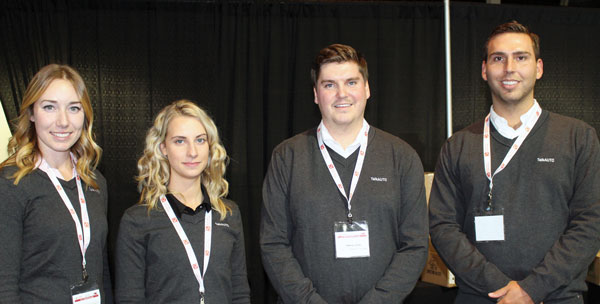
Students from the Automotive Business School of Canada volunteered at the event
Stephens noted that there’s a growing consumer confidence in autonomous vehicles.
Gen-Yers have a particularly strong affinity for connected vehicles, said Stephens. Based on recent J.D. Power studies, she found that demographic is willing to spend $3,703 per vehicle for in-vehicle technologies — more than any other generation.
But a lot of consumers have been slow to warm up to these kinds of technologies because they often don’t know what they are or how to use them. That’s where dealers have an opportunity to educate the customer about the features in their vehicles, said Stephens.
“Are we ready for autonomous vehicles?” asked Stephens. “Not yet, but we’re getting there,” she added.
A panel of dealers, all CADA Laureates, also took to the stage — and they weren’t afraid to say that dealers need to step up their game.
On the panel were Christian Chia, President and Chief Executive Officer of OpenRoad Auto Group Ltd., Steve Chipman, President and CEO of Birchwood Automotive Group, Emain Kadrie, Chairman, Phaeton Automotive Group and Mary Nurse, President, Nurse Chevrolet Cadillac Ltd. They were joined by J.D. Ney, Manager, Canadian Automotive Practice, J.D. Power.
The panelists agreed dealers need to do a better job of being transparent with their customers. “If you hold back on information, particularly price, you risk losing the customer’s trust,” said Chipman.
The way they can meet and improve customer expectations is to invest in the right people, whether it’s hiring product and delivery specialists or more Millennials.
“I think human capital is much more valuable that monetary capital,” said Kadrie.

Josh Bailey of Canadian Black Book provided a wholesale market update and forecast
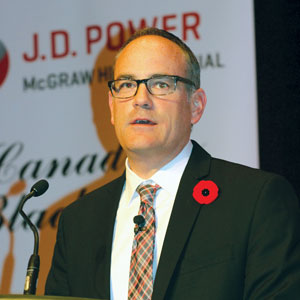
Jeff Schuster, Senior Vice-President of Forecasting for LMC Automotive
COMPETITIVE INTELLIGENCE
The conference also broke out into smaller groups for afternoon workshops, covering topics such as digital conversations, competitive knowledge and strategies for a successful dealership.
Robert Karwel, Senior Manager of Power Information Network for Canada at J.D. Power, showed dealers how they can gain a competitive advantage through PowerDealer. The web-based dealer management software by J.D. Power provides access to pure retail transaction data based on new and used car sales.
Dealers can filter through data by brand, make or even dealership per geographical areas to analyze recent sales. The ROI is indicated by traffic colours, with green meaning a good investment, and red a poor one. On the used car side, this can help dealers zoom in on certain vehicles, and determine if they are worth picking up at an auction or should be kept as trade-ins.
The software also has Google map capabilities so that dealers can plot dealerships sales on a map. This can be particularly useful in large metropolitan areas, said Karwel.

Steve Chipman, President and CEO of Birchwood Automotive Group
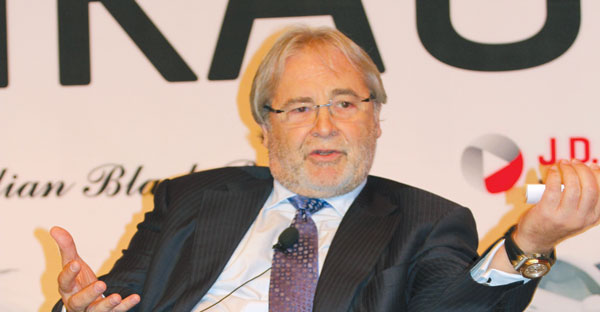
Emain Kadrie, Chairman of Phaeton Automotive Group