IT’S TIME TO CONSIDER SOME NEW WAYS OF FUNDING CANADA’S CRUMBLING ROADS
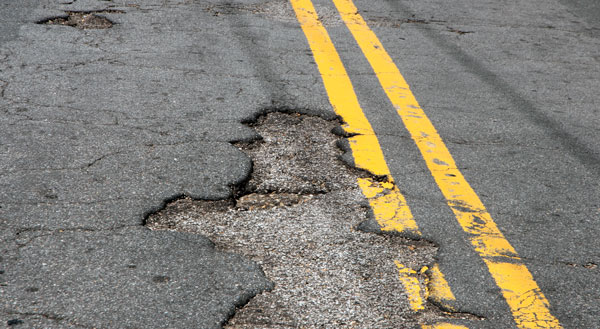
One of the most time-worn political gripes is the horrible and ever-degrading state of the roads we drive on.
But just because everyone complains about it all of the time, it doesn’t mean there’s not at least a grain of truth to it. Canadian roads are beset by a world of problems: a growing fleet of vehicles and seasonal temperature and weather swings so intense they dominate our national conversation to a degree seen nowhere else on earth.
They also suffer from an increasingly anachronistic funding model. The big seasonal temperature swings is leading to a crisis in national transport infrastructure funding that will only get worse unless action is taken.
At the national level, the single biggest funder of road building and maintenance is the excise tax on gasoline. This tax costs consumers 10 cents for every litre of fuel they put in their vehicles, and raises several billion dollars per year.
The reasoning behind it is simple enough. Since direct road funding such as tolls or transponder-driven per-km monthly bills is largely absent in Canada, an excise tax on fuel will charge drivers roughly in line with how much they drive, and will provide predictable and sufficient funding to maintain the thousands of kilometres of roads under federal jurisdiction.
The reality is less ideal, and is becoming worse with each passing year. First of all, the federal excise tax has been the same 10 cents per litre since 1995, and over time that dime has lost fully 45 per cent of its buying power to inflation.
Secondly, over that same 20-year period, gains in fuel efficiency have meant that despite an ever-growing national vehicle fleet, demand for gasoline is not what it once was. Gasoline sales, in short, are a less reliable proxy for road demand than they once were.
Technological advances and regulatory fiats that now bring us farther on a tank of gas than we have ever gone leave that much less in the kitty to fill the potholes we complain about so loudly.
As usual, numbers tell the story better than words.
Total federal gas tax revenues decreased in inflation-adjusted terms from $6.3-billion in 2000 to $5.8-billion in 2014, despite a national fleet of light vehicles increasing from 16.8 million to 21.7 million (+29 per cent) over that same period. In that 15-year period, net sales of gasoline increased by 12.5 per cent, but the fixed nominal level of the federal gasoline levy meant its real value was eroded by inflation each year.
For the state of road funding, it gets worse. While increased fuel efficiency has saved the consumer billions, and has prevented untold pollutants and emissions from escaping into the atmosphere, it has been a disaster for road funding.
No one will dispute the importance of our national road network for our economy and quality of life, but no one wants to be stuck with a growing bill for keeping it safe and up-to-date.
Though the car fleet grows every year with a growing population of drivers and ever-longer vehicle lifespans, 2014 was the first year — other than recession-hammered 2008 — in which fuel sales actually decreased.
This combination of a nominally-fixed gasoline excise tax and decreasing gasoline demand will not bode well for the account balance in our national road maintenance fund under today’s model.
It all points to a need for a comprehensive review of how we pay for the roads we rely on in Canada.
No one will dispute the importance of our national road network for our economy and quality of life, but no one wants to be stuck with a growing bill for keeping it safe and up-to-date. Politicians are also loathe to raise taxes.
But burying our heads in the sand while our roads degrade with decreasingly sufficient funding to keep them going isn’t a sustainable course of action, either.
As an industry we need to acknowledge that worsening road conditions and productivity-sapping congestion are not good for our image or bottom lines.
Any policy aimed at increasing road funding, while potentially painful to the driver or taxpayer, isn’t necessarily a net negative for the auto industry.
It is often assumed that higher gasoline taxes or road levies will only hurt the driving public, and therefore, the car industry. However, we must also acknowledge that jammed, crumbling and unsafe roads are a large part of the public relations problem the industry faces, even though road funding falls rightly under public responsibility.
So let’s think long and hard about a solution to this growing problem.
In some places, targeted tolling is likely to be considered to accomplish the twin goals of reduced congestion and increased user-funding that overused roads desperately need. In other areas, an update to gasoline taxation may be on the agenda.
It’s an inevitable debate, and one the public is already initiating. As impacted and responsible stakeholders, we should be part of that conversation.