CANADIAN AUTO DEALER TAKES A LOOK AT SOME SUCCESSFUL RETENTION STRATEGIES TO BOOST BOTH CUSTOMER LOYALTY AND SATISFACTION

A silver E 350 4MATIC pulls into the drive through and before the driver even gets out, a service advisor is there to greet them, tablet in hand ready to do the walk around and devote the next 20 minutes completely to that customer.
It’s a far cry from the traditional service shop scenario, when come 8.00 a.m. on a Monday, it wasn’t uncommon to have a line up of frustrated customers out the door and not enough advisors or staff on hand to deal with them efficiently.
Chris Cowle, Service Manager at Mercedes-Benz Maple in Maple, Ont. says that today, thanks to a combination of advanced scheduling and retention software, as well as a practice staff now view as second nature, the fixed ops side of the dealership has witnessed a huge transformation.
Cowle runs a very busy department but working with Retention Provider Xtime has allowed him and his staff to witness not only a much more even flow of service appointments throughout the day but also higher customer satisfaction and greater profitability.
“The beauty about Xtime’s Retention System that it works in real time,” he says, as we sit in his office, a stone’s throw from the busy service waiting area. “We’re able to instantly open up capacity if we need to. Multiple sources within your network can look and see what your service capacity is and load it right away. For us, because people are calling the dealership’s BDC all the time, if we have a no show, or an appointment becomes available — bam!
It’s scheduled.”
Since it began working with Xtime in 2012 and rolling out its Check-In 7 drive lane software, Maple’s service department has become a highly efficient operation. Seeing the process in action firsthand, it’s hard not to come away impressed. It’s a good example of how a combination of sophisticated retention software and a well-oiled, in-store staff process can deliver outstanding results.
WINNING BACK THE BUSINESS
Chris Howie, Vice-President at Xtime, says tools within the Retention System like Check-in 7 (which streamlines the check-in, walkaround and menu selling process), as well as Marketing 7 (designed to track customers down who’ve not visited the dealership for some time and provide them with a special offer to come in during non-peak periods); plus Scheduling 7 (that provides dealership staff quick and easy access to service scheduling) have been designed to help dealers keep their service customers as well as win back the service business from independent garages and aftermarket chains.
“Some OEMs have been reporting defections rates as high as 50 per cent after the first service interval,” Howie says “and it still remains a challenge for dealers to deliver a consistent message to their customers, whether it’s over the phone, online or in the service drive through.” He notes that staff should have easy and ready access to customer information, such as service history and vehicle recalls. By doing so, service staff can make accurate recommendations, load the shop properly and set the right expectation for each and every customer.
Howie also says that from a retention standpoint, many dealerships suffer on the service side because they tend to load up appointments at peak times, often because firstly; advisors prefer certain days and times for booking them and secondly, because many existing systems enable overbooking. The result is inconsistency when it comes to service capacity and money left on the table — often because the shop is either significantly underutilized at certain times, or, fed up customers waiting in line during busy periods choose to take their business elsewhere.
With Xtime’s Retention System, the real time data access, instant shop loading ability and mobile advisor check-in tools ensure service departments and technicians are consistently busy, customers are happy and that the dealership’s fixed operations side is more profitable.
Sam Rizek, Executive Sales Manager, Franchise Sales with DealerSocket in Canada, says that from a CRM standpoint, the beauty of the fixed ops side is that because data can be easily tracked and is therefore transparent, it’s straightforward to monetize it. He says that service reminders can be a great way for dealerships to earn extra revenue, especially for those service customers that have previously declined maintenance or repair work. “Let’s say I take your database and plug it into DealerSocket and set up a campaign that targets everybody who hasn’t been into your store for six months or longer, what is the likely outcome when they receive that notification? What happens when the doctor’s office calls you?”
Rizek says he’s witnessed stores collect thousands of dollars in service work over a three-month period, simply because they reached out to those customers who had previously declined suggested maintenance or repairs.
It’s something Kerry Mueller, Senior Director, Operations at Waterloo, Ont-based CRM provider ONE-EIGHTY CORP also sees as a very effective retention strategy. “If you can track the data and follow up with the customer regarding those repairs, there’s a good chance you’ll be able to pick up those missed sales.”
Mueller also notes that another, often key obstacle to an effective CRM strategy, whether it’s on the service or sales side, is not having an effective approach to scheduling appointments and she says that often has to do with a lack of training, either because people don’t know what do, or because there isn’t an emphasis within the store’s culture to do it. For those that are able to implement an effective process, where appointments are consistently scheduled ahead of time, dealership staff are ready to handle the customer and the result can be a huge difference in both sales and customer satisfaction.
AN INTEGRATED APPROACH
With any solid process, ease of operation is the key and when it comes to the CRM being able to effectively mine the dealership’s customer data base, a high level of integration is essential. That’s something Quorum Information Technologies has focused on since its inception in 1995. Quorum’s core DMS product, XSellerator uses embedded CRM tools to help dealerships better take care of their customers without having to contend with clunky interfaces and duplicate data bases.
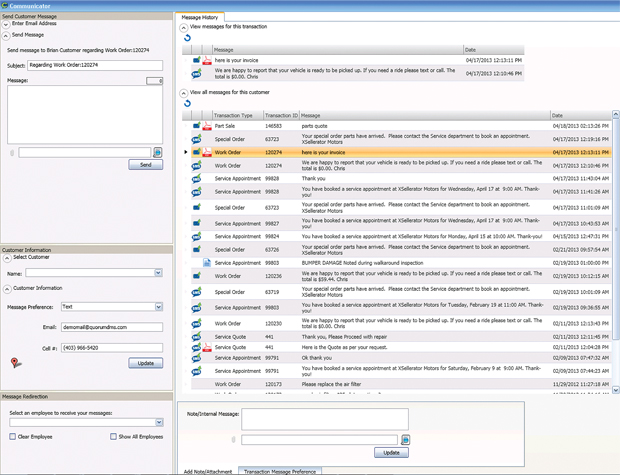
Quorum’s Communicator: A big hit with dealers
And, since it was introduced, Communicator has rapidly evolved. “It is changing the way that dealers contact their customers,” says Allen. He notes that Communicator is able to reinforce the level of service dealers are able to provide customers in their fixed operations departments compared with independent shops, because it’s able to send an instant text message or email — whether it’s progress on service repairs, notifying a customer their vehicle is ready for pick up, or scheduling service reminders or follow ups. On the internal side, it also allows stores to ensure staff are ready for customers before they get out of the vehicle and even provides opportunities for up-sells in the drive through by contacting dealership salespeople when their customers show up for service work.
Allen says that of about 90 dealers who have signed up so far, the number of messages going back and forth between staff and customers has exploded. “Since we began tracking data in September 2013, we’ve seen message volume increase from 7,500 then to 95,000 this past April and that doesn’t include internal messages within the store’s network.” Allen says that Quorum is on track to hit one million messages sent through Communicator by the end of the year.
Allen says that dealers who really understand the benefits of Communicator are seeing big benefits on the retention side, though he stresses that the right tools are only part of it. To really have an effective CRM strategy, it requires buy-in from the top down and that everybody sees customer retention as an integral part of their daily activities within the store, not an additional function.
CHAMPIONING THE CAUSE
That’s something ONE-EIGHTY has consistently viewed as an integral part in working with its dealer clients, a philosophy that led to the creation of its Guru Program, which essentially focuses on an individual within the store championing the CRM process. “If you have that one person inside the dealership that will really help to ensure things get done,” says Kerry Mueller. The Guru serves as a liaison with ONE-EIGHTY that keeps the store up-to-date with all the latest developments, including software upgrades and new tools and functionality. Additionally, Gurus are encouraged to provide feedback on new developments as well as take an active role in the dealership’s CRM training process.
Mueller says that with fewer staff at many dealerships and a greater emphasis on productivity, seamless systems and training are more critical than ever. She also notes that stores need to be able to manage customer data effectively through their CRM — one reason why ONE-EIGHTY saw an opportunity to automate data collection, tracking information at crucial points during the sales process with staff focusing on their roles instead of bothering people to fill out forms. “By automating data collection and reporting, it increases accuracy,” says Mueller, “which allows store management to really see what is happening.”
As a result dealerships could see clear patterns on where things were going well and areas that needed improvement on the retention side, putting them in a better position to further improve their approach to customer service.
UNDERSTANDING ROIDealerSocket’s Sam Rizek says that when it comes to CRM tools, especially if dealers are looking to acquire them, he frequently gets asked “what’s the ROI,” and “when will I see it?” Rizek says it’s important to differentiate between sales and service and often, the process in place at the store has a big impact on both. “Those stores that have good processes in place, tend to see a quicker turnaround,” he says “but still, it may be 3-6 months before you see a return on the sales side, simply because of the nature of the buying cycle for most consumers.” When it comes to service however, he says the ROI can essentially be immediate. Rizek says this is often due to the fact that many dealers still aren’t actively pursuing a retention strategy on the service side, so when they do, it can yield big results. He says it goes back to the doctor’s office scenario. “If I’m a consumer, it’s not likely I’ll remember on my own to bring my vehicle in for maintenance or even pay attention to that little sticker in the windshield. But if I’m sent a message or receive a phone call telling me I need to bring my vehicle in I know that the responsibility is on me to do it.” |