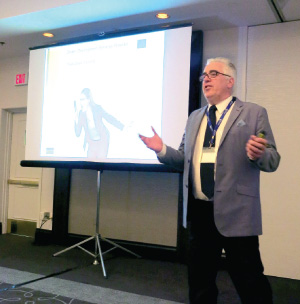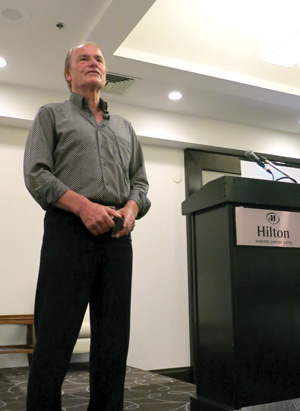
Laurie Skreslet became the first Canadian to climb Mount Everest after a gruelling and costly expedition in 1982. He was the keynote speaker for the Manitoba Motor Dealers Association annual conference
It was a journey that cost the lives of four companions, broke three ribs and took four months, 27 tonnes of gear and $3 million. By the time it was over, Calgarian Laurie Skreslet had become the first Canadian to scale Mount Everest.
His gripping retelling of his 1982 odyssey to the highest spot on Earth served as a rousing keynote address for the 2014 Manitoba Motor Dealers Association conference in Winnipeg May 9. If there was an overarching theme, it was if he can scale Everest, anyone can succeed in business with the right effort.
“What I kept thinking (while climbing) were all the people who said ‘you can’t do that,’ and I realized that the only person who can define what you can and can’t do, is you,” he said. “The key to tapping into the potential every one of us has is getting over that fear — that fear of being inadequate, of not succeeding.”
Turning online shoppers into customers
In today’s market, 84 per cent of consumers are researching vehicle purchases online, according to Vic Kovacs, network trainer with Autonet Dealer Solutions, who presented on the challenges of converting online leads to in-person visits and, ultimately, sales.
He said effectively turning virtual visitors into paying customers requires an almost immediate response by dealers. “You have five minutes, we say, to get back to your client. After that, the odds decrease of you making strong contact and qualifying those leads,” Kovacs said.
“If you wait 30 minutes, he’s already moved on. Why bother? Why bother phoning him?” Kovacs outlined a proven strategy for dealing with Internet leads, from calling customers immediately to walking them through the dealership’s website, asking what car they are looking at and whether there are any other cars — even on competing websites — they are looking at.
Kovacs touched on a few key don’ts that apply specifically to Internet customers:
Don’t change the model: the customer has spent time researching that model and if you try to move them to another, he or she will go away to research the new model before coming back, if they ever do.
Don’t change the numbers: If you’re going to give specific prices, give the correct ones. Don’t add documentation fees and tire and A/C levies after you’ve almost closed the sale, because you could blow it.
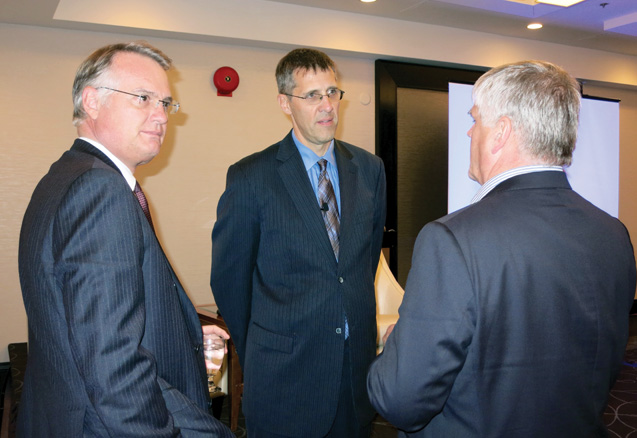
From left: Mercedes-Benz Canada President Tim Reuss, Niel Hiscox, President of Universus Media Group and Al McCormick, Vice-President, Sales, Ford of Canada, chat prior to a panel discussion led by Hiscox on May 9 at the Manitoba Motor Dealers Association annual conference
The benefits of benefits
Catherine Jay, Director of CADA 360 Employee Benefits, which administers benefits for CADA member dealers, encouraged dealers to consider employee benefits as a critical business function. “You can design a benefit package that will help you attract and retain the right employees, who will help make your dealership successful and prosperous,” she said.
Dental, health care, vision care, disability and life insurance coverage can all be presented to employees as a part of their total compensation package and becomes a tax-free added compensation for employees and a tax deduction for dealers.
Tom Aldridge, a consultant with Investors Group and CADA 360 Retirements Savings Program, extolled the virtues of a deferred profit-sharing plan (DPSP). He said aside from saving money on payroll fees and taxes, a DPSP helps encourage successful new hires to stay and provides flexibility for when a new hire doesn’t work out. “I just saved you $41,000,” he said of his example of distributing $200,000 in bonuses to employees via a DPSP instead of a group RRSP. “That’s another employee.”
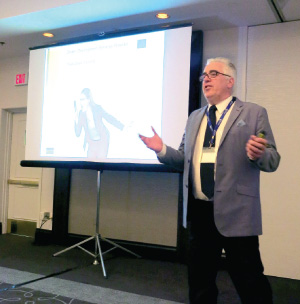
Vic Kovacs, Internet training specialist for Autonet Dealer Solutions, says your odds of converting an online contact into a sale diminishes rapidly after
five minutes
Video changed the world
Niel Hiscox, President of Universus Media Group and publisher of Canadian auto dealer, spoke of the emergence of video as a sales, training and demonstration tool.
A startling example of how effective video can be was a video produced for Toyota demonstrating a cargo area liner for the 2014 Highlander. “The enthusiasm coming back was great and it was like ‘hey, that’s great. When is it on the market?’ and the answer was ‘five months ago.’ So the video was able to cut through the clutter very effectively.”
Carmakers and the Internet
Tim Reuss, President of Mercedes-Benz Canada and Al McCormick, Vice-President of sales for Ford of Canada, agreed that OEMs and dealers must continue to improve both their online communications with customers and the infrastructure operating behind the scenes.
Reuss said steps Mercedes-Benz must take include focusing on the integration of various communications platforms, so a sales manager can conduct an entire transaction using the same online tool, rather than communicating with customers on one platform and then having to log on to another to, for example, find a vehicle.
McCormick said using online video as a customer information tool is key to explaining certain features. “I don’t think anyone wants to demonstrate the operation of an airbag during a test drive,” he said.
Social media and the car business”Saying you don’t believe in social media is like saying you don’t believe in the Internet.”
Shane Gibson, author of Sociable! How Social Media Turned Sales and Marketing Upside Down, used that quote from Gary Vaynerchuk (@garyvee), who used social media to turn his family’s small liquor store into a worldwide wine infotainment sensation, to highlight the ability of social media in helping dealers grow their businesses.
Gibson said social media has the benefit of multiplying low-cost messages many times across a wide audience. “The Internet and social media really are inseparable,” he said.