MANY DEALERS ARE STILL STRUGGLING TO PROPERLY HANDLE ONLINE LEADS. TO MAKE MATTERS MORE INTERESTING, CHANGING CONSUMER BEHAVIOUR IS ALSO HAVING A MAJOR IMPACT ON THE PROCESS
 Would you ignore eight out of every ten customers that came into your showroom? Probably not. Yet, when it comes to the digital face of automotive retailing, statistics continue to point to the fact that less than 20 per cent of Internet leads are being followed up. As a result it seems a great deal of potential business is being left on the table. So what’s the issue?
It certainly isn’t the tools available. Modern lead management and CRM software as well as Google Analytics and Big Data, enable stores to target and respond to customers like never before.

Sam Rizek
“The problem, is that many dealers still treat the online lead process generically,” says Sam Rizek, National Sales Manager in Canada for leading CRM and solutions provider DealerSocket. Rizek notes that around 50 per cent of all leads dealerships receive don’t get a reply from store employees. Furthermore, even if a salesperson does respond and then doesn’t receive a reply back, that particular lead tends to get dropped.
Rizek says a big reason why responses aren’t generated is often due to the fact that the dealership in question doesn’t have a proper process in place to manage the leads that come in. For those that do however, the results can be quite amazing.
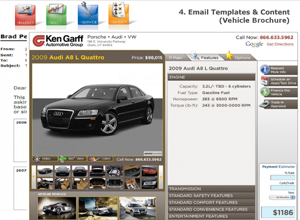
DealerSocket’s Smart Reply allows dealers to send detailed e-brochures of inventory along with information on comparable models in stock
Rizek cites a good example from one of DealerSocket’s customers in Eastern Canada. When this particular store receives an unqualified customer (i.e. the salesperson has responded to the initial inquiry but hasn’t received a reply back) several touchpoints are built in to increase the chance of that lead becoming a sale. To give an example, the store has an email that is sent out on day 15, another at day 25 and another at day 45 from the dealership’s general manager. At this particular store, a day 45 email initiated a response from an “unqualified” customer, one who ended up setting an appointment with the dealership, showed up and purchased a car.
“There are too many stores that will follow up with leads for 2-5 days and then just forget about them,” says Rizek. He notes it’s important to remember that just because a dealership receives an Internet lead it doesn’t mean the person in question is actually in the market for a vehicle at that particular time. “They might be looking to buy six months from now,” he says.
Ritzek says that as a CRM and lead management tool, DealerSocket’s role is to understand the dealership’s process and customize it based on the store’s requirements. He says that one strategy in which dealers can reduce the number of “dropped” leads is to have either all leads sent to one particular individual at the dealership or have the “type” of lead sent to a particular staff member. “The tools available have become so sophisticated that you can tailor specific leads to the person best able to handle them,” he says. An example would be a lead that comes into a Ford dealer regarding a F-150 pickup. If that lead goes straight to the store’s top F-150 product specialist, Rizek says the chances of that individual actually closing a sale are likely much higher than other members of the sales team.
To help ensure leads are properly followed up, DealerSocket is able to put time gaps in place, so one individual gets priority to handle a particular lead. If they don’t act within a specific timeframe, that lead is taken away from them and given to the next person in sequence. “It’s a feature a lot of dealerships like about our tool,” says Rizek “because it encourages the salesperson to take it seriously.” Additionally, with its mobile CRM, dealership staff can download DealerSocket’s app and be able to effectively reply to a lead no matter where they happen to be.
Sales staff can also serve to pique interest by using DealerSocket’s Smart Reply feature. “What we did, was take dealers’ inventory and create e-brochures for their new and used vehicles,” says Rizek. Smart Reply allows dealership sales staff to reply to Internet leads with an email that incorporates a brochure on a specific vehicle request as well as a link to the store’s inventory and comparable vehicles in stock. “The biggest thing that we as shoppers are looking for are options,” says Rizek, “so if you’re able to present them with some alternative choices, there’s a good chance they’re less likely to go elsewhere.”

Ron Cassan
EYEBALLS TO INVENTORY
Yet despite the fact that more stores are learning to harness the power of lead management technology, there’s still a number obstacles affecting operations in the “digital showroom.” Ron Cassan, Vice-President of Sales at Rides.ca (a used vehicle portal that was created in response to issues dealers are having with many listing sites) says stores need to understand that the online process is about driving “eyeballs to inventory” and emphasizing simple, easy to understand (and buying emphasized) Vehicle Detail Pages (VDPs). “The more eyeballs you can drive to your site, the faster you can move,” says Cassan.
Rides.ca, which is partnered with the New Car Dealers Association of B.C. (NCDABC) and launched last September, was designed to maximize value for dealers. As a result, it features a rather unique pricing model — dealers pay based on how well the site performs in generating leads for them and the more cars a dealer lists, the lower the cost on a per vehicle basis. Multiple touchpoints are also designed to lead viewers to the specific website of the dealership that’s listing a vehicle on Rides.ca.

Rides.ca was developed as result of feedback from dealers
Yet when it comes to online leads, Cassan says it’s quality, not quantity that’s likely to entice stores to follow up. A 2011 Google Auto Study revealed some interesting statistics when it came to online shopping trends. The study noted that among the top reasons car buyers use the Internet, “a request for information” was considered important by just 16 per cent of those surveyed. By contrast, checking availability of a particular car or truck among the dealership’s inventory was a priority for 39 per cent.
CHANGING BEHAVIOUR
Ron Cassan says that since Rides.ca went live last year, his team has noted some interesting trends. Month after month, he says many dealers are questioning the value of third-party leads that come in and consequently aren’t choosing to respond to them. He says that the general consensus of using third-party online lead forms just isn’t giving dealers the results they’re looking for and a big reason for that is shifting buyer behaviour.
“With more people moving toward mobile, it’s creating a different kind of search experience altogether,” says Cassan.
It’s something Adam Wilson, Senior Vice-President and General Manager with digital metrics platform UPTRACS, in Detroit, Mich., also notes. “We can see today, based on the data that 50 to 60 per cent of visits to dealership websites are now mobile,” he says.
UPTRACS is designed to measure every aspect of a firm’s digital marketing efforts, including cost-per-lead conversions offline — an aspect that’s critical in determining ROI because it allows companies to measure their online performance and adjust their strategy accordingly.
Wilson says that today, dealers need to optimize the mobile experience by providing features such as click to call, one click to location and references to Google Maps. “Anything to make it easy — that is what it should be about.” He says dealers need to be able to have a lead response mechanism that works just as effectively across all platforms. “You don’t need to be managing a desktop site and a mobile site, you need one very smart site where you’re able to take that data and use it. At the end of the day, that is what is going to increase your ROI.”
Rides’ Ron Cassan notes that besides the shift to mobile, another factor that’s making the notion of third party lead generation less relevant today concerns the personal protection of information online. Consumers are more reluctant to supply personal details, meaning that for dealers utilizing lead forms, there’s less of a chance in receiving the specific information required to steer a user to a particular store or vehicle, reducing the quality of that third party lead and giving the salesperson less of a reason to act upon it.
“With mobile, people want to be able to see reviews and ratings of the dealership they’re targeting,” says Cassan, “not a request for information, since there is plenty of stuff already out there on the web for them. Mobile users want to locate the dealer, they want to review its inventory and be able to drop by the store whenever they want.”
ACCOUNTABILITY EQUALS SALESAccountability equals sales  Clint Burns There’s an old saying that you can lead a horse to water but you can’t make it drink. When it comes to a dealership’s digital marketing efforts, sophisticated lead management tools can bring appointments into the showroom but in many cases, dealers lose business at the door, simply because they don’t have a proper sales process in place. It’s something Clint Burns, founder and CEO of Anaheim, Calif.-based The Next Solutions Inc. is all too familiar with. Burns who comes from a CRM background says that was a primary reason for developing The Next Up closed sales floor system. The Next Up has seen significant growth in the U.S. and has expanded into Canada, Australia and is now embarking upon a pilot project in Europe. “A lot of the time dealerships are closing between 12-14 per cent of the customers that come into the showroom,” says Burns “and a big reason is because there’s a lack of accountability, not a lack of customers.” The Next Up is designed to solve this issue by tracking every prospect that comes into the showroom and the status of the leads that come in. By doing so, it enables stores to allocate the right number of sales staff to accommodate them and enables managers to monitor the tasks and productivity of each member of the sales force. The end result is that the staff spend more time with each customer, schedule more test drives and close more deals. “It’s a proven process,” says Burns “and the simple fact is, the more time you spend with a customer, the greater the chance of closing a sale. To get a 3 per cent increasing in closing ratio you will need 6 per cent more proposals and write-ups and to get that you will need just 9 per cent more test drives. It’s a 4-3-2-1 ratio. It’s always been that way.” |