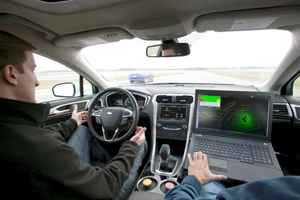
As part of the next step in its Blueprint for Mobility strategy, Ford Motor Company, in conjunction with the University of Michigan and State Farm has unveiled a Ford Fusion Hybrid automated research vehicle. The car in question will be used to make progress on future automated driving and other advanced technologies.
The result of an ongoing project that builds on more than a decade of Ford’s automated driving research, the Fusion Hybrid automated vehicle will test current and future sensing systems and driver-assist technologies. Ford’s goal is to advance development of new technologies with its supplier partners so these features can be applied to the company’s next generation of vehicles.
“The Ford Fusion Hybrid automated vehicle represents a vital step toward our vision for the future of mobility,” remarked Ford Executive Chairman Bill Ford. “We see a future of connected cars that communicate with each other and the world around them to make driving safer, ease traffic congestion and sustain the environment. By doing this, Ford is set to have an even greater impact in our next 100 years than we did in our first 100.”
The automated Fusion Hybrid will serve as the research platform to develop potential solutions for these longer-term societal, legislative and technological issues raised by a future of fully automated vehicles.
The Fusion Hybrid research vehicle builds on driver-in-control studies conducted in Ford’s VIRTTEX driving simulator. Using VIRTTEX, Ford researchers study how to merge the capabilities of human and automated drivers to create a seamless, integrated experience.
In 2012, at the Mobile World Congress in Barcelona, Spain, Bill Ford outlined Ford Motor Company’s Blueprint for Mobility — a plan that describes what the automaker believes transportation will look like in 2025 and beyond, and the technologies, business models and partnerships needed to get there.
Today, Ford is working on improving technology already used in vehicles on the road. This includes functions that alert drivers to traffic jams and accidents, and technologies for parking and for driving in slow-moving traffic.
In the mid-term, vehicle-to-vehicle communications will begin to enter into the mainstream. This will include some autopilot capabilities, such as vehicle “platooning,” where vehicles traveling in the same direction sync up their movements to create denser driving patterns.
In the longer-term, vehicles will have fully autonomous navigation and parking. They will communicate with each other and the world around them, and become one element of a fully integrated transportation ecosystem. Ford says that personal vehicle ownership also will change as new business models develop. The benefits are expected to include improved safety, reduced traffic congestion and the ability to achieve major environmental improvements.