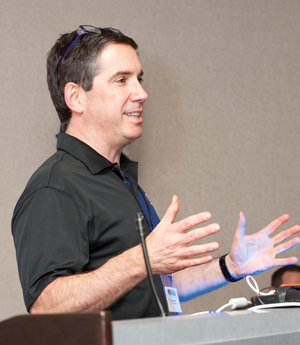
Brian Pasch, President and CEO of PCG Pit Stop says Canadian dealers are hungry for more information
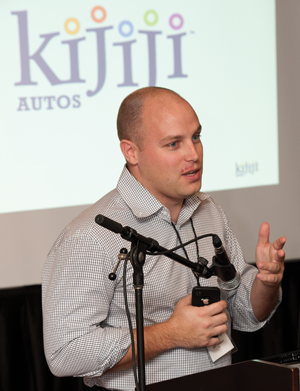
Ryan Thompson, Ontario Outside Sales Manager, from Autos at Kijiji presented a luncheon keynote about digital marketing trends.

AJ LeBlanc, Managing Partner, Car-Mercial, told delegates that videos help dealers boost Google search results.
PCG Pit Stop event brings experts north to inform dealers about new marketing tools
Time starved dealership staff were able to take a day off the treadmill and focus on some intense digital marketing learning when the PCG Pitstop Conference stopped in Toronto in October.
Canadian auto dealer dropped by to take in some sessions, and interview dealers and organizers about the emerging trends in finding customers online and interacting with them.
The conference was organized by PCG Digital Marketing, an Internet marketing company specializing in search engine optimization (SEO) strategies, reputation management and social media.
Topics ranged from sessions on fixed operations marketing with search engine optimization; using mobile devices to speed up and organize vehicle inspections and merchandising; reputation management; mastering Google using AdWords and retargeting strategies; properly implementing live chat on dealer websites; using video SEO as a tool to boost Google rankings, and lots of talk about social media.
Brian Pasch, PCG’s CEO, explained to Canadian auto dealer what dealers get from the roadshow event. “I’m very happy with the engagement,” says Pasch of the Toronto event. “The people attending this Pit Stop are asking the right questions and more importantly they are making a commitment to implement what they’ve learned.”
Pasch is an 18-year veteran of the digital marketing industry, and he is a frequent speaker at industry conferences on digital marketing, search engine optimization and social media. He says his company acts as a “digital investment advisor” to its dealership clients. “Some pieces of the strategy we may implement for them, but we are also a collection of best practice solutions. We are going to recommend things to dealers based on their needs,” says Pasch.
He says dealers have a difficult time sorting out the best approach to digital marketing and want to ensure their efforts are effective and not working at cross-purposes. “There are 20 strategies that a dealer should be implementing,” says Pasch. “We find that, on average, most dealers aren’t doing more than 7 or 8 of the 20.”
Pasch spoke at the Pit Stop about what Google has called the “Zero Moment of Truth” when consumers make purchasing decisions. Before the Internet, stimulus created by the OEM or local marketing efforts drove people into the dealerships to gather product information. “The First Moment of Truth” is when they walk into the dealership to engage with them directly.
“Today, before they walk into the dealership, there is something called the Zero Moment of Truth,” he says. Google says these are the 18 touch points that a consumer has before they contact a dealership directly. This includes visits to OEM sites, review sites, safety sites, videos, cost of maintenance sites, reading blogs, and customer driving experience sites. “Those 18 touch points will either enhance more people going to the dealership, or if they read horror stories, going to the competitor.”
If you don’t have a solid body of evidence in the “zero moment of truth” that supports your dealership as a good place to do business, they aren’t coming to you, says Pasch. “It forces dealers to be more transparent,” he says. “It changes the way phone calls are answered, leads are answered, and ups are answered.” Dealers have to invest so that they look good online during this “zero moment of truth.”
Canada behind the U.S.
Pasch says Canadian dealers appear to be further behind than their American counterparts in implementing digital marketing effectively. “There’s not enough competition in Canada that drove the innovation that we see in the U.S.,” he says. “For example, lots of dealers are locked into one website vendor and one advertising solution, and there are very little competitive forces.”
He says in the U.S., for example, there are about 50 different website platforms vying for their business, and “tons” of people at digital conferences educating dealers about their technology choices. “The exciting thing about Canadian auto dealer is you are really creating the forum for dealers to learn about new technology, because without having a national conference and without having the competitive forces in play, they are not getting the robust set of choices there are in the U.S,” he says. “Their menu is more like a fast-food menu, where in the U.S. it’s more like a gourmet menu.”
Pasch says the landscape is changing so rapidly, and tools offered by companies like Google are evolving regularly, so dealers need to constantly adapt and stay informed to remain effective. “There is a pent up demand for education,” says Pasch. He says when dealer principals are exposed to the information, they sometimes get upset that their OEMs or ad agencies aren’t keeping them in the loop about the changing marketplace.