Canada’s best-selling vehicle segments are proving remarkably resilient in a year marked by economic uncertainty, with sales remaining relatively stable despite some notable shifts in consumer demand.
According to new data from DesRosiers Automotive Consultants (DAC), the country’s six largest vehicle segments recorded relatively modest changes through the first nine months of 2026, reflecting a market that has remained steady despite broader economic pressures.
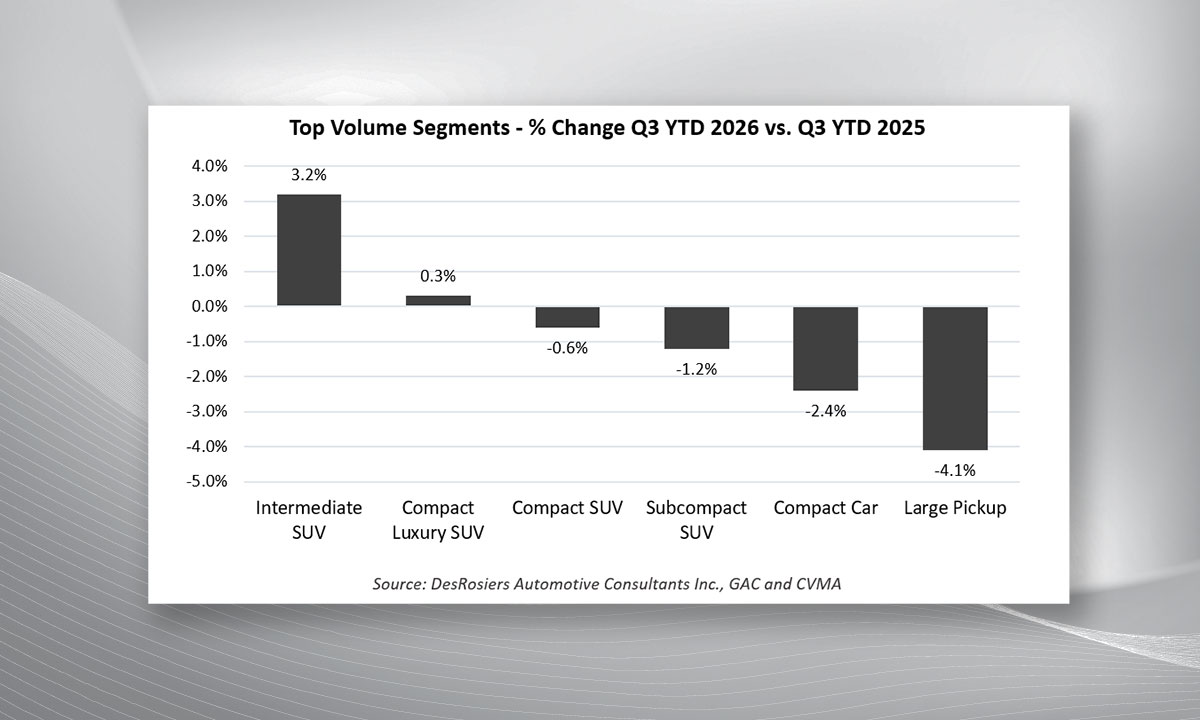
Intermediate SUVs led growth among the six highest-volume segments, with sales increasing 3.2 per cent year to date. Compact luxury SUVs also recorded a slight gain of 0.3 per cent.
Meanwhile, compact SUVs, Canada’s largest vehicle segment, saw sales decline 0.6 per cent year to date. However, a stronger third quarter helped offset earlier weakness, with sales jumping seven per cent during the July-to-September period.
Compact passenger cars also recorded a strong third quarter, although the improvement was insufficient to push year-to-date sales into positive territory.
Subcompact SUVs experienced a slower third quarter, contributing to a 1.2 per cent decline in year-to-date sales. Large pickups recorded the biggest decrease among the six leading segments, falling 4.1 per cent, although third-quarter sales declined by a smaller 0.7 per cent.
Among smaller-volume segments, luxury passenger cars recorded particularly strong growth, while small vans and intermediate luxury SUVs also posted gains.
Overall, passenger car sales declined 1.3 per cent through September, while light truck sales fell 0.6 per cent. Light trucks continued to dominate the Canadian market, accounting for 87.2 per cent of new light vehicle sales, compared with 12.8 per cent for passenger cars.
Total new light vehicle sales remained 0.7 per cent below the same period in 2025.
“The high volume segments were fairly subdued, showing only single digit percentage sales changes for 2026 so far,” said Andrew King, Managing Partner at DAC, in a statement. “This is in line with a market that has, despite significant geopolitical and economic disruptions, had a surprisingly stable year with a very welcome positive performance in Q3 and in September.”