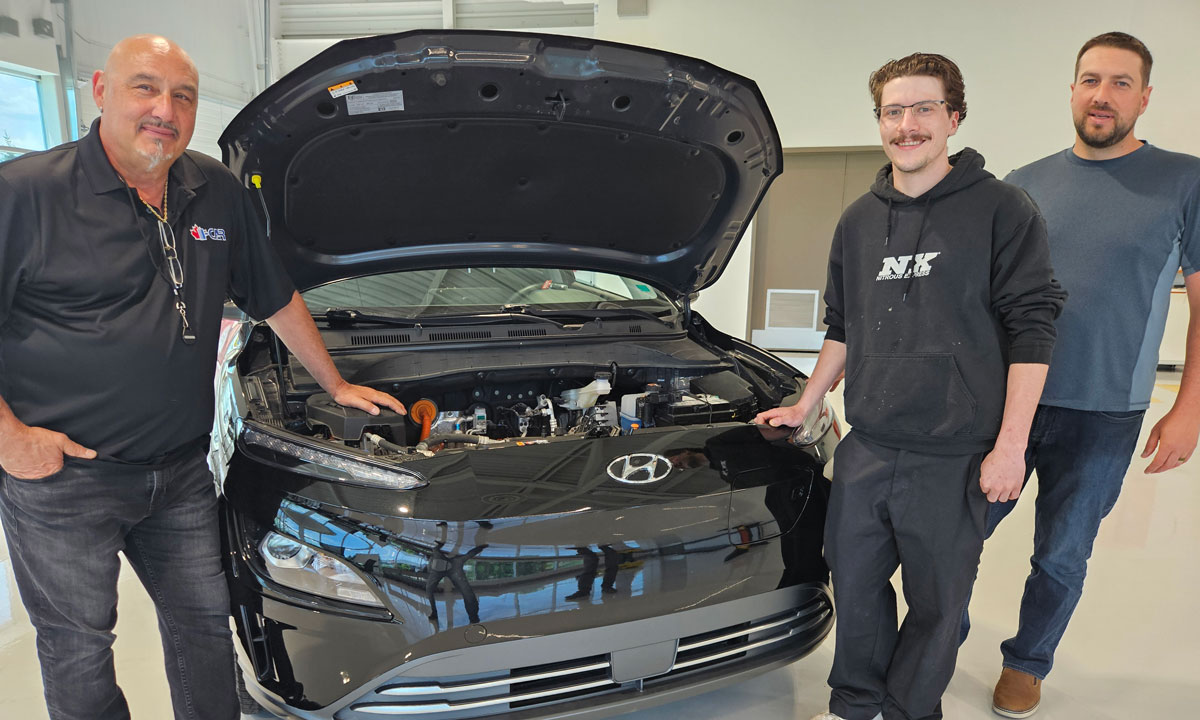
Pete Halasz, course instructor, and students David Simon and Mike Kennedy.
Collision repair technicians in Canada now have an opportunity to learn how to safely approach and repair electric vehicles through a certified Inter-Industry Conference on Auto Collision Repair (I-CAR) training program.
The Automotive Industries Association of Canada (AIA Canada) has secured the contract to deliver I-CAR training, which is already available in the U.S. and is now being adapted for the Canadian market. The training is being offered in space leased at the Canadian Welding Bureau (CWB) Centre of Innovation in Milton, Ont.
Stuart Klein, Vice-President of Collision Programs and Executive Director of I-CAR Canada, told Canadian auto dealer that most automakers represented by Global Automakers of Canada have a collision certification program.
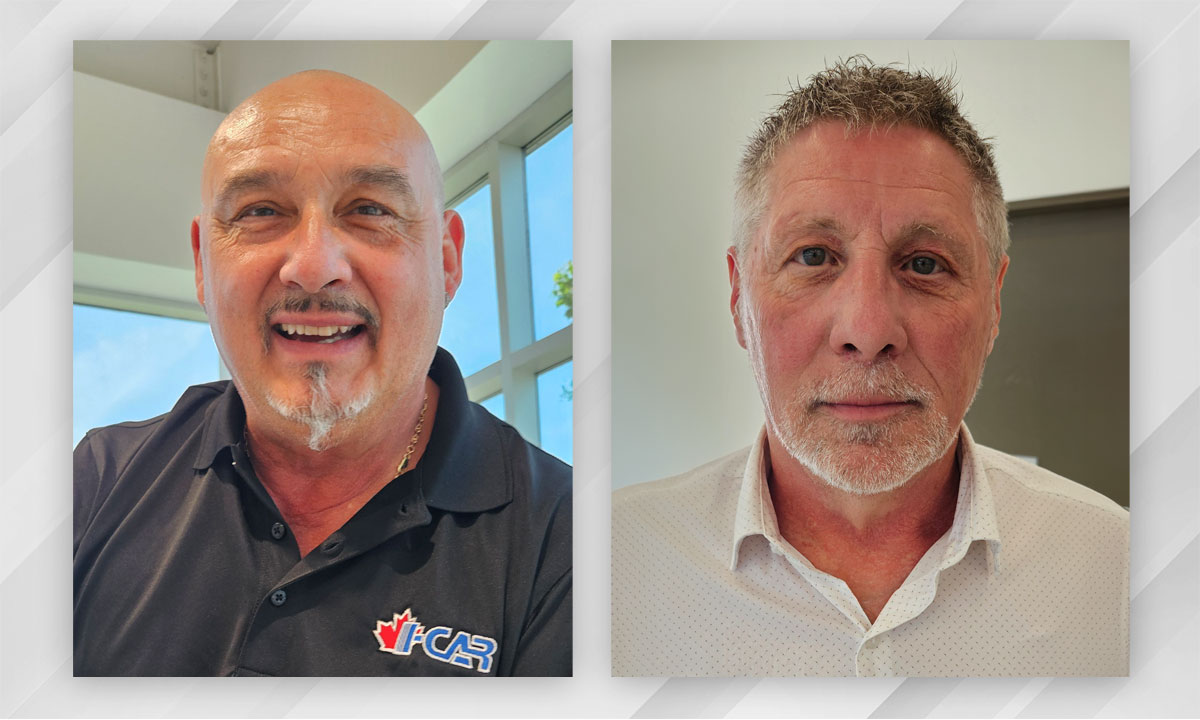
Pete Halasz and Stuart Klein
“Their concern was that there was no standardized high-voltage EV training that they could all get on board with,” said Klein. “That’s exactly what I-CAR had in Chicago. That’s what drove me to bring the course to Canada.
“OEMs in the U.S. are starting to mandate that their certified shops take this training if the OEM sells EVs. The same thing is happening in Canada.”
Klein said discussions with the CWB led to the leasing of space that had previously been used for offices and the conversion of it into a dedicated training centre.
He said he also works closely with Certified Collision Care (CCC), which manages collision repair programs for 13 OEMs. According to Klein, CCC also identified a need for EV training.
The hands-on training program runs for five days. Klein said technicians begin by building circuits and learning how to use EV-specific tools. From there, they move to a simulator cart — an EV component without the vehicle body attached — where they apply their knowledge in a low-voltage environment designed for safe learning.
“In that system, we can introduce faults that you would find in a real-life scenario, and the technicians have to identify what the fault is using technology and tools and then apply the appropriate solution,” said Klein. “After they’ve done that, they move to actual vehicles, where they learn how to safely shut down the high-voltage system. We don’t open or remove batteries.”
He said that while safety is important in any shop servicing EVs, collision repair facilities face unique challenges.
“In a mechanical shop, an EV might come in for a brake job or another component replacement, and 90 per cent of the work is focused on safety,” said Klein. “In a collision shop, you’ve got a tow truck showing up with a damaged EV. You don’t know if it’s even safe to touch or bring into the shop. The focus is always on safety and triage.”
Klein said the course has been in development for a year and that AIA Canada has been working closely with major collision repair centres and OEMs. A pilot program began this week with two students and one instructor. Future classes are expected to expand to four or five students per instructor, with a second instructor to be added.
“EVs and batteries are still being produced. EVs are not going away,” said Klein. “They are already on the road and showing up in shops. We can’t ignore them, especially when there’s such a significant safety risk. It’s safe when you know what to do and have the right equipment.”
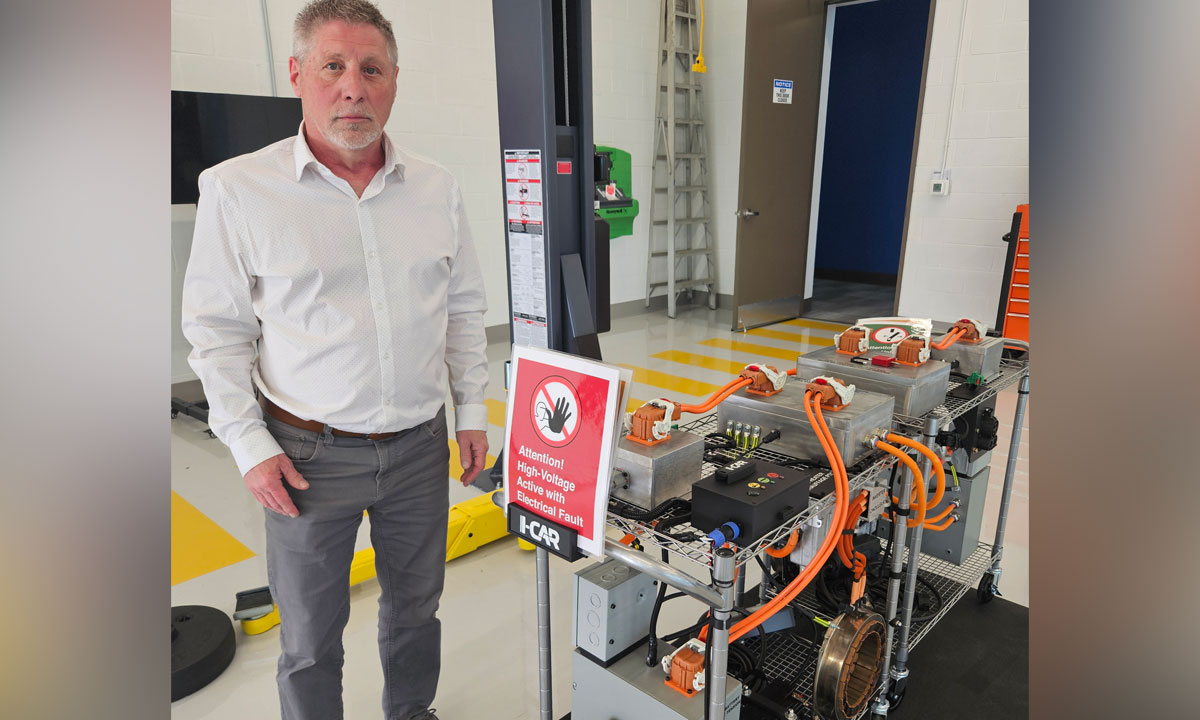
Stuart Klein standing by a simulator cart, which is an EV component without the vehicle body attached.
Pete Halasz, Senior Automotive Technical Trainer and Instructor with AIA Canada, said there are more than one million EVs on Canadian roads. He expressed concern about how collision repair shops handle damaged EVs arriving for repair and advised technicians to wait between 24 and 48 hours before moving vehicles into the shop for traditional repairs.
“Once it’s approachable, I want to make sure they know how to shut it down safely,” said Halasz. “The batteries could be off-gassing, which is toxic and could be fatal. There could also be live wires and live contacts. We’re welding in these areas, and we’re disassembling components that are linked to these systems, so you have to know what you’re doing. These are hybrid systems where traditional cooling systems are now connected to battery cooling systems. I need these students to understand how to approach a vehicle long before it enters the garage.”
Mike Kennedy, one of the two technicians taking the course, is an autobody instructor at Fanshawe College and an I-CAR welding instructor. He said EVs are becoming increasingly common in the industry and that apprentices and future technicians need to know how to work on them safely and effectively.
“Right now, the industry doesn’t really know what it doesn’t know,” said Kennedy.
David Simon, who works at a CSN-certified shop in Hamilton, said the course has provided valuable insight into areas he had not previously considered.
“Taking it has opened my eyes to certain dangers and practices that just aren’t common knowledge in the industry,” said Simon. “I imagine most technicians in the industry would learn something from taking a course like this.”