Dealers hoping to catch a breath after the chaos and uncertainty of 2025 are facing another year with even less certainty.
To no one’s surprise, the Canadian automotive industry faces ongoing uncertainty in 2026, still feeling the effects of U.S. President Donald Trump’s tariff agenda, while the Canadian government wrestles with how best to support the future of vehicle electrification.
Trump created a tsunami effect for the industry after imposing 25 per cent Section 232 tariffs on imported passenger vehicles and light trucks, effective April 2025. Under the policy, vehicles compliant with the Canada–U.S.–Mexico Agreement (CUSMA) can exclude the value of U.S.-made content from the tariff calculation, subject to certification requirements.
He later expanded the measures to include 25 per cent tariffs on imported medium- and heavy-duty trucks and key automotive parts, effective Nov. 1, 2025.
“We had a market that was along the lines of recovery (from COVID) and it was completely tipped in the scales through a U.S. administration changeover and an onset of tariffs,” said Daniel Ross, Canadian Black Book’s senior manager of industry insights.
“It put our market — and the broader North American car market — into a volatile scenario once again. It front-loaded a bunch of interest in our car market, artificially inflating the first half of 2025 because of fears around this geopolitical issue of tariff imposition.
“It’s magnified the return to a normalized market we were supposed to get back to by the end of 2024. It’s dramatized the whole thing so it’s now occurring in a faster fashion. Now our market needs to come back — and then some — to the retention level it was on track to reach.”
Vaughn Wyant, president and CEO of the Wyant Group in western Canada, said tariff uncertainty remains a major concern.
“It’s a chess game and politicians aren’t very good at making deals,” said Wyant. “Stuff happens. I think there will be pockets in Canada that will have a really tough time, like Sault Ste. Marie, because of steel. That’s going to be a tough one.”
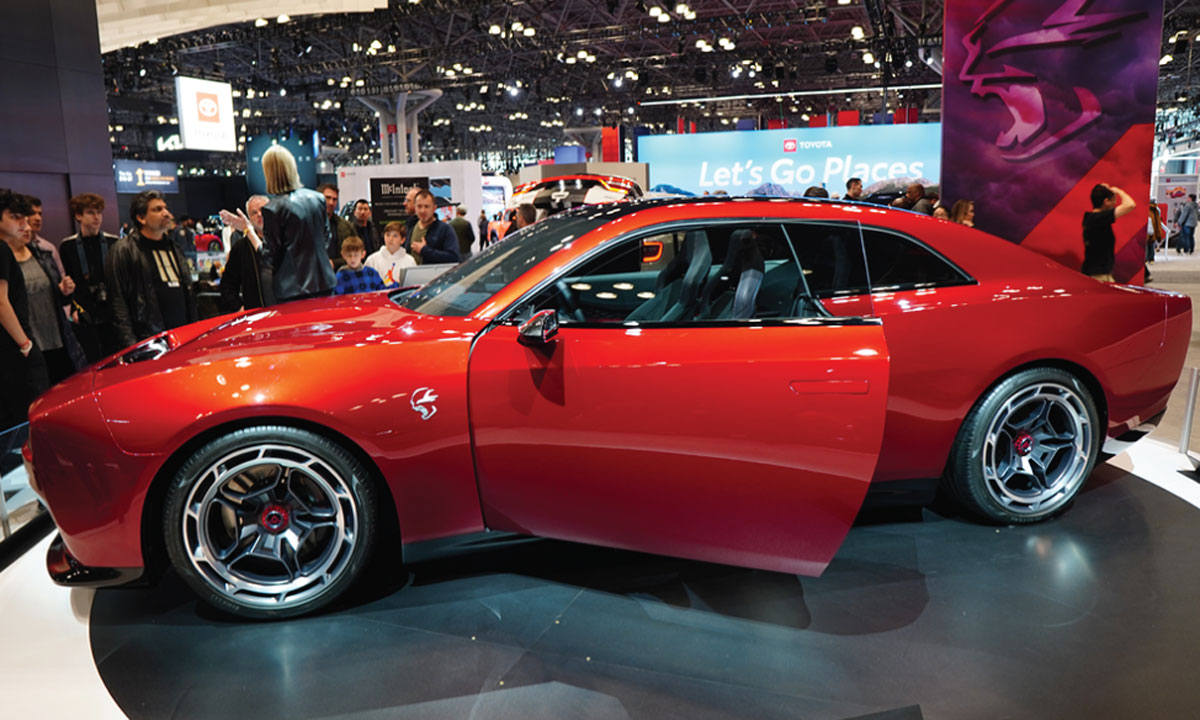
Dodge Charger Daytona SRT Concept at the New York International Auto Show
David Adams, president of Global Automakers of Canada (GAC), said Trump’s tariffs have presented significant challenges for manufacturers.
“It’s complex for the auto industry and probably for the Canadian negotiating team trying to figure out what’s the best way to approach this,” said Adams.
While aluminum, steel, and lumber producers generated much of the early tariff headlines, Adams said the automotive sector has been working to ensure its concerns are also heard.
“I guess we’re trying to negotiate, but you need two parties that want to negotiate, and it seems at the moment the U.S. is not really all that interested in having that dialogue,” he said.
CUSMA faces its six-year joint review in 2026, a process that could determine whether the agreement is extended or shifts into annual review cycles — a prospect that has heightened uncertainty across the North American auto sector.
Joe McCabe, president and CEO of U.S.-based Auto Forecast Solutions, said Canada is largely subject to U.S. policy direction.
“I believe there’s going to be some negotiation for USMCA, whether there are two bilateral agreements or one trilateral agreement, but Canada and Mexico are attached to the U.S.,” said McCabe. “Right now, with this big push toward U.S. production — incentivizing and penalizing companies if they are not building there — it does not provide a good lens for Canada into the future.
“Anyone that’s going to come plant their flag in North America, the odds are they will not pick Canada for manufacturing because of that volatility. You’re going to have disruption in terms of tariffs affecting new business coming to Canada. For existing businesses, I think these are also troubling times.”
McCabe said he expects Asian manufacturers to continue investing in Canada, but suggested growth among GM, Stellantis, and Ford will be “near zero.”
Moreover, McCabe said any new North American plant investments will be concentrated in the U.S.
“That’s going to be their primary focus because they don’t want to upset the White House,” he said. “We do a lot of work with Canada and the Canadian government. We are pro-Canada. But in our list of pros and cons for future automotive investment, there are simply too many items in the con category right now.”
Stellantis announced in October plans to shift production of the Jeep Compass from Brampton, Ont., to Belvidere, Ill., as part of a $13-billion, four-year investment plan in the United States.
The move effectively impacted about 3,000 jobs and put at risk hundreds of millions of dollars in government support tied to production and battery-related agreements. In early December, the federal government confirmed it had served Stellantis with notices of default related to its Brampton assembly plant and the Windsor battery facility.
“The premise there is that the government has made financial investments in not only Stellantis but all the automakers with respect to upgrading their facilities, creating products, and all kinds of other initiatives,” said Adams. “If the government is going to give money to a company, it’s reasonable to expect some form of obligation attached to continued production or employment.”
Whether Stellantis will replace the Compass with another vehicle has been widely speculated but remains uncertain. According to a Reuters report in December, Stellantis CEO Antonio Filosa is prioritizing sales growth over short-term profits and shifting production toward Jeep and Ram models.
Peter Frise, a professor of mechanical and automotive engineering at the University of Windsor, told CBC News there is no reason for Stellantis to default on its Canadian commitments.
“Stellantis has been a great employer of Canadians, especially in Windsor, but also in the Brampton area and elsewhere in the country,” said Frise. “And I expect they will want that to continue. How that will go is really hard to say.”
Meanwhile, Prime Minister Mark Carney’s government has paused the timelines associated with the federal Electric Vehicle Availability Standard, which was set to begin with the 2026 model year and require 20 per cent of new light-duty vehicle sales to be zero-emission.
The pause follows the federal government’s decision to suspend the iZEV consumer incentive program after available funding was fully committed, ending rebates of up to $5,000, while several provinces have also eliminated or are in the process of eliminating EV purchase incentives.
“The expectations set out in the ZEV mandate do not match what is happening in the marketplace,” said Canadian Automobile Dealers Association President & CEO Tim Reuss in a statement issued in December. “With affordability concerns rising and new pressure created by U.S. tariffs, continuing on the current path risks making vehicles even more expensive for Canadians and undermining the competitiveness of our sector.”

GM confirmed it would end production of BrightDrop electric delivery vans at its CAMI Assembly Plant in Ingersoll, Ont.
GM confirmed in October 2025 it would end production of BrightDrop electric delivery vans at its CAMI Assembly Plant in Ingersoll, Ont., after the facility had been operating below capacity and idled since May due to weak demand.
Earlier shutdowns and temporary layoffs affected about 1,200 workers, with the long-term workforce expected to be smaller under a one-shift production plan, raising fresh concerns about the plant’s future.
McCabe said electrification is here to stay, but added there should never have been a mandate to eliminate internal combustion engines.
“What the manufacturers are going to do is be creative — more hybridization is going to come in,” said McCabe. “The idea of flexible platforms, like Stellantis’ STLA architecture, is important because you can build multiple variants on the same platform and dial production based on demand. Asian manufacturers have always been good at letting consumer demand drive production, not the other way around.”
Wyant said he hopes federal EV incentives are gone permanently.
“Let the industry survive on its own,” he said. “I don’t think they’ll get rid of the targets entirely, but the targets will change dramatically and gradually. They have to.”
“People want to transition into electrification by buying hybrids,” Wyant added. “Hybrids sell. Ten years from now, we’re still going to have internal combustion engines, but they’ll be paired with more efficient hybrid systems that let vehicles go further and run longer.”