
Jason Stein, Amy Karam and Michael Robinet
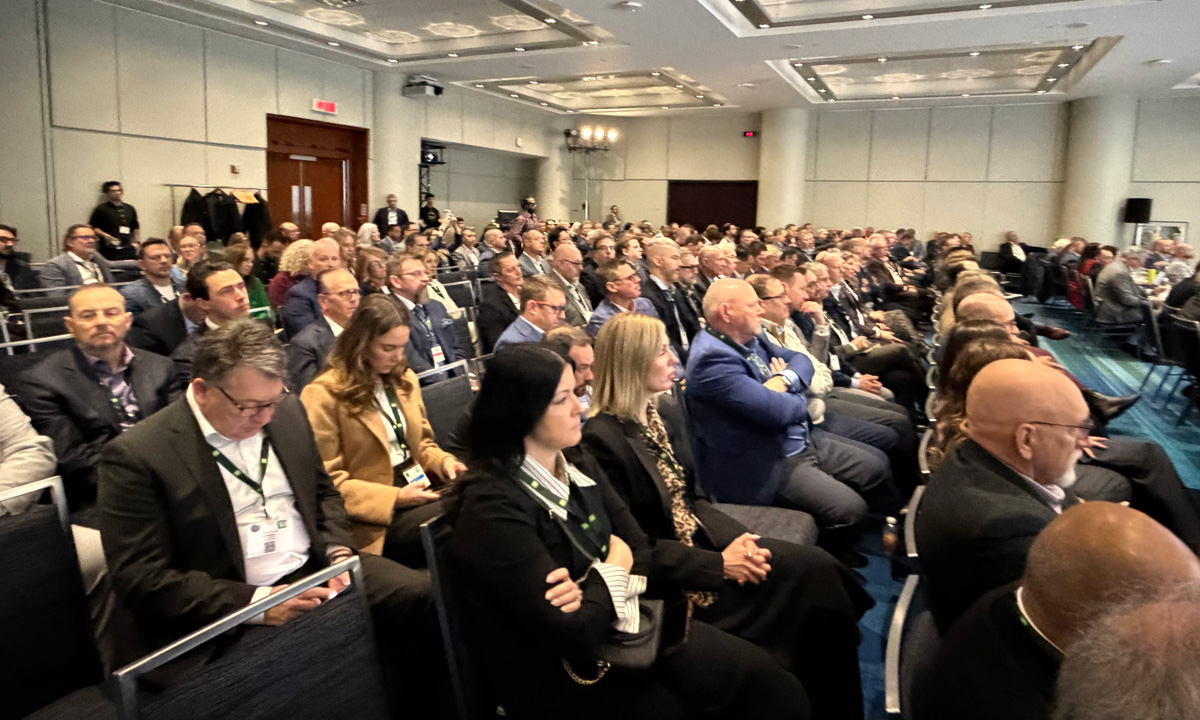
A CADA Summit session held last week in Toronto put China’s OEM ambitions and Canada’s affordability crunch at the centre of the conversation for dealers.
After welcome remarks from Michael McGhee, Senior Vice President and Head, TD Auto Finance Canada, keynote speaker Beata Caranci, Chief Economist and Senior Vice President for TD Bank Group, outlined a restrained Canadian growth outlook and limited prospects for meaningful rate relief.
In a moderated panel with journalist Jason Stein, analysts Amy Karam and Michael Robinet warned that Chinese OEM entrants could reshape pricing and expectations for Canada, and that partnerships require hard guardrails.
Opening the morning, McGhee pointed to an operating environment that has become defined by volatility and constant adaptation, telling the room: “What I love about our industry is its resilience and innovation in the face of adversity.”
He also noted that technology is increasingly part of that resilience, saying: “More recently, we’ve all identified ways that technology like AI can save us time and money.” At the same time, he cautioned that new efficiencies bring new risks, adding: “Certainly, these changes come with their own challenges like rising fraud.”
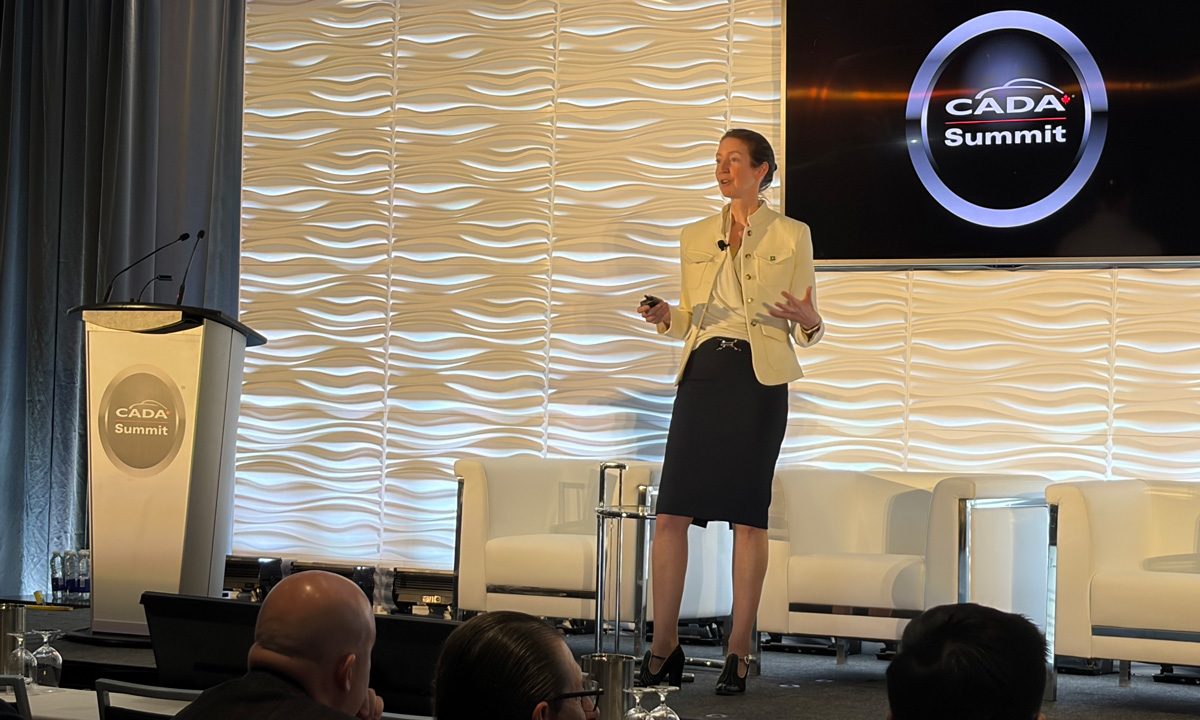
Beata Caranci, Chief Economist and Senior Vice President for TD Bank Group
Caranci’s outlook reinforced why dealers are still operating in what she described as a constrained Canadian growth environment, even as the U.S. economy shows more momentum.
She urged attendees not to react to every tariff headline, arguing that the practical focus should be on what actually becomes policy. “Basically, the only tariffs we need to be thinking about are the ones that turn into executive orders,” she said, adding that the U.S. “will continue to play the dominant strategy.”
For dealers, the near-term message on demand was steady rather than spectacular growth. Caranci said the auto market continues to attract consumer dollars more reliably than housing, and framed the sales outlook in simple terms, anticipating about 1.9 million in annual vehicle sales.
Caranci also tried to reset expectations around interest rates and auto lending conditions. “We have interest rates of about two and a quarter in Canada,” she said, and cautioned that meaningful and further declines would likely require economic weakness.
In a line that drew direct relevance for conversations with payment-sensitive customers, she added: “I feel like it’s as good as it gets. And if it gets lower, it’s not going to be a good outcome for the economy.”
That macro framing flowed into the global outlook panel moderated by journalist Jason Stein, with Michael Robinet, Vice-President, Forecast Strategy, S&P Global Mobility, and Amy Karam, Global Business Strategist and author.
Robinet opened with a point dealers have lived through since the pandemic: traditional economic indicators don’t map cleanly to vehicle sales the way they used to. “The correlation between GDP growth and the vehicle market used to be pretty well aligned,” he said, but “there’s been so many supply shocks and other affordability issues” that the relationship has weakened.
The most dealer-focused part of the discussion turned to China and what a more open Canadian posture to accepting more vehicles from Chinese OEMs could mean for the Canadian market.
Karam described China in blunt terms: “China is formidable. They’re smart, they’re sharp, they’re innovative, they’re quick.”
Karam’s key caution for Canadian business leaders was not about product quality so much as the nature of commercial agreements and how quickly conditions can shift.
“They are very shrewd. They are excellent business people,” she said. “Of course, talk to them, learn, explore, but keep a few things in mind. A deal is not a deal.”
She also urged dealers to think beyond the first sale and ask how aftersales and software support will work in practice, including over-the-air updates. “Servicing and support and the OTA. How are you going to do that?” she asked.
Robinet suggested near-term Chinese market penetration in Canada may remain limited under the current tariff framework discussed on stage, estimating it could be “maybe 5 per cent” through 2030.
Robinet also warned dealers not to assume incumbent OEMs will fill every segment if affordability becomes the central battleground. “There are gaps in the market,” he said, adding that some automakers “walked away from the middle of the market” because they couldn’t make money there.
TD Auto Finance is the event’s exclusive sponsor.