A trade deal has been struck between Canada and the U.S., ensuring the nation remains part of a trilateral agreement that will now be known as the United States-Mexico-Canada Agreement (USMCA).
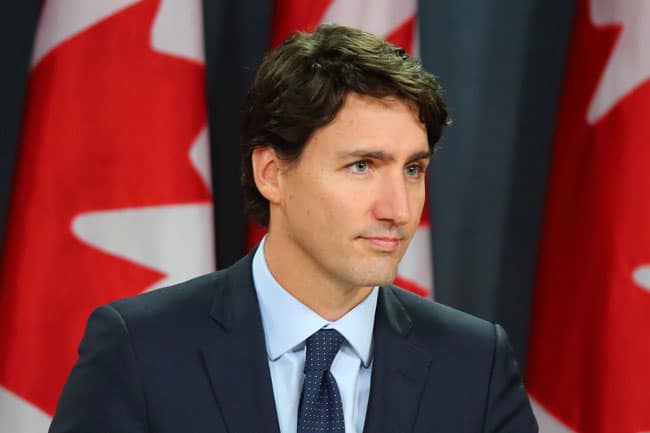
“The agreement-in-principle we reached today is good for Canada, good for Canadian businesses, and most importantly, good for Canadian workers and their families,” said Justin Trudeau, Prime Minister of Canada, on Monday. “When this improved agreement is implemented, North American trade will be preserved and modernized for the 21st century – just as we set out to do.”
Essentially a reworked NAFTA, negotiators managed to reach a deal late Sunday night prior to a midnight deadline imposed by the U.S. administration. Several minor concessions were made on the part of Canada to receive an exemption from the U.S. President’s continued threats to impose Section 232 tariffs (their national security loophole) on automotive imports coming from Canada.
What did Canada agree to?
The new trade agreement revised the automotive rules of origin rule, boosting regional value content (made in USMCA nations) from 62.5 per cent to 75 per cent. It also includes stronger content requirements for core car parts, such as engines and transmissions, and there is a 70 per cent North American steel and aluminum requirement. The tariff imposed on Canadian steel and aluminum has not yet been lifted, and is expected to be resolved separately.
There is also a new labour value content provision requiring that 40-45 per cent of a car producer’s activities (such as costs of manufacturing, assembly, R&D and information technology) must be carried out by workers earning a minimum of US$16 an hour. Some argue that some of these concessions could still result in a higher vehicle sticker price for consumers.
Most important of all, however, is the Section 232 side letter to exempt Canada from U.S. auto tariffs. In other words, if the U.S. were to apply its auto import taxes on a worldwide scale, Canada may continue to export vehicles and auto parts to the U.S. — tariff-free — up to a certain amount. Canadian auto exports cannot grow by more than 40 per cent to the U.S. as it would exceed their production numbers, according to CBC. The U.S. can still apply Section 232 to other Canadian sectors, so long as they provide the nation with at least a 60-day exemption to the measures.
Either way, the new trade agreement includes safeguards Canada previously did not have — meaning dealers can relax in knowing the automotive sector, at least, is safe.
Associations comment on USMCA
In an interview with CADA Newsline, John White, President and CEO of the Canadian Automobile Dealers Association (CADA) acknowledged the association’s tremendous effort to ensure the Government of Canada was aware of the impact auto tariffs would have on the nation’s auto sector. “Our association has been front and centre at the national debate, pointing out the importance of getting a deal, and the importance of the automotive sector for the economy, while ensuring that we are not undercutting Canada’s negotiating position or the Prime Minister.”
He adds, “After many months of uncertainty during often tense negotiations between the U.S. and Canada, a deal has been struck. The nation will be included in a trilateral deal, the threat of auto tariffs has been lifted, and dealers can finally take a breath.”
The Global Automakers of Canada (GAC) also offered a comment about the new USMCA trade agreement: “The United States-Mexico-Canada Agreement will continue to provide our members — which have a footprint in all three countries — with preferential access to the U.S. market,” said David Adams, President of Global Automakers of Canada, in a news release. “Importantly, the agreement also provides protection for Canada’s automotive industry from U.S. 232 national security tariffs.”
The Canadian Vehicle Manufacturers’ Association (CVMA) also issued a statement congratulating the Canadian government in finalizing the agreement on a “trilateral North American basis.” They also said the Canadian negotiating team is to be commended for reaching a “modernized agreement which provides certainty and builds a strengthened platform for trade across the industry.”
“We look forward to updates and working with government towards finalizing and implementing the USMCA.”
The new trade deal must be signed by all three leaders of the USMCA nations, and it must still pass through the U.S. Congress before final approval. In the meantime, NAFTA remains in place.