Remember when running a car dealership was a relatively simple business?
You bought vehicles, sold vehicles, serviced them, kept your customers happy, competed with the dealer down the road and tried to make a reasonable return doing it.
Not that any of that was ever particularly easy.
But look at the list of threats facing dealerships today. Cyberattacks. Ransomware. Phishing. Deepfakes. Identity theft. Synthetic identities. Fraudulent financing. Organized crime. Vehicle theft. Internal fraud. Stolen customer credentials. And criminals who seem to change their methods about as quickly as the industry finds ways to stop them.

It’s a lot.
And unlike the challenges dealers deal with every day — OEM relations, staffing, inventory, competition, government regulation, new market entrants and demanding customers — many of these threats are largely invisible.
You don’t see the hacker sitting halfway around the world trying to get into your network. You don’t necessarily know the customer sitting across from an F&I manager is using a false identity. You don’t know that the perfectly legitimate-looking email, phone call or even video conference might not be legitimate at all.
Until something happens.Then it gets real very quickly.
That’s one of the themes running through several stories in this issue of Canadian auto dealer.
Carina Ockedahl’s feature on cyber fraud looks at how artificial intelligence is making scams more convincing. Criminals can now clone voices, create deepfake video and combine emails, texts and phone calls into multichannel attacks designed to establish trust before they strike.
In a companion story, Proton Dealership IT and Cybersecurity reports that phishing now accounts for more than half of the attacks it sees. At one point earlier this year, attack activity across its dealership environments surged to nearly 1,000 per cent above the level it was tracking before the major automotive cyberattack of 2024.
The criminals aren’t standing still.
Neither are vehicle thieves. As we report elsewhere in this issue, vehicle thefts are falling nationally — encouraging news — but recovery rates have also slipped. Thieves continue to adapt to tracking systems, factory technology and dealership procedures.
There is a common thread here: every time the industry adds another layer of defence, someone starts looking for a way around it.
It raises a question worth considering. At what point do fraud and security become a dedicated job inside a dealership group?
Some large U.S. retailers are already treating cybersecurity that way. AutoNation has a Chief Information Security Officer. Asbury Automotive Group has a Director of Cybersecurity and a formal team of analysts.
Perhaps we are approaching the point where larger Canadian groups need people whose primary responsibility is not selling cars, fixing cars or marketing cars, but protecting the organization — its systems, its inventory, its transactions and its customers.
For smaller dealerships, that might mean assigning clear responsibility to a senior manager and bringing in outside expertise rather than creating another full-time executive position.
But somebody needs to own it. And everybody needs to participate.
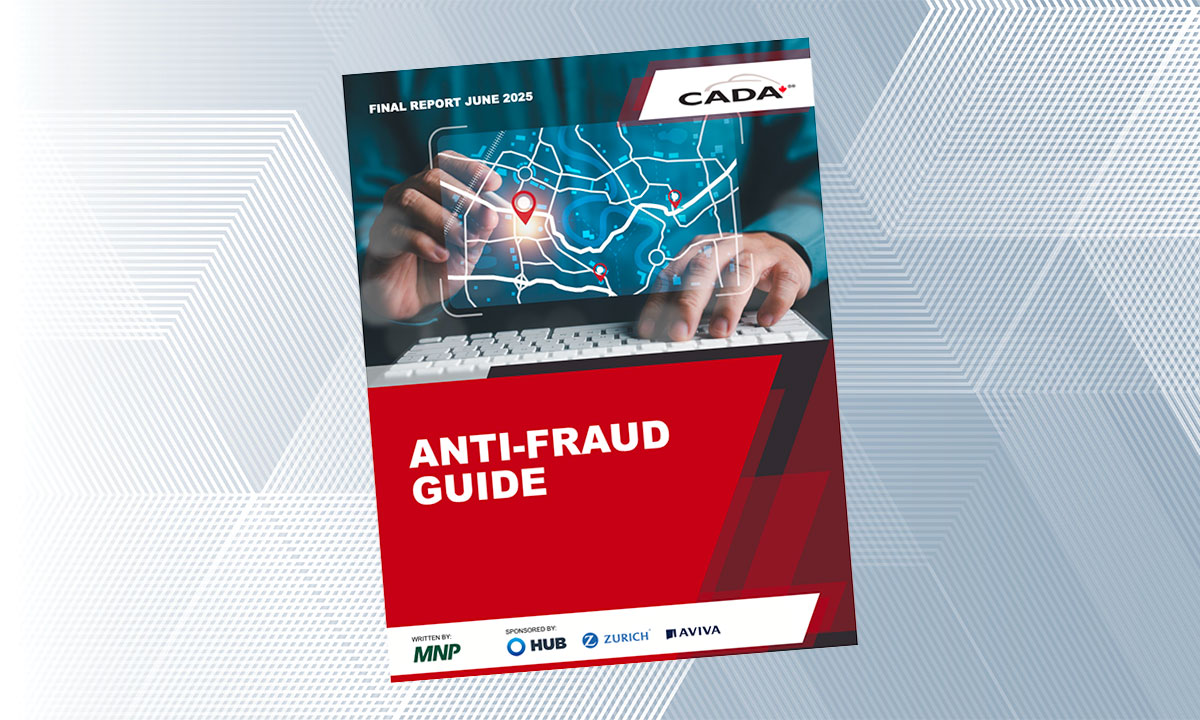
With the help of MNP, CADA has produced an Anti-Fraud Guide for dealers. Banks, lenders, F&I providers, insurers, technology companies and OEMs increasingly offer fraud prevention, cybersecurity and identity-verification training.
Take the training. Use the tools. Review the procedures. Make sure employees know what to look for and, just as importantly, what to do when something doesn’t look right.
Question unusual requests. Verify sensitive transactions independently. Protect passwords and credentials. Review who has access to dealership systems. Examine how vehicles and keys are secured. Talk openly about fraud attempts when they occur rather than treating them as embarrassing incidents nobody wants to discuss.
Dealers have a lot competing for their attention and resources. It is understandable that an invisible threat that may never materialize can lose out to the very visible problems sitting on the desk today.
But the stakes are different. A bad CSI score from an unhappy customer can certainly ruin your morning. A serious fraud, theft or cyberattack can disrupt your business, expose your customers and do damage that takes months — or longer — to repair.
Those of us of a certain age will remember Sgt. Phil Esterhaus ending the morning roll call on the cop TV drama Hill Street Blues with a piece of advice that seems increasingly appropriate for anyone running a dealership today: “Let’s be careful out there.”